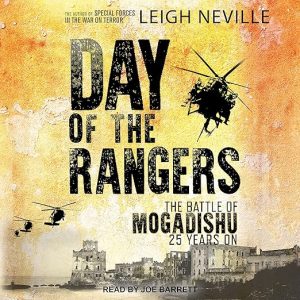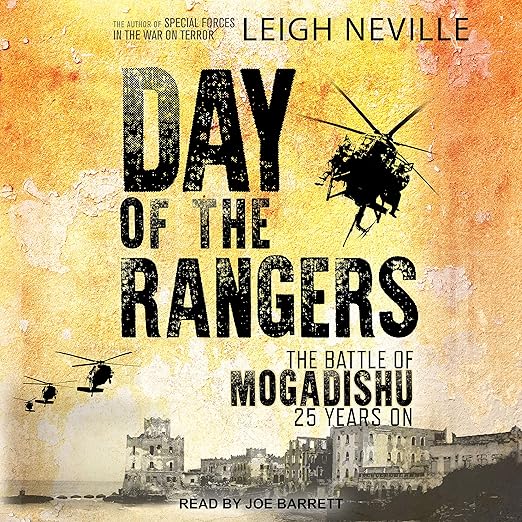
October 3, 1993 is when Task Force Ranger's mission to seize two lieutenants of a Somali warlord was projected to wrap in roughly sixty minutes, and this audiobook spends its eleven and a half hours on everything that went wrong after that estimate collapsed. Two Black Hawk helicopters went down under heavy fire, a relief column was hours away, and American Special Forces troops, Rangers, Delta operators, Nightstalker helicopter crews, found themselves fighting for survival in what became known by several names: the Battle of the Black Sea, the Battle of Mogadishu, Operation Gothic Serpent, and, most famously, Black Hawk Down. Leigh Neville's Day of the Rangers arrived for the battle's quarter-century mark, built on newly declassified documents and fresh interviews with participants.
The book's real distinction from the more famous Black Hawk Down account is where it puts its focus: Neville centers the soldiers themselves, the Rangers on the ground, the Delta operators, the Nightstalker crews flying overhead, rather than treating the battle primarily as a strategic or political case study. Reviewer JSG 458 makes the comparison directly, writing that this one 'builds on' Mark Bowden's earlier book and then 'takes things several steps further,' thanks in large part to the declassified documents and new interviews that weren't available when the original account was written twenty-five years earlier. That access gap matters: a book published on a battle's anniversary with fresh archival material has a genuine structural advantage over the account that first made the story famous.
Joe Barrett narrates, taking on a genuinely different register here than the kind of measured expository nonfiction narration is often associated with. Combat oral history demands something specific: enough urgency to convey real chaos and danger without tipping into overwrought dramatization of events that don't need embellishment to land hard. Barrett keeps that balance under control across the runtime, letting the documented detail reviewers repeatedly point to do the emotional work rather than reaching for vocal theatrics the material doesn't require.
Neville's own specialization in modern Special Forces history is worth noting as context for how the book handles technical detail. Weapons, radio procedure, and small-unit tactics get treated with a precision that assumes a reader who cares about getting those specifics right, rather than smoothed over for a general audience the way a more journalistically-minded account sometimes does. That precision is a genuine strength for readers who want it and a minor hurdle for anyone who'd prefer the human drama without the tactical texture surrounding it.
More Accurate Than the Film, Says Brady
Reviewer K. Brady draws the sharpest contrast with the more familiar version of this story, titling the review 'more detail and more accurate than Blackhawk Down' and specifically praising it for skipping 'the Hollywood insertions,' a clear reference to the 2001 film adaptation's dramatic license. That's a meaningful distinction for listeners who already know the broad outline of the battle from the movie and want the version built from primary sources and firsthand testimony instead of one shaped for a two-hour theatrical runtime.
The book is part of Osprey Publishing's General Military line, a series with a track record of exactly this kind of tightly sourced, soldier-focused military history, and that pedigree shows in how Neville organizes the material. Zach James's review opens by naming every alias this single battle now carries in popular memory before getting to his actual point, a small illustration of how much this one event has been mythologized across popular culture, and how much room there still was for a book built specifically to cut through that mythology with sourced detail.
The 25th-anniversary framing also matters for a specific practical reason: enough time had passed by 2018 for classification restrictions on some documents to lift and for participants who'd stayed silent for years to become willing to speak on record. That kind of anniversary-driven access window is a real, recurring pattern in military history publishing, and Neville's book is a clean example of a historian arriving at the right moment to take advantage of it.
Eleven Dense Hours That Don't Stop at Rescue
Running past the eleven-hour mark, listeners should expect a genuinely dense account rather than a streamlined narrative built for maximum pace; JSG 458 specifically flags just how much documented detail the book packs in as a defining feature, a selling point for readers who want comprehensiveness but a real time commitment for anyone hoping for a tighter, more cinematic retelling closer to the film's compressed timeline. K. Brady's review also notes the book doesn't flinch from showing how few good options commanders sometimes had in the middle of the fighting, meaning this isn't a triumphant war story so much as an honest account of a mission that went badly wrong and the people who had to manage that in real time.
That honesty extends to how the book handles the aftermath, not just the battle itself. A history built specifically around a 25th-anniversary reassessment tends to spend real time on what changed afterward, doctrine, tactics, how the Army rethought urban raids, rather than ending abruptly once the last helicopter lifts off, and listeners expecting the account to stop at rescue should be glad to find it doesn't.
Listeners should also know this stays focused specifically on the ground battle itself rather than broader U.S. policy in Somalia before or after October 1993; anyone wanting the wider political and humanitarian context of the Somalia intervention, including what led up to the raid and the policy fallout that followed, should look for a book with that broader scope, since Day of the Rangers keeps its lens tightly on the operators during the fighting.
Barrett Delivers Six Times the Film's Runtime
Anyone who already knows Black Hawk Down from Bowden's book or Ridley Scott's film, and wants the more detailed, primary-source-driven version, gets the most out of this specific account, and the 25th-anniversary framing with newly declassified material gives that listener genuinely new information rather than a rehash. It's also a strong pick for anyone specifically interested in Special Forces operations, Rangers, Delta, Nightstalker aviation crews, since the book's focus stays tightly on the operators themselves rather than zooming out to broader geopolitics.
Casual listeners looking for a fast-paced, cinematic war story closer to the film's two-hour compression should know this runs nearly six times longer and prioritizes documented detail over narrative economy. If your main exposure to this battle is Ridley Scott's movie and you want something similarly brisk, the density here, 'enormous' by one reviewer's own description, may feel like more than you bargained for.
At a Glance
- Read by: Joe Barrett takes on a genuinely different register here, holding real urgency without tipping into overwrought dramatization the documented events don't need.
- At its heart: Battle of Mogadishu, Special Forces combat oral history, declassified 25th-anniversary military research
- Vibe: Dense and unflinching, built for comprehensiveness rather than cinematic pace
- Short version: The detailed, primary-source alternative to Black Hawk Down for military history listeners, not a fit for casual war-movie fans wanting a brisk retelling.