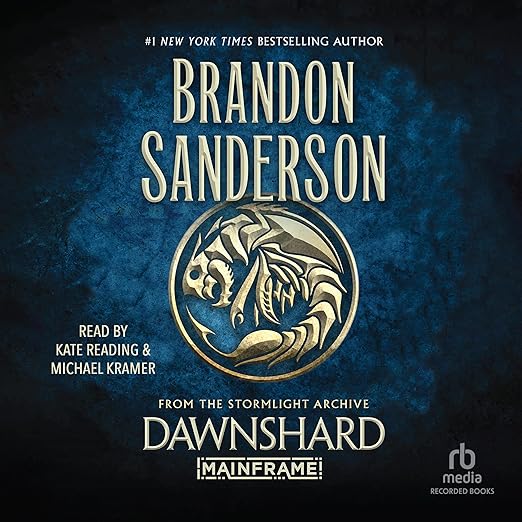
At a Glance
- Voice: Kate Reading delivers her customary warmth and precision, making Rysn's interior voice feel genuinely earned while keeping Lopen's banter delightfully breezy.
- Big ideas: Second chances, disability and agency, the weight of ancient secrets
- Atmosphere: Adventurous and surprisingly tender, with bursts of Sandersonian revelation
- Worth it?: A compact but consequential detour in the Stormlight Archive that rewards patient readers with one of the series' most satisfying protagonist showcases.
I finished Dawnshard on a Tuesday afternoon when I had maybe three hours to spare between longer commitments, and that turned out to be exactly the right amount of time. Brandon Sanderson's novellas have a peculiar rhythm, they sit outside the main Stormlight sequence yet feel anything but optional. This one, slotted between Oathbringer and Rhythm of War, does what the best bridging fiction does: it makes you realize how much you were missing about characters you thought you already understood.
Kate Reading has narrated the Stormlight Archive from the beginning, and by this point her command of the ensemble is total. She shifts from Rysn's measured, observational cadence to Lopen's irrepressibly cheerful stream of consciousness without any seams. That tonal flexibility matters here because the two protagonists occupy very different emotional registers, and the novella asks you to hold both simultaneously.
Our Take on Dawnshard
What makes this novella stand apart is its choice of protagonist. Rysn Ftori has appeared in Stormlight Archive interludes, brief, self-contained vignettes that orbit the main action without quite touching it. Giving her a full narrative arc is a genuine act of authorial generosity, and Sanderson earns the decision by not pretending her disability is incidental. Her inability to use Stormlight the way conventional Knights Radiant do shapes every strategic decision the expedition makes. The sea voyage to Akinah, shrouded in a permanent storm that drains Radiants of their power, becomes a plot mechanism that is also a kind of thematic statement: sometimes the one who cannot fly is the only one who can actually walk through the door.
Lopen provides necessary counterweight. His point of view sections have the quality of a comedy with genuine stakes buried inside the punchlines. One of the reviews I came across described how his mind shifts abruptly from banter to full tactical awareness when danger arrives, and that observation is exactly right. It is a subtle piece of character writing, and Reading performs it with the kind of light touch that keeps it from feeling manipulative.
Why Listen to Dawnshard
Because the Cosmere lore introduced here is not optional if you intend to continue the series. The nature of Dawnshards, what they are, what they do, and why their discovery at Akinah matters, carries significant weight for Rhythm of War and almost certainly for the books beyond it. Sanderson has always built his magic systems with an engineer's obsession for internal consistency, and what Rysn stumbles into on that island changes the terms of the conflict in ways that the main installments can only gesture at obliquely.
Beyond the plot machinery, there is something refreshing about a Sanderson story operating at novella scale. The bestselling Stormlight books run comfortably past a thousand pages. Dawnshard has room only for what it needs, and the compression sharpens rather than diminishes it. The climax lands with the weight of a much longer book, not because the setup was slow but because Sanderson has been placing emotional pieces efficiently throughout.
What to Watch For in Dawnshard
Pay attention to the Lopen and Huio dynamic. The cousins' competitive relationship is played for laughs more than once, but the moments when their bond is tested quietly illuminate what knighthood means when it is stripped of ceremony and social rank. It is the kind of character work that Sanderson tends to seed in the margins and harvest three books later.
Also worth noting: Chiri-Chiri, the larkin companion Rysn has been carrying since an earlier interlude, becomes more than a plot device for getting the expedition to Akinah. Her illness anchors Rysn's motivation in something personal and specific rather than merely political, and her recovery arc runs parallel to Rysn's own in ways that feel earned rather than schematic. One listener noted that they had never thought much about Chiri-Chiri before this book and came out of it with a genuine emotional investment. That is good novella writing.
Who Should Listen to Dawnshard
Existing readers of the Stormlight Archive who are between Oathbringer and Rhythm of War. This is not a standalone; the lore revelations will mean very little without the context of the larger series, and jumping in here would be like reading the fifth chapter of a mystery. For those already in the Cosmere, though, it is genuinely not skippable, both for plot reasons and because it offers some of the most thoughtful character work Sanderson has done with a peripheral figure. Readers who have complained that the main series pays insufficient attention to disabled characters navigating a world designed around Radiant powers will find Rysn's arc particularly satisfying.
Do I need to read Dawnshard before Rhythm of War?
Sanderson himself has suggested it is optional, but the Dawnshard-related revelations in Rhythm of War land with considerably more weight if you have read this novella first. Most fans treat it as required reading for that reason.
How does Kate Reading handle the Lopen sections, given his comedic voice?
Quite well. Reading keeps Lopen's narration light without undermining the moments when his tone shifts into genuine urgency. Her years with the series mean she knows exactly how much comedic weight each line can carry.
Is the sea voyage setting meaningfully different from the typical Stormlight environment?
Yes, and intentionally so. The storm-shrouded ocean and the restriction on Stormlight use force the characters to operate without their usual advantages, which is what allows Rysn, who cannot use those advantages anyway, to be the most capable person on the expedition.