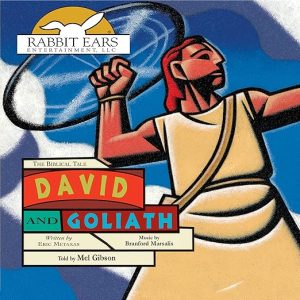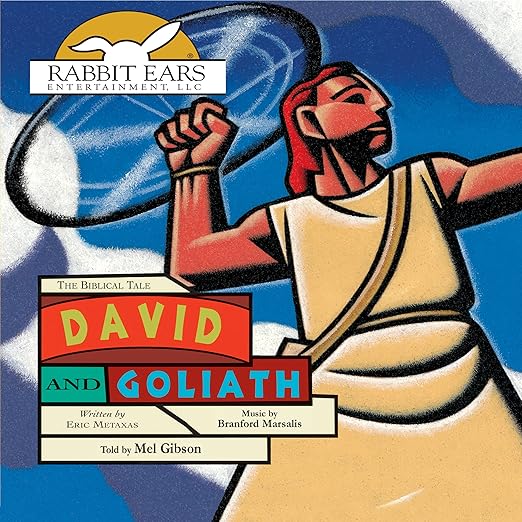
- Performance: Mel Gibson brings deep-voiced gravitas to the Old Testament tale, and Branford Marsalis's original score gives the 24-minute listen a genuinely cinematic atmosphere.
- What it covers: Faith over brute force, courage and divine empowerment, the underdog archetype
- Feel: Reverent, warm, and suited to family listening
- Our call: A beautifully produced 24-minute reading of the biblical story, the Rabbit Ears format is a children's audio presentation, not the Malcolm Gladwell book of the same name.
Before anything else, a clarification that matters: this is not the Malcolm Gladwell book. If you searched for the Gladwell title about underdogs and mismatched advantages, you want a different audiobook entirely. This is the Rabbit Ears Entertainment production from their Greatest Stories Ever Told series, a 24-minute narrated version of the David and Goliath story from the Old Testament, read by Mel Gibson and scored by jazz musician Branford Marsalis. That is a very different thing, and it is worth knowing before you purchase.
With that said: as the thing it actually is, this is a lovely production. I listened to it one evening after putting my niece to bed, I had been browsing through shorter audio titles and stumbled on it, and the combination of Gibson's narration and Marsalis's score creates something more atmospheric than you might expect from a 24-minute children's audio release. It does not talk down to young listeners, and it does not feel like a lesson dressed up as a story. It simply tells the story, with weight and care.
The Rabbit Ears series was a significant cultural production in its time, bringing high-quality narrators and musicians together for short-form audio adaptations of classic stories aimed at families. This edition sits within that tradition: the narration is not a dry recitation of scripture but a dramatized, emotionally present reading that captures the scale of the confrontation between David and Goliath. Gibson's voice has the kind of depth that makes a 24-minute story feel considered rather than brief.
One reviewer noted some disappointment that the story did not include David taking the head of the giant, calling that detail critical to the spiritual resonance of the account. That is a fair observation, the adaptation makes choices about where to begin and end, and those choices reflect a particular reading of the story's purpose. Listeners wanting the full scriptural account with every detail included will find this more impressionistic than comprehensive. But as a family-oriented introduction to one of the most enduring stories in Western religious culture, the Rabbit Ears version is warmly rendered.
Marsalis's Score Gives Twenty-Four Minutes Cinematic Weight
The Branford Marsalis score is the element that genuinely distinguishes this from simply reading the passage aloud. The music evokes the landscape and emotional stakes of the story without overpowering the narration, and it gives the 24 minutes a cinematic texture that pure reading cannot replicate. One reviewer described the atmosphere as evoking the charged atmosphere of the Middle East, which is accurate, there is genuine production craft here. For family listening, the score alone justifies the format over simply reading the passage aloud.
The brevity is both the format's strength and its limit. At 24 minutes, there is no room for contextual depth or exploration of the story's meaning beyond the immediate narrative. Parents who want their children to sit with the story more fully will likely want to follow up with conversation or additional reading. But as a first encounter with the material, or a ritual revisit, the compact length makes it genuinely accessible for young children who would not sustain a longer listen.
Gibson Plays the Anger Completely Straight
Gibson plays the story completely straight, which is the right call. There is no irony and no modern framing, just a genuine attempt to inhabit the emotional register of the account. The narration emphasizes David's anger at the Philistines' challenge to the armies of God, and that anger feels real rather than performed. The voice has a quality of belief in the material that lifts it above a simple reading job. Whether you are coming to this as a person of faith or simply as a lover of story, the sincerity in the performance is not difficult to appreciate.
Double-Check the Author Before You Buy
Families with young children looking for a beautifully produced, faith-oriented audio story will find this well worth the time. It works for ages six and up, as the publisher notes, and the 24-minute runtime fits a bedtime story slot perfectly. Adults who appreciate the Rabbit Ears series for its craft will also enjoy it. Skip it if you are looking for Malcolm Gladwell's analysis of underdogs and advantages, and double-check the author and publisher before purchasing, since the title overlap creates genuine confusion in audiobook catalogs.
Before You Listen
Is this the Malcolm Gladwell book David and Goliath about underdogs and advantages?
No. This is a completely different title, a 24-minute children's audio production from the Rabbit Ears Greatest Stories Ever Told series, narrated by Mel Gibson with a score by Branford Marsalis. The Malcolm Gladwell book of the same name is a full-length nonfiction audiobook from a different publisher. Check the author name and runtime before purchasing.
Does the Branford Marsalis score distract from or enhance the narration?
It enhances it substantially. The score sets the atmosphere of the story without competing with Gibson's voice, and it gives the production a cinematic quality that distinguishes it from a plain reading. Several reviewers specifically noted the musical atmosphere as a highlight.