In Brief
- Narrator: Jason Harris captures Dave's guarded sardonic quality with restraint, not over-externalizing what the character would not show, which is exactly right
- Subjects: Resilience and survival, the Harlem Renaissance, unexpected friendship across class and culture
- Tone: Warm and historically grounded, with genuine darkness that the story does not pretend away
- Bottom line: A finely calibrated historical fiction audiobook that earns its emotional warmth by not protecting Dave from the world he actually inhabits.
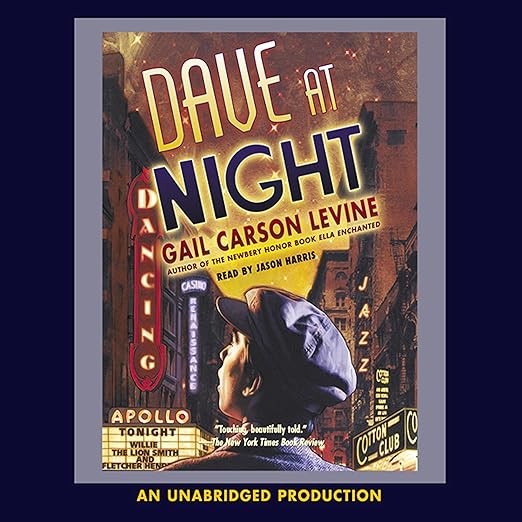
Dave Caros arrives at the Hebrew Home for Boys in 1926 New York with nothing except the fact that his father just died and his stepmother did not want him. The institution he lands in, which the boys call the Hell Hold for Brats, is every bit as grim as the name suggests, rigid, punishing, governed by rules designed to break individual will into collective compliance. Gail Carson Levine's achievement in this audiobook is to take that genuinely dark premise and build something from it that is warm without being dishonest about the darkness. Jason Harris narrates, and his voice carries the appropriate register for Dave: guarded, sardonic, funny underneath the wariness.
I came to Dave at Night as a parent reading alongside my kids, which is how this audiobook works best, as a shared listening experience that opens up more history and emotion than either audience could find alone.
By Day a Prisoner, by Night Inside Harlem
The novel's structural conceit is elegant. Dave sneaks out of the HHB at night and discovers the Harlem Renaissance in full flower: musicians, artists, writers, gamblers, and prophets moving through an electric cultural moment that the 1920s are producing specifically in this neighborhood at this time. By day, Dave is a prisoner. By night, he is inside one of the most significant artistic movements in American history, seen through the eyes of an eleven-year-old Jewish boy from Brooklyn who simply follows his curiosity wherever it leads.
Levine has written extensively in fantasy, Ella Enchanted is her best-known work, but Dave at Night is straight historical fiction, and she commits to it fully. The Harlem setting is not backdrop; it is substance. The music Dave encounters, the people he meets, the specific culture of the Renaissance, these are researched and rendered rather than sketched. One reviewer noted the book's historical, sociological, and romantic elements were achieved without sentimentality, an accurate description of Levine's tonal control throughout.
The friendship that develops between Dave and Solly, a wealthy old man who becomes his unlikely guide to the Harlem social world, is the novel's emotional engine. Dave is used to adults who want something from him or want to contain him. Solly's interest is genuinely generous, and Dave does not quite know what to do with that. The friendship is written with the awkwardness that real unexpected generosity produces, which is more interesting than the mentor-student dynamic it could have easily become.
Jason Harris Balances Toughness and Vulnerability Through Restraint
Jason Harris's narration captures Dave's particular combination of toughness and vulnerability without pushing either quality too far. Dave has to read as both a kid who can take care of himself and a kid who is genuinely alone in ways he has not fully processed, and those two things have to coexist without Harris choosing between them. He manages this through restraint, Dave's emotional states are present in the narration without being externalized beyond what the character would allow himself to show.
The audiobook runs five and a half hours, which is well calibrated for the target age range and makes it a comfortable multi-session listening experience for family listening. Levine does not let the pace drag even in the quieter sections, and the alternation between the HHB's institutional grimness and the nighttime Harlem sequences provides natural rhythm without the structure feeling schematic.
One parent reviewer described listening to it with an eleven-year-old son who was so engaged that they themselves stayed up past the child's bedtime to continue. That is a meaningful endorsement for a historical fiction audiobook aimed at middle-grade readers, the history is present and accurate without being pedagogical, and the suspense elements are real rather than manufactured.
Real Light Gets Found Inside a Hard Childhood
The HHB sections are genuinely bleak in places. Levine does not soften the institutional cruelty Dave experiences, and the punishment scenes have real weight. This is entirely appropriate to the story and the era, but parents listening with younger or more sensitive children should be aware that the book does not protect its protagonist from the consequences of the environment he is in. This is not a comfortable childhood the novel is depicting; it is a hard one with light in it.
The Harlem Renaissance figures Dave encounters are rendered with care, but some of the historical scaffolding is simplified for a middle-grade audience. Adult readers with deep knowledge of the Renaissance may find certain depictions compressed. For younger listeners and for adult listeners who know the period primarily from other sources, the rendering is accurate enough to be genuinely illuminating.
The romance subplot is age-appropriate and lightly drawn. Dave's feelings for Irma Lee, the granddaughter of a prominent Harlem family, are written at exactly the pitch a novel for this age should operate at, present, real, and not the primary focus. It is worth knowing that the romantic element exists, but it does not dominate the story.
Fantasy Fans Will Find Levine's Other Worlds Elsewhere
This audiobook is ideal for middle-grade listeners, roughly ages nine through thirteen, and for family listening sessions where a range of ages are in the room. The historical content, New York Jewish immigrant experience, the Harlem Renaissance, Depression-era institutional care, is genuinely educational without being presented as instruction, and the story is strong enough to carry the history without the history feeling like an obligation.
Adult listeners who enjoy historical fiction with a strong sense of place and period will find it engaging beyond its middle-grade designation. Skip it if you want fantasy, Levine's imaginary worlds are elsewhere. But for anyone drawn to 1920s New York and to a protagonist navigating two worlds neither of which was designed with him in mind, this is a carefully built and emotionally honest audiobook.
Good to Know
What age range is the Dave at Night audiobook appropriate for?
Middle-grade listeners, roughly nine through thirteen, and family listening. Adults who enjoy historical fiction will find it engaging beyond its target age range, but it is written specifically for younger readers.
Does this audiobook contain content that might be difficult for younger listeners?
Yes. The HHB sections depict institutional cruelty and punishment with real weight. Levine does not soften Dave's circumstances. The content is age-appropriate for the middle-grade range but parents of sensitive younger children should be aware.
Is this audiobook a good introduction to the Harlem Renaissance for young listeners?
Yes, and this is one of its genuine strengths. The historical material is rendered with accuracy and care without being presented as instruction. Levine makes the Renaissance vivid through specific scenes and characters rather than through narrated summaries.
How does Dave at Night compare to Gail Carson Levine's fantasy work like Ella Enchanted?
It is straight historical fiction without fantasy elements, a deliberate departure from her better-known mode. Readers who come specifically for Levine's fantasy writing will find something different here, but the narrative craft and emotional intelligence are consistent with her other work.