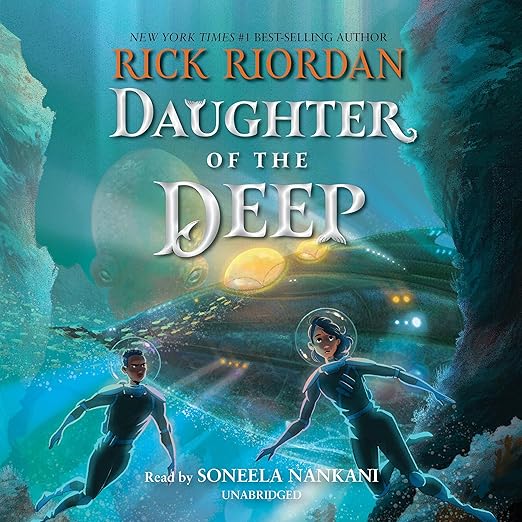
- Narration: Soneela Nankani brings Ana Dakkar to life with urgency and warmth, well-suited to Riordan's fast-paced first-person adventure style.
- Themes: Legacy and inheritance, found family under pressure, the ethics of hidden power
- Mood: Propulsive and humorous, with genuine moments of grief
- Verdict: A confident Jules Verne homage that introduces middle-grade readers to 20,000 Leagues mythology via Riordan's reliable adventure formula.
My nephew has been working his way through Percy Jackson, and I made the mistake of mentioning Daughter of the Deep while he was in earshot. I ended up listening to most of it alongside him over two long car trips, which is, I think, exactly how this book was designed to be experienced. Riordan's adventure rhythm has always had a spoken quality to it, and Soneela Nankani's narration captured the way Ana Dakkar thinks: quick, observational, scared in moments she will not entirely admit to.
The premise takes the Jules Verne universe, specifically 20,000 Leagues Under the Sea and elements of The Mysterious Island, and rebuilds it around a contemporary high school. Harding-Pencroft Academy trains marine scientists, naval warriors, and underwater explorers. Ana is a freshman, still finding her footing, when a class trip ends in disaster and she discovers her school has been fighting a cold war with a rival institution, Land Institute, for 150 years. And then comes the revelation about her family name.
Our Take on Daughter of the Deep
For readers who know Riordan's work well, this will feel immediately familiar in structure and tone. There is the reluctant young hero who turns out to have been chosen for something enormous. There is the ensemble of friends who each bring different skills. There is the adult institution that is more complicated than it appears. And there is humor, consistently, threaded through even the most tense sequences. Riordan's comic timing translates well to audio, and Nankani knows when to let the laugh land before moving forward.
What distinguishes this from his mythology books is the absence of pantheon complexity. The stakes here are political and personal rather than cosmic, and that makes it somewhat more accessible as a standalone for readers who have not committed to five-book series. The Verne mythology, as one adult reviewer put it, functions in the same structural role as Greek mythology does in Percy Jackson: it provides history, consequence, and a framework of inherited obligation.
The Strengths
The Audible production is clean, and Nankani works well with the material's range. She handles Ana's grief over her parents, who died on a scientific expedition two years before the story begins, with real restraint. Riordan does not let his protagonists be stoic about loss, and the moments where Ana's grief surfaces amid the action are among the book's most effective. Nankani handles the shift in register without softening what Riordan wrote.
At 11 hours and 16 minutes, this is comfortable pacing for middle-grade. There are no sections that feel like padding, and the underwater sequences in particular move with a propulsive urgency that suits the audio format well.
What to Watch For in Daughter of the Deep
A few reviewers, including at least one Jules Verne devotee, noted repetition in the prose and sections that could have used another revision pass. Riordan is a prolific writer and sometimes produces at a pace where certain books feel less tightly edited than others. This is one of them. The internal dialogue that Ana uses to process events occasionally slows momentum in ways that a more ruthlessly edited draft might have caught.
Adults reading this without a young person alongside them may also find the coincidences of Ana's heritage stretched beyond comfortable suspension of disbelief. As one reviewer put it, the economics of the world, where all this technological wealth has remained hidden and uncontested for 150 years, strains plausibility in ways that mythology-based fantasy sidesteps more gracefully.
Recommended For
Middle-grade readers who love Percy Jackson and are ready for something set in an underwater science-military academy will enjoy this enormously. Adults who want to introduce a young listener to Jules Verne's world through a modern gateway will find it a reliable choice. Skip it if you are a Verne purist looking for fidelity, or if you have read deep into Riordan's work and find the formula feeling repetitive. As an entry point for new listeners to either Riordan or Verne, it delivers what it promises.
Questions Listeners Ask
Should a listener read or know Jules Verne's 20,000 Leagues Under the Sea first?
Not necessary. Riordan provides enough context through Ana's world that prior Verne knowledge enhances the experience but is not required. In fact, several reviewers found this book made them want to read Verne for the first time.
Is Soneela Nankani's narration appropriate for both adult listeners and children?
Yes. Nankani's narration has enough energy to keep young listeners engaged and enough nuance for adults listening alongside them. The tonal range she brings to Ana's grief and humor makes the audiobook accessible across the age gap.
Is this book appropriate for the lower end of its middle-grade target, around age 8 or 9?
The content is fine for younger middle-grade readers, though some of the early tragedy and themes of inherited obligation may require some parental context. Riordan has always written slightly above the youngest edge of his target demographic, and Daughter of the Deep follows that pattern.