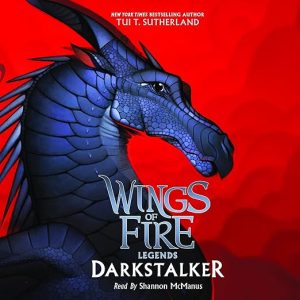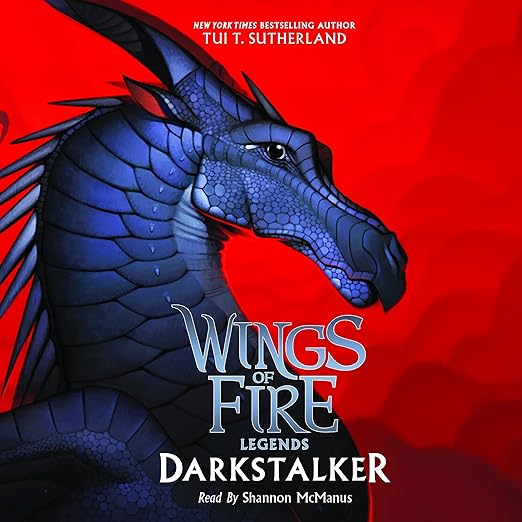
Scholastic files this audiobook as Wings of Fire book one, and the description contradicts that number by its second sentence. What the copy actually calls the book is a Wings of Fire special edition, set before the battle of the SandWing queens and before the prophecy that sends dragonets out to save Pyrrhia. The people writing underneath then disagree about where it belongs: one says take it after books six through ten, another says before or after the second arc, a third says you can start here though it makes more sense later. The field says one. Nobody else agrees with the field.
Three Futures Rotating Toward One Villain
Clearsight, Fathom and Darkstalker are dragonets here, long before any of them becomes what the later books treat as settled fact. Chapters alternate among the three, and that rotation is the structural choice giving the story its shape, since you watch three futures forming at once and only one of them curdles. Anne Pruitt states the result better than the copy manages, describing Darkstalker as a villain with good intentions, which made him really, really bad. That is the whole book in eleven words. Sutherland writes backward from an outcome the audience already knows, which trades suspense for dread and gets the better end of the deal.
Nine hours and fifty minutes covers an origin story the description promises will change everything, and the promise holds up rather well, because this is the volume explaining a character the rest of the series treats as a fixed quantity. One respondent describes Darkstalker as maybe seven or eight when he did all the things that he did, newly full grown and morally collapsing. Origin stories usually soften a villain. This one explains him with very little softening applied.
Anne Pruitt opens with MAY CONTAIN SPOILERS in block capitals before supplying a placement rule: come to this after books six through ten, because in that order it spoils nothing raised by the second series. Lauran P. proposes either before or after the second arc, having gone before, and reports that it worked. kemilie relays a ten year old's verdict that you can jump straight in, with the caveat that the book makes more sense if the main series came first. Three answers, one question, no help from the metadata.
McManus Alone Keeps Three Dragonets Apart
Shannon McManus takes the whole of it, with no other performer named anywhere on the listing. That carries weight on a book whose chapters rotate among three dragonets, since the rotation only pays off if a listener can tell instantly whose head they are inside. Scholastic Audio Books supplies a runtime and a reader and nothing beyond that. Whether the alternating structure survives one voice is the single production question this page raises and then leaves standing.
Khady Ulloa's five star entry, filed from Mexico and written in Spanish, praises the product and the delivery time, explaining that the book was ordered for a son and arrived almost at once. Excelente producto, reads the headline. Nothing in it touches the story, the writing or the recording. It is a shipping note fastened to an audio edition, and it counts toward the same badge as the entries that actually discuss the book. A grade of that kind tells you nothing about the recording and a good deal about the warehouse.
Ages come up repeatedly down the column, which is unusual and genuinely useful. A ten year old had read the entire series first and then vanished for a day with this one. A twelve year old received it as a Christmas gift and has gone back to it several times. An eight year old had it read aloud by a parent who has read plenty of fantasy and science fiction and rates the series highly. Eight to twelve is the clearest audience signal the page offers.
The Real Risk Here Is Placement
Placement is the real risk here, more than content. Two responses warn in different ways that arriving at the wrong moment costs you something: Anne Pruitt frames the after books six through ten rule as spoiler avoidance, while Lauran P. describes the book as background and context for the Nightwing dragons that lands better once you know who they are. Following the series field on this listing and starting here would drop a new listener into precisely the position both writers are warning about. The safest reading of the metadata is that the number one belongs to a special edition line, never to a listening order.
Parents wrote almost all of this column, which means the enthusiasm reaching you is secondhand. Adults report that a child disappeared with the book for a day, loved it, reread it, or asked for more of the series. That is a real signal about engagement and a poor one about craft. Nobody relays what a child made of the prose, the pacing or the ending, and the one response that does analyze the book is written by an adult who came to it skeptical.
Formats named in this column include a Kindle, a wrapped Christmas gift, a bedtime read aloud and a parcel that arrived quickly. Not one of them is an audio file. That does not make the opinions worthless, since the story is the same story in every format, though it does leave the nine hours and fifty minutes offered here unassessed by every single person whose words appear on this page.
For Households Already Deep in Pyrrhia
Households already deep in Wings of Fire are the safe recommendation, particularly ones where a child has finished the main sequence and wants more of Pyrrhia. Listeners between eight and twelve are represented directly in the column, with a parent reading aloud at the lower end and independent reading at the upper. Adults with no series history behind them will still follow the plot, since kemilie relays a ten year old's report that you can jump straight in. Anyone who enjoys a villain explained instead of excused will find the more interesting version of that operation here.
Steer clear when you are mid series and spoiler averse, because two respondents have taken the trouble to tell you exactly which books to finish first, and the series field will point you the opposite way. A listener wanting a self contained fantasy should also note that even the most permissive response admits the book makes better sense with the main series behind it. Order matters more on this listing than anything else printed on it.
Key Details
- Voice: A single reader, Shannon McManus, handles chapters that rotate among three dragonets, with no support named.
- Big ideas: Villain origin story, prophecy and foresight, moral collapse in youth, dragon politics before the war.
- Atmosphere: Ominous and unexpectedly tender.
- Worth it?: Strong on its own terms, though the series field calls it book one and every reviewer says it is not.
Is the Darkstalker audiobook a good place to begin the series?
Only if you accept some spoiling. The copy calls it a special edition set long before the main storyline, and it explains a character the later books rely on. Two parents in the column advise finishing several volumes first. A new listener starting here loses the reveal these books build toward.
Who narrates the Darkstalker audiobook, and are the dragons voiced separately?
Only Shannon McManus appears in the credit, with no co-reader anywhere in the metadata. The chapters alternate among Clearsight, Fathom and Darkstalker, so one reader distinguishes all three plus the surrounding cast across nine hours and fifty minutes. Nothing on the page describes how well that separation comes across.