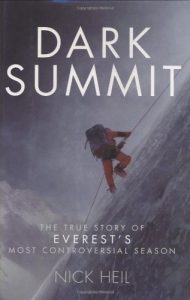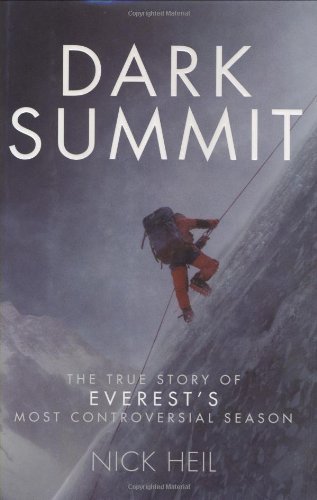
I came to Dark Summit already familiar with Jon Krakauer's Into Thin Air, which most readers reach first when they discover high-altitude mountaineering writing. Krakauer's account of the 1996 disaster is visceral and personal in a way that made it a crossover phenomenon. Nick Heil's book, which covers the 2006 Everest season, a year that produced an extraordinary and disturbing number of deaths and near-deaths, including the controversial case of David Sharp, is a different kind of account. Colder, in a way. More interested in the structural conditions that produce tragedy than in any single narrative of survival.
The synopsis is minimal, and the publisher metadata is sparse, but the book's subject and Heil's approach are well-documented in its critical reception. Dark Summit investigates a season on Everest during which commercial climbing had reached a scale that created ethical questions the mountaineering community had not previously had to confront explicitly. When climbers passed the dying David Sharp without stopping to render aid, it forced a public conversation about what obligations exist at altitude, whether summit fever constitutes a suspension of normal human responsibility, and whether the commercialization of Everest had created conditions in which that suspension became normalized.
The Review
The one substantive review describes a book that delivers more than expected: the reviewer expected summit-attempt history and found instead a book with a substantial historical dimension woven through the contemporary account. That is a description of good narrative nonfiction structure, the present-tense drama gains weight from the accumulated history around it, and the history becomes more vivid because it is always pointing toward the events Heil is actually investigating. At 8.5 hours with David Drummond narrating, this is a serious audio commitment, and the rating of 5.0 (small sample, but consistent) suggests it rewards that commitment.
David Drummond is one of the genuinely excellent voices in nonfiction audio, and his particular strengths align well with this material. Everest writing can veer into the operatically heroic, the mountain as backdrop for narratives of human transcendence. Drummond's measured, slightly austere delivery resists that pull. He reads Heil's account with the same seriousness Heil brings to his investigation, which means the book sounds like what it is: a serious examination of what goes wrong when commercial ambition and personal obsession combine in a place where mistakes are permanent. The 272-page source text rendered across 8.5 hours suggests a pace that does not rush through the difficult material, and that pacing is appropriate to the subject.
What to Watch For in Dark Summit
The synopsis is genuinely empty in the available metadata, which means listeners are going into this with limited information about specific content. The 2006 Everest season and the David Sharp controversy are the central subjects based on the book's critical record, but listeners should approach this without expecting a neat resolution, the ethical questions Heil raises about what happened at altitude are not questions that have clean answers, and the book appears honest about that. The small review count (two reviews at this point) means the rating, however positive, should be weighted accordingly. Those who have already read extensively in the Everest nonfiction genre, Krakauer, Boukreev's The Climb, Ed Viesturs's No Shortcuts to the Top, will find this a strong complement rather than an introduction to the subject.
Is This One for You?
Essential for anyone who found Into Thin Air's human drama compelling and wants to understand how the conditions that made 1996 possible were amplified, not resolved, in the decade that followed. Listeners interested in the ethics of high-stakes adventure, the obligations created by shared risk and shared conditions, will find Heil's framing more philosophically substantive than most mountaineering books attempt. Not recommended as a first entry into Everest literature; this is a book that gains considerably from existing familiarity with the mountain, the history of commercial guiding, and the specific cultural economy of high-altitude climbing. David Drummond's narration makes the 8.5-hour investment comfortable enough that the serious subject matter never becomes a burden.
Before You Listen
Does Dark Summit focus primarily on the David Sharp controversy, or does it cover the 2006 season more broadly?
Based on critical reception, Heil uses the Sharp case as a central ethical lens but covers the 2006 season more broadly, including the historical context of commercial Everest climbing that produced the conditions for that season's particular failures.
How does Dark Summit compare to Into Thin Air as an Everest account?
Krakauer's account is first-person, visceral, and built around personal survival. Heil's is more investigative and analytical, he is examining a system and its failures rather than rendering a single experience. The two books complement each other well.
Is David Drummond's narration consistent across the full 8.5-hour runtime, or does his performance vary in intensity?
Drummond is a consistently professional narrator with a long track record in serious nonfiction. His delivery is measured throughout, which suits the material, this is not a book that benefits from theatrical variation.
Does the book take a clear moral position on climbers who passed David Sharp without helping, or does it present multiple perspectives?
Based on Heil's journalistic approach and the ethical complexity of the questions involved, the book appears to examine multiple perspectives rather than issuing a verdict, the conditions that produced the situation are Heil's primary interest.