W. F. Howes stamped this audiobook February 24, 2026. The written column underneath it has been accumulating for more than two decades, which means every response a shopper can read was filed before this recording existed. That gap is not a scandal, it is simply the condition under which you are buying, and on a recording of this length it changes what the star column is worth to you. Read the responses as assessments of a book. Nobody on this page has heard the file you would be downloading.
What We Made of It
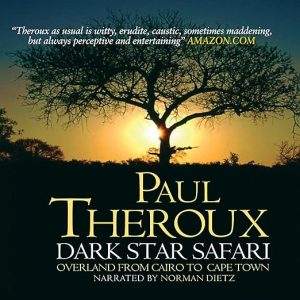
Safari means a journey in Swahili, typically a long one, and the copy opens by telling you so. Theroux's version runs Cairo to Cape Town: down the Nile, through Sudan and Ethiopia, into Kenya and Uganda and on to South Africa, by train and boat and cattle truck, across landscapes the copy is willing to call life-threatening. The book is also a return. Almost forty years earlier he had taught in the Malawi bush, and this trip takes him back to the old school, to former students, to African friends he had not seen since. Those two structures, a line drawn down a continent and a loop back into a past, are what raise it above a straight travelogue.
Look at the badge and the counter together: 4.4 printed above a line reading one rating. A lone vote can only be a whole number of stars, four or five, never a value sitting between them, so the badge and the counter cannot both be describing the same population of voters. Meanwhile the text underneath runs to five long assessments, posted from three different countries and spread across more than twenty years. Whatever machinery stacks editions behind a single page has put a decimal average over a count of one and left five people's writing sitting below it. Treat the badge as decoration and the responses as the only reception evidence here.
The Best Parts of Dark Star Safari
Theroux does not travel to be charmed, and the responses that argue with him are more useful than the ones that applaud. A five-star reader who had saved this title for last, after a long stretch of other Theroux books, summarizes the thesis as Africa being doomed barring a miracle, calls that idea anathema, and awards five stars anyway. That is the correct reaction. The value here is not that Theroux is right about aid, independence and the four decades he is measuring against. The value is that he went, looked, and wrote down answers that leave a comfortable reader uncomfortable, which is a rarer thing in this genre than the shelf suggests.
The narrator of record on this edition is Norman Dietz, and twenty-two hours and forty-eight minutes is a long time to spend in one voice's company. Nothing in the column speaks to how that voice handles the material, because the column predates the file by years. The demand the material makes is easy to name, though. The copy itself calls Theroux obsessively curious and wittily observant, and dry wit is the hardest register in prose to read aloud: push it and the joke dies on delivery, flatten it and nobody notices a joke was made. Ten minutes of sample will tell you more about this purchase than any number on the page.
What Might Not Land
A map would help enormously. The route crosses six countries the copy names and a good many it does not, and a listener working through the whole of it has no way to see where the journey currently sits. No supplementary file is offered with this download, so the geography lives in your head or it lives nowhere. That is a real loss on a book whose entire shape is a line drawn from the top of a continent to the bottom. Keep a map open on a second screen, or accept that the itinerary will blur into a sequence of border crossings and truck beds.
Read the headlines before you read the stars. One response is headlined as a great book considering how little insight the author has, then awards five stars, with the complaint narrowing to two specific passages rather than to the book as a whole. Another asks, from 2025, what the same route would show if somebody ran it again now, which is the sharpest thing anyone on this page says. The book measures one moment against the forty years behind it, and that moment has itself receded a long way since. Buy it as history carried by a strong voice, not as reporting on the continent as it currently stands.
Who Should Pick Up Dark Star Safari
You want this one if you like a travel writer with opinions and can tolerate the opinions you disagree with. Theroux is not a companionable guide, he is a demanding one, and most of the pleasure runs through the friction. Anyone who has spent real time anywhere along that route will find something to argue with in almost every hour, which I mean as a recommendation. So will anyone curious about what four decades of independence look like from a train window and a bush school rather than from a report, since ground level is the only altitude this book operates at.
Look elsewhere if you want the warm, everything-was-wonderful mode of travel writing, because this is emphatically the other kind, and the sour passages run as long as the generous ones. The second warning concerns commitment: twenty-two hours is a serious ask, and the book builds slowly rather than hooking anybody inside the first hour. Give it the full run or leave it alone. On a listing where the badge is broken and every written word predates the recording, the recommendation has to rest on the book itself, and this one has been outlasting its own reviews for more than twenty years.
Key Details
- Read by: Norman Dietz holds the credit on a 2026 edition that no written response has yet heard, which leaves dry wit as the one thing a sample has to settle.
- At its heart: Post-colonial Africa at ground level, foreign aid and where the money lands, a return to a teaching post forty years on
- Vibe: Dry, argumentative, unhurried across a continent
- Short version: A contrarian journey that earns its length, sold under a rating badge describing nothing you can verify.
Are the written reviews about this audiobook edition?
No. The February 2026 recording arrived after the readable column was already complete, so nothing in it grades the reading, the pacing or the file itself. Use those responses to decide whether you want Theroux at this length, then judge the recording from the sample and nothing else.
Is this audiobook a reasonable entry point to Paul Theroux?
It is a long one. Nearly twenty-three hours, and the book assumes a listener willing to sit with a writer who argues rather than charms. If you have never read him, the running time is the risk rather than the tone. It stands alone, and no earlier title is assumed.
How much of the book is about Theroux's own past?
A substantial strand. The copy calls the trip in part a sentimental journey, built around returning to the school where he taught in the Malawi bush almost forty years earlier and to the students and friends he left behind there. How much room that strand occupies is something the description declines to quantify.
Does the book work if you know nothing about African politics?
Yes, and that appears to be the design. Theroux reports what he meets at borders, on trains and in the towns he passes through, so the argument builds out of incidents rather than out of background reading. Anyone starting cold will follow it, and will want a second source afterwards.