The Short Version
- Narrator: Andrew Tell brings a grounded, steady quality to Grace Hamilton's fast-moving survival scenario - he doesn't oversell the tension, which actually makes the more chaotic sequences land harder.
- Subjects: Survival and group dynamics, trust under pressure, societal collapse
- Tone: Taut and kinetic
- Bottom line: Dark Nation Book One sets up its EMP-prison scenario with genuine efficiency and enough character texture to make the survival stakes feel personal rather than generic.
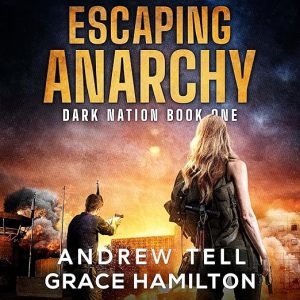
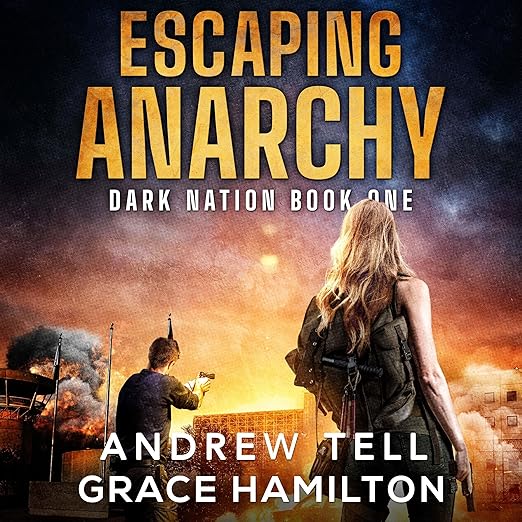
Molly, the high school teacher at the center of Dark Nation, begins this audiobook with a plan: take her troubled students to a local prison to show them where bad decisions lead. Grace Hamilton's setup is the kind of irony that post-apocalyptic fiction has always loved - the cautionary field trip that becomes the catastrophe it was meant to prevent. When an EMP blast takes out power across the country while Molly's group is inside, the lesson plan becomes beside the point. This audiobook, the first book in the Dark Nation series and narrated by Andrew Tell, runs seven hours and thirty-two minutes and covers the immediate chaos of the power-out, the prison riot, and the first stages of the wider societal collapse that follows.
The EMP premise is familiar enough in the post-apocalyptic genre that Hamilton needs to do something specific with it rather than merely using it as a trigger for survival action, and the prison setting is where the book earns its distinctiveness. A prison in the immediate aftermath of a power failure is not the same as a shopping mall or a suburban neighborhood: the existing power dynamics, the locked infrastructure, the specific expertise of the guards and the specific desperation of the prisoners all create a scenario that neither Molly nor the ex-Marine bus driver Colton can navigate using the standard survival fiction playbook. The book is at its strongest in these early prison chapters, where the constraint of the setting forces Hamilton to develop character rather than simply escalate danger.
First, the Big Picture
Molly is a more interesting protagonist than the setup might suggest. Hamilton resists the temptation to make her immediately competent under pressure; she is a teacher, not a prepper, and her instincts in the prison chaos are sometimes right and sometimes badly wrong. The dynamic between her and Colton - the ex-Marine who knows the operational side of survival but lacks Molly's relationship with the students - is the book's central partnership, and it generates both conflict and genuine cooperation in ways that feel earned rather than formulaic. One reviewer specifically notes the "excellent characterization" and "genuine" dialogue, which is a fair assessment: Hamilton writes characters who talk like people rather than like archetypes.
The prisoner who allies with the group for his own purposes is a more complicated narrative choice. Hamilton gives him enough specificity that he avoids being a simple plot device, but his motivations remain somewhat opaque in ways that serve thriller mechanics but complicate character development. This is a first-book limitation rather than a series-level problem: readers who follow into the subsequent Dark Nation volumes will presumably get more of that context. The caveat offered by one reviewer - that some characters needed more development - is most applicable here.
Why Listen to Dark Nation
Andrew Tell's narration makes the early prison chaos genuinely immersive. The 7-hour runtime moves at a pace that suits the material: fast enough that the survival action doesn't stall, but with enough space in the quieter moments for character dynamics to develop. Tell handles the ensemble well, maintaining consistent voice characterization for Molly, Colton, and the students across scenes that shift register quickly from confrontation to strategy to physical danger. Survival fiction in audio is particularly effective when the narrator can convey the exhaustion and improvisation of characters who are thinking under pressure, and Tell achieves that.
The book's transition from prison escape to the wider collapse - Molly's plan to reach her cabin outside the city - is where the series establishes its long-term shape. The prison section is self-contained enough to be satisfying as a narrative arc, and the final chapters open the story outward in ways that make the subsequent volumes feel necessary rather than merely available. For listeners who want a clear series hook in Book One without feeling like they've been handed a fragment, Dark Nation delivers a genuine first-act structure.
A Few Reservations
The question of trust is the book's most persistent thematic preoccupation. Every major decision Molly and Colton make comes down to who can be trusted in a situation where normal social contracts have been suspended. The prisoner alliance is the most explicit version of this, but it runs through the group dynamics of the students as well - some of whom, having been troubled in ordinary circumstances, turn out to be capable in extraordinary ones, while others do not. Hamilton doesn't resolve this question cleanly, which is appropriate for a first book in a series about long-term survival.
The scope of the collapse is deliberately left partially offscreen in this first volume. The EMP's origin, the national situation, and the longer-term shape of the crisis are all gestured toward without being explained. This is a structural choice that serves the series arc - the reader knows as much as Molly does, which is the right level of information for a character who is managing immediate survival rather than analyzing geopolitics. Listeners who prefer the early volumes of a post-apocalyptic series to establish the wider picture before the personal stakes may find this frustrating, but it is a consistent approach that Hamilton uses across the series.
Who Should Listen to Dark Nation
Fans of post-apocalyptic survival fiction who want a female protagonist in a scenario that is genuinely constrained by its setting - rather than using collapse as backdrop - will find this a strong series opener. The prison setting is unusual enough to distinguish it from the crowded EMP fiction field. Listeners who want full character development from the first book or extensive world-building of the collapse scenario should know that Hamilton prioritizes immediate stakes over contextual breadth. Those who commit to the series will find the pieces accumulate.
Does Dark Nation audiobook work as a standalone, or do I need to continue the series?
Book One has a complete narrative arc covering the prison escape and the first steps toward Molly's cabin, but it deliberately opens story threads that continue through the series. It is satisfying as a first installment rather than as a fully self-contained story, and the ending is designed to make the next book feel like a natural continuation rather than an optional addition.
How much of the audiobook takes place inside the prison versus in the wider collapsed world?
The majority of the runtime is set inside and immediately around the prison, which is where the book's distinctive scenario lives. The final section opens into the larger collapse, but Dark Nation Book One is primarily a contained survival thriller rather than a wide-ranging post-apocalyptic narrative. The series broadens that scope in subsequent volumes.
How does Andrew Tell's narration handle the ensemble of characters, including the troubled teens?
Tell differentiates the main cast effectively, with distinct voice approaches for Molly's measured intensity, Colton's ex-military practicality, and the student ensemble. The teens are the most challenging voices in the cast to keep distinct, and Tell manages their individual characterizations consistently across the book's most chaotic sequences.