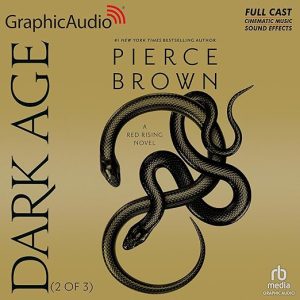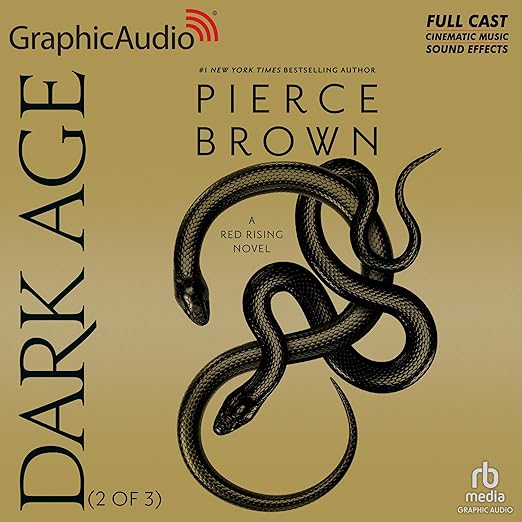
- Narrator: The full cast production, with Jenna Sharpe as Virginia, Stewart Crank as Darrow, Elena Anderson as Lyria, Alex Hill-Knight as Lysander, and Christopher Tester as Ephraim, brings Pierce Brown's multi-POV structure fully to life with immersive sound design.
- Subjects: Revolution and its cost, the corruption of idealism, loyalty under impossible conditions
- Tone: Relentless and harrowing, with moments of devastating beauty in the quiet scenes between battles
- Bottom line: For Red Rising fans who want to experience Dark Age in the most fully realized audio form available, this dramatized production earns its complexity and its runtime.
Pierce Brown's Dark Age is the fifth book in the Red Rising Saga and widely regarded as its most brutal, most ambitious, and most polarizing entry. The full-cast dramatized adaptation, split into three parts for audio release, takes the novel's sprawling multi-POV structure and translates it into a production format that matches its scope: immersive sound design, cinematic music, and a cast of dozens bringing each narrative thread its own distinct sonic texture. This second part of three, running 11 hours and 5 minutes, arrives mid-chaos. Darrow is waging a rogue war on Mercury, outnumbered and cut off from the Republic he founded. Virginia is fighting on Luna to preserve democracy and retrieve her exiled husband. Lysander is moving to unite the fractured Gold forces. Ephraim has been assigned the extraction of Pax au Augustus. And Lyria, a Red refugee, is making a desperate bid for freedom with two unlikely allies. The audiobook does not ease the listener into any of this; it picks up where Part 1 left off and runs.
First, the Big Picture
The dramatized format matters here in ways that single-narrator performance cannot achieve. Dark Age is built on multiple first-person narrators whose storylines run parallel without intersecting for long stretches, which means readers spend chapters inhabiting the logic of characters who are direct opponents. Stewart Crank's Darrow is a man who has led a revolution, watched it turn on him, and is now fighting a war he may have already lost, not a fallen hero in a clean arc but someone who has spent a decade becoming something more complicated than the hero he set out to be. Alex Hill-Knight's Lysander provides the ideological counter: methodical, aristocratic, genuinely convinced that the Gold empire represents a more sustainable order than Darrow's Republic. The production gives each a voice and soundscape that reflects their position, so moving between their chapters is not just a tonal shift on the page but an acoustic one in the audio.
Jenna Sharpe as Virginia au Augustus is the performance that carries the most emotional weight in this middle section. Virginia's fight to preserve the Republic while her husband wages an unauthorized war represents Brown's most sophisticated political construction in the saga; she is the book's clearest-eyed character, the one most aware of what democracy actually requires to survive, and the one most at risk of having to choose between the institution she built and the person she loves. Sharpe handles the political calculation and the personal cost without separating them into different registers, which is the correct approach for a character who cannot afford to separate them herself.
Why Listen to Dark Age (Part 2 of 3) (Dramatized Adaptation)
The production values distinguish this from any narrated version of the same material. The battle sequences on Mercury, some of the saga's most physically and psychologically extreme combat involving Obsidian war parties and Gold military technology, use layered sound design that communicates chaos in ways that words alone carry less effectively. The contrast with Christopher Tester's Ephraim, whose thread is more intimate and morally complicated than the large-scale battles, is sharpest in audio: the production shifts register entirely between the two storylines, giving Ephraim's scenes a quieter, more claustrophobic atmosphere that matches his position as a Gray operative navigating a conflict between people far above his social station.
Lyria's thread, voiced by Elena Anderson, is the entry point for listeners who find the Gold political machinations abstract, a Red refugee navigating a war between people who barely register her existence, trying to survive systems built without reference to her humanity. Anderson's performance makes Lyria's perspective visceral, and the two unlikely allies who assist her escape give the thread moments of genuine warmth that contrast sharply with the relentless strategic darkness of the Darrow and Lysander chapters. The production includes over forty named cast members in supporting and featured roles, which reflects how many threads Brown carries simultaneously, and the sonic differentiation between storylines makes the POV shifts immediate rather than requiring the listener to re-orient after chapter headings.
A Few Reservations
This is the middle section of a three-part serialization of a single novel, and its satisfactions are those of a narrative in full motion rather than one that arrives anywhere. No major thread resolves. Characters are pushed to more extreme positions and the cost of the decade-long revolution is most starkly enumerated in these chapters. Brown is methodical about denying his characters any comfort for extended periods, and Part 2 is where that methodology is most relentless. Listeners who have not heard Part 1 will be lost immediately; this production is built for Red Rising readers who know the saga well and want the most fully realized audio experience of its most demanding installment.
The production includes Tia Shearer as Volga, Robb Moreira as Pax, and a supporting ensemble that extends across every thread. The sound design for Pax's captivity sequences is particularly effective; the confined space and Ephraim's moral ambivalence about his assignment are communicated as much through the audio environment as through Tester's performance. For readers who have followed the saga since Red Rising and want to experience Dark Age in its most fully realized form, this production represents the most ambitious audio version of Pierce Brown's work available.
Who Should Pick Up Dark Age (Part 2 of 3) (Dramatized Adaptation)
Red Rising Saga listeners who have engaged with the series, ideally through the prior dramatized adaptations of the earlier books, and who want the most fully realized audio experience of Brown's most demanding novel. Those who found the single-narrator audiobooks of the earlier Red Rising books satisfying may find the full-cast format a significant upgrade for material this dense and multi-threaded. Series newcomers should begin with the Red Rising dramatized adaptation from the saga's beginning; starting here is not just inadvisable but genuinely incomprehensible without the prior four books' context. For committed fans, this production delivers on the ambition of Brown's most complicated and consequential installment in the saga.
Good to Know
How does the full-cast dramatized audiobook format change the Dark Age experience compared to reading the novel?
The format gives each narrative POV its own distinct sonic identity through cast, voice, and sound design, which clarifies the multi-thread structure for listeners who found the parallel storylines difficult to track in print. The battle sequences benefit significantly from layered sound production, and performances like Jenna Sharpe's Virginia and Christopher Tester's Ephraim add dimension that single-narrator readings cannot achieve.
Is this audiobook suitable as a standalone listen within the Dark Age trilogy of parts?
No. It picks up mid-story and ends mid-story. Its satisfactions are those of a narrative in motion rather than one that arrives anywhere. The three parts together constitute a single unified production of the novel and should be experienced in sequence.
Who are the main narrators in this full-cast audiobook, and which character threads do they carry?
The principal voices are Jenna Sharpe as Virginia au Augustus, Stewart Crank as Darrow, Elena Anderson as Lyria, Alex Hill-Knight as Lysander, and Christopher Tester as Ephraim, with Robb Moreira as Pax and Tia Shearer as Volga. Each carries their character's full thread through the production, supported by over forty additional cast members.