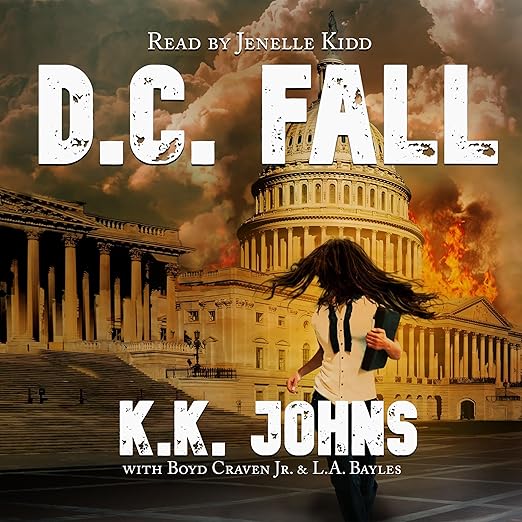
The October Fall World, K.K. Johns's post-apocalyptic series, arrives in its Washington, D.C. chapter with a scenario that is well-worn in the genre but executed with more character specificity than most: a rogue nation detonates an EMP over the East Coast, and within hours a city that runs entirely on infrastructure becomes a cage. D.C. Fall, narrated by Jenelle Kidd, is the audiobook that places Vivienne Harmon at the center of that collapse, on the very day she had planned to leave her controlling, mob-connected husband Cosmo and start over. The timing is not accidental. Johns constructs the EMP as a second trap for Viv, one that freezes her escape plan at its most vulnerable moment and turns the city she was trying to leave into a maze she cannot navigate without risk.
The genre context here is post-apocalyptic survival fiction, but Johns is doing something more specific than the genre label suggests. D.C. Fall runs two concurrent survival stories: Viv's attempt to move through a D.C. collapsing into civil unrest while being hunted by a husband with Russian mob connections, and Tobin Grant's effort to protect his friend Vale's farm and children from desperate raiders outside the city. The two narrative threads are genre-standard for the EMP subgenre, which tends to alternate between urban chaos and rural resilience, but the writing earns the format by making both protagonists specific rather than archetypal. Viv's problem is not just survival; it is survival while carrying a priceless artifact that Cosmo is willing to be ruthless to recover. Tobin's problem is not just defense; it is the psychological reconstruction of a man already broken before the grid went down.
What K.K. Johns Delivers
One experienced reviewer describes D.C. Fall as ranking alongside the original four books in the October Fall World, high praise from a reader invested enough in the series to rank entries comparatively. That context is useful for new listeners approaching the book: this is a series with an established readership that knows the world's rules and rewards entries that respect them. The reviewer who entered post-apocalyptic fiction for the first time through this book and finished the trilogy without stopping also offers a meaningful data point, suggesting the book functions as a standalone entry point even without prior series knowledge.
The character work is where Johns distinguishes D.C. Fall from the more action-driven titles in the subgenre. Viv's relationship with Cosmo is not a simple villain-versus-victim dynamic: the detail that Cosmo runs a fencing operation with Russian mob ties while presenting a different face to Viv is the kind of specific backstory that makes the domestic threat feel earned rather than imposed. The artifact she took when she left, the thing Cosmo desperately needs to recover before the mob finds him, gives the survival story a propulsive object around which the threats organize. Johns understands that post-apocalyptic fiction works best when the emergency amplifies pre-existing tensions rather than replacing them.
What K.K. Johns Gets Right
Jenelle Kidd's narration is a significant reason to choose the audio format for this book. She manages the dual-perspective structure, which alternates between Viv's first-person urgency and the wider narrative tracking Cosmo and Tobin, with clear differentiation that keeps the listener oriented across the shifts. The scenes where Cosmo pursues Viv through the collapsing city carry a low, persistent menace in Kidd's read that would be harder to maintain in silent text. Her handling of the community-building sequences at Vale's farm, which are quieter and more emotionally varied, demonstrates the range the book demands.
At nine hours and forty minutes, D.C. Fall is a substantial listen that moves consistently enough to sustain attention across its runtime. The EMP premise grounds the story in specific, detailed consequences: no cell service, no traffic lights, no hospitals on backup power, no cash registers, no gas pumps without electricity. Johns does the infrastructure homework that the subgenre requires, and Kidd's delivery gives that detail texture rather than letting it become a technical checklist. Listeners who have found other EMP fiction too focused on tactical prepper scenarios will find D.C. Fall notably more interested in human psychology under pressure.
Where K.K. Johns Loses Some Ground
The continuity note from one reviewer, identifying some inconsistencies for a debut novel, is worth keeping in mind, though the same reviewer rates it positively overall and specifically notes looking forward to the next installment. For listeners unfamiliar with the October Fall World, the book includes enough world-setup to follow without prior reading, but the series framing means certain relationships and backstory elements will carry more weight for readers who have encountered the broader world. The series tag should be read as an invitation to continue rather than a barrier to entry.
The Russian mob subplot, which operates in the background of the EMP chaos, functions as a secondary thriller engine that prevents the story from settling entirely into survival-mode pacing. Cosmo's pursuit of Viv intersects with his own panic about what the mob will do to him now that his operations are exposed and the power is out, and that intersection gives the third act a different kind of urgency from the physical survival elements. Johns manages the genre balancing act with enough skill that neither thread overshadows the other.
Who Should Pick Up D.C. FALL
Listeners who enjoy EMP-based post-apocalyptic fiction but want character-driven plotting rather than tactical prepper logistics will find D.C. Fall a rewarding audiobook. Fans of the October Fall World who have read the earlier novels will get the most from the series context, but the book functions independently for new readers. Jenelle Kidd's narration makes a strong case for the audio format over print, particularly for the thriller elements. Readers who are sensitive to domestic abuse themes presented in a survival context should be aware that Viv's situation with Cosmo is handled with specificity rather than as a background detail.
The Short Version
- Narrator: Jenelle Kidd handles both Vivienne's first-person urgency and the broader ensemble cast with conviction; her read of the domestic-threat scenes involving Cosmo is particularly sharp.
- Subjects: post-EMP societal collapse, domestic escape intersecting with survival, community versus predation
- Tone: Tense and propulsive, with a grounded thriller register distinct from most apocalyptic fiction
- Bottom line: Kidd's performance and Johns's character-driven plotting make D.C. Fall one of the stronger entries in the October Fall World series, though the series context adds payoff for committed readers.
Frequently Asked Questions
Do I need to read the earlier October Fall World books before listening to the D.C. Fall audiobook?
The book is functional as a standalone entry. The October Fall World is an established series with recurring readers, and some context about the world's rules adds depth, but Johns provides enough setup that new listeners can follow without prior books.
How does Jenelle Kidd handle the dual protagonist structure of the D.C. Fall audiobook?
Kidd differentiates clearly between Vivienne's sections, which carry urgency and personal threat, and Tobin's sections, which are slower and more focused on defense and community. The shifts between perspectives are handled with tonal shifts that keep the listener oriented.
Is D.C. Fall more focused on survival logistics or character drama?
Character drama, primarily. The EMP consequences are researched and specific, but Johns is most interested in how existing psychological pressures, Viv's abusive marriage, Tobin's pre-existing damage, organize and amplify under survival conditions. Listeners wanting pure tactical prepper content should look elsewhere.
At roughly 10 hours, does the D.C. Fall audiobook maintain pacing throughout or does it have slow sections?
The pacing is generally consistent. The dual-thread structure, alternating between Viv's urban crisis and Tobin's rural defense situation, prevents any single register from dominating for too long. The third act, driven by Cosmo's pursuit converging with the mob timeline, picks up speed considerably.