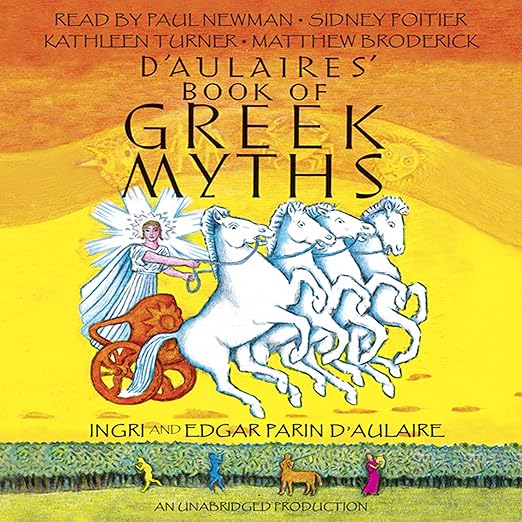
- Narrator: Paul Newman, Sidney Poitier, Kathleen Turner, and Matthew Broderick form a full-cast ensemble that transforms a beloved illustrated book into a genuine theatrical event for young ears.
- Subjects: Divine caprice and mortal consequence, the origins of natural phenomena, heroic transformation
- Tone: Warm and ceremonial, with occasional moments of genuine darkness handled with care
- Bottom line: One of the rare children's audiobooks where the casting is itself an event, and the material is strong enough to deserve it.
There are books that belong to specific stages of childhood, and D'Aulaires' Book of Greek Myths is one of those for a certain generation of American readers. Ingri and Edgar Parin d'Aulaire published the original in 1962, and it has remained in print because it achieves something genuinely difficult: presenting the gods of Olympus as simultaneously magnificent and absurd, dangerous and familiar, without condescending to young readers. The audiobook adds something remarkable to that foundation. I sat with my nephew for most of this one on a rainy Saturday, and we were both absorbed in a way that I did not anticipate.
The casting is the headline. Paul Newman, Sidney Poitier, Kathleen Turner, and Matthew Broderick constitute a full-cast ensemble that Listening Library assembled with evident care. This is not a single narrator reading through the myths. It is something closer to a radio drama, with the weightiness of four distinct voices distributing the material in a way that gives each section its own register and momentum.
What Ingri d'Aulaire Delivers
What the d'Aulaires understood, and what this audiobook preserves, is that Greek mythology is most interesting when it is allowed to be genuinely strange. Zeus's romantic misadventures are not bowdlerized into harmlessness, but they are framed with the kind of matter-of-fact narrative distance that children can absorb without distress. One parent reviewer mentions reading only parts of it to an eight-year-old because Greek mythology is dark, which is fair, but that darkness is part of what makes the stories memorable. The petty jealousies of the gods, Hera's vindictiveness, the casual transformation of mortals into animals and trees and stars, function as genuinely engaging narrative rather than sanitized moral allegory. The d'Aulaires treat their young readers as capable of handling the full spectrum of mythological consequence, which is part of why this book has outlasted so many gentler competitors.
What Ingri d'Aulaire Gets Right
The full-cast approach solves a problem inherent to this particular book's structure. The original is organized loosely by deity and hero, covering Zeus, Hermes, Athena, Asclepius, Orpheus and Eurydice, Helios, and many others in episodic sections that are more thematically unified than narratively continuous. A single narrator reading through that structure for four hours can become monotonous. With four distinct voices distributing the material, each section lands differently, and the shifts in vocal character create natural breaks that help younger listeners track the mythological landscape. At just over four hours, the runtime is also manageable for family listening in segments, making it practical for car journeys or bedtime sequences spread across several evenings.
Where Ingri d'Aulaire Loses Some Ground
Listeners who know the original book will notice that the audiobook necessarily loses the illustrated dimension that is central to the d'Aulaires' achievement. The vibrant, lithograph-style images that accompany Athena, Apollo, and Heracles are a significant part of how young readers process and remember these stories. The audio adaptation compensates through performance but cannot replicate the visual texture. For children being introduced to Greek mythology through this audiobook without the physical book alongside, some of the mythological relationships and genealogies may need supplementary explanation. The family tree of the Olympian gods is complex, and the audio format cannot reproduce the visual genealogy charts the book provides. Having the physical copy open during listening sessions is the ideal configuration for younger audiences.
Who Should Pick Up D'Aulaires' Book of Greek Myths
This is ideal for family listening with children roughly aged seven to twelve, and it works equally well for adults who want an accessible and beautifully performed introduction to the Olympian myths. Listeners who grew up with the physical book will find the full-cast production a worthy audio companion. Anyone preparing children for broader engagement with classical literature, from Percy Jackson to actual Homer, will find this an excellent starting point that does not oversimplify its source material or talk down to its young audience.
Good to Know
Does the audiobook follow the same structure as the original illustrated book?
Yes, the audiobook preserves the d'Aulaires' organizational structure, moving through the major gods and heroes in episodic sections. However, the illustrated component that is central to the physical book's appeal is not present in the audio format.
Can children who have not read the physical book still follow the audiobook?
Yes, though some of the complex family relationships between the gods may benefit from supplementary explanation. Having the physical book available alongside the audio is ideal, but the audio version works as a standalone introduction to the material.