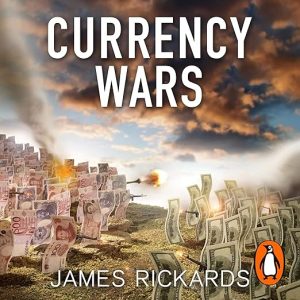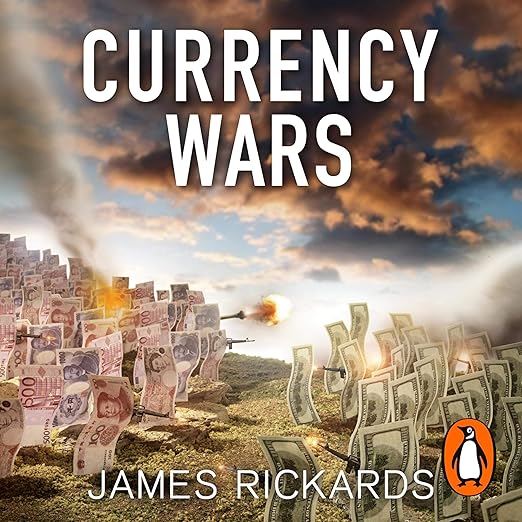
James Rickards has a gift for making the machinery of international finance feel like a thriller plot. Currency Wars, his examination of how nations use currency devaluation as a weapon against trading partners, was called 'one of the scariest books I've read' by Bloomberg Businessweek, and the Financial Times registered its alarm with the dry note: 'Let's hope he's wrong.' That kind of reception tells you something about both the argument's seriousness and its capacity to unsettle.
This audiobook, narrated by Walter Dixon across just under ten hours, takes a Penguin-published text and gives it the auditory treatment a work of this density probably needed. Rickards is a financial expert, investment advisor, and New York Times bestselling author, and the book reflects the breadth of that background, part economic history, part geopolitical analysis, part warning.
Currency Wars Degenerate Through Retaliation and Escalation
Rickards's central argument is that currency wars are not anomalies but recurring features of the international economic order, and that they carry consequences far beyond the quarterly GDP figures. He traces a pattern in which countries, faced with economic pressure, devalue their currencies to steal competitive advantage from trading partners, triggering retaliation and escalation. The historical record he marshals is detailed and damning: from the interwar period through Bretton Woods to the contemporary era of quantitative easing and sovereign wealth fund maneuvering.
What distinguishes this book from standard financial journalism is Rickards's willingness to follow the logic to its darkest conclusions. He describes how currency wars degenerate through stages, inflation, recession, retaliation, and sometimes actual violence, and argues that contemporary conditions, including China's clandestine gold accumulation and the hidden agendas of sovereign wealth funds, replicate the preconditions of past crises. The Fort Worth Star-Telegram called the book 'unsettling' and 'a thorough analysis of how nations have manipulated their currencies with disastrous consequences.'
Walter Dixon narrates with the controlled authority this material demands. He does not dramatize unnecessarily; the dread that runs through Rickards's analysis is sufficient on its own, and Dixon respects that, delivering the dense economic argument in clean, well-paced sentences that allow listeners to follow the reasoning without losing the thread. At nearly ten hours, his consistency is itself a performance achievement.
Dixon's Narration Scaffolds a Dense Argument
The audiobook format serves this particular book better than you might expect. Rickards writes clearly for a non-specialist audience, but the density of the argument, the interlocking monetary relationships, the historical parallels, the institutional acronyms, can make the text feel demanding on the page. Dixon's narration provides a kind of scaffolding. His measured delivery gives listeners time to absorb each stage of the argument before the next builds upon it.
At nearly ten hours, Currency Wars is not light fare. But the reward for sustained engagement is a coherent and frightening map of how the global financial system actually operates beneath the level of official statements and reassuring press releases. Rickards is not an alarmist for sport; he documents his case carefully, and the argument accumulates weight across the runtime in a way that would be harder to achieve in a shorter work.
The book sits in a tradition of financial warning literature that includes works like Nassim Taleb's writings on fragility and Carmen Reinhart and Kenneth Rogoff's historical analysis of financial crises. Currency Wars is less academic than those but more politically specific. Rickards is interested in the intentions and strategies of states, not just statistical regularities. That makes the argument both more accessible and more overtly alarming.
Rickards' Dollar Predictions Have Not Yet Materialized
Rickards writes from a particular ideological orientation, broadly skeptical of fiat currency systems and sympathetic to gold-standard thinking, and listeners should hold that context in mind. His predictions about the collapse of the dollar's reserve currency status have not materialized on the timeline he suggested, though the structural arguments he makes remain actively debated among economists. The analysis is stronger as historical diagnosis than as forward-looking forecast.
The China sections are particularly worth attention. Rickards's examination of Chinese currency strategy, gold accumulation, and the strategic use of sovereign wealth funds was ahead of mainstream financial commentary when the book was published, and subsequent events have validated portions of his analysis in ways that make for unsettling retrospective reading. The parallels he draws between contemporary dynamics and the period before the Great Depression are drawn with enough specificity to be genuinely illuminating rather than merely rhetorical.
Gold-Standard Skeptics May Find Some Chapters Frustrating
This audiobook belongs in the queue of anyone trying to understand how economic power actually operates in the international system, including investors, policy-minded readers, students of international relations, and anyone who found the 2008 financial crisis underexplained by the coverage at the time. Rickards writes for intelligent non-specialists, and Dixon's narration makes the technical passages navigable.
Listeners expecting a neutral, academic treatment should note Rickards's advocacy for particular policy conclusions. Those who find gold-standard arguments reflexively implausible may find certain chapters frustrating. But even readers who disagree with Rickards's prescriptions tend to find the historical and structural analysis worth the time. For ten hours on a subject this consequential, that is a reasonable return. The audiobook's greatest service is making the mechanics of currency conflict legible without requiring a graduate degree in economics, and Dixon's narration ensures that legibility holds across the full runtime. Anyone who wants to think more carefully about the weapons states deploy in economic competition will find Rickards's framework, whatever its limitations as prophecy, a durable and illuminating lens.
Frequently Asked Questions
Do I need a background in economics to follow this audiobook?
Rickards writes for a general intelligent audience and explains technical concepts as he introduces them. A basic familiarity with concepts like inflation, interest rates, and trade balances helps, but no specialist knowledge is required.
Is this audiobook still relevant given it was written some years ago?
The historical analysis and structural arguments remain highly relevant. Some of Rickards's specific forward-looking predictions have not played out as he suggested, but the framework for understanding currency conflict applies directly to contemporary events including US-China trade tensions and dollar reserve currency debates.
Does the audiobook cover recent developments like cryptocurrency or digital central bank currencies?
Currency Wars predates the digital currency era and does not address Bitcoin, CBDC, or related developments. Rickards has addressed these topics in subsequent books; this audiobook is focused on the traditional mechanisms of currency conflict through gold, devaluation, and sovereign fund strategy.