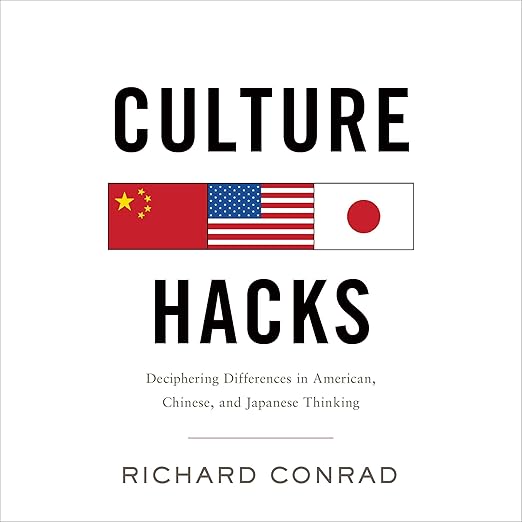
I had a conversation some years ago with an editor from a Tokyo-based publishing house that has stayed with me ever since. We were discussing a licensing deal and I kept trying to move the conversation toward a decision point, summarizing the terms, clarifying the next step, waiting for a direct response that would move us forward. She kept redirecting, circling the topic from different angles, returning to context I thought we had already established and agreed on. What felt to me like evasion or reluctance was, I later understood, her way of building the comprehensive picture she needed before any decision could responsibly be made. I was operating on linear logic. She was operating intuitively. We eventually got there, but it cost both of us unnecessary friction that neither would have created if we had understood what the other was actually doing in that room. I thought about that conversation more than once while listening to Culture Hacks.
Richard Conrad spent twenty-five years living and working in Asia, and this audiobook is his attempt to make accessible the fundamental cognitive differences between American, Chinese, and Japanese thinking. The core distinction he draws is between American linear reasoning, Chinese lateral reasoning, and Japanese intuitive reasoning. He is careful throughout to acknowledge individual variation within each culture and to avoid the reductiveness that makes cultural frameworks slide into stereotype. But he argues, with the weight of decades of direct professional experience, that these patterns are genuinely embedded in cultural tradition, philosophical heritage, and educational practice in ways that consistently affect how business is conducted, how trust is established, and how decisions get reached.
American Linear, Chinese Lateral, Japanese Intuitive Reasoning
The most intellectually interesting material in this audiobook is Conrad's exploration of how each culture's reasoning style emerged from distinct historical and philosophical traditions rather than from arbitrary cultural preference. American linear reasoning reflects, among other things, a legal and commercial culture that prizes explicit agreement, documented outcomes, and individual accountability for specific commitments made in writing. Chinese lateral reasoning, drawing on traditions that value relational context and indirect approach, tends to circle a problem from multiple entry points before any commitment can be comfortably made by anyone involved. Japanese intuitive reasoning, shaped by social obligation, hierarchical structure, and a deep preference for implicit rather than explicit communication, operates in ways that can seem equally opaque to both American and Chinese counterparts approaching the same negotiation from their own frameworks.
One reviewer who had previously conflated Asian cultures into a single undifferentiated category described the book as correcting that reductiveness in a way that improved their understanding of international affairs beyond the business context specifically. Another reviewer who read the book while living in a small Chinese town during the pandemic called it a lifeline to understanding the culture surrounding them across those isolated years. Both testimonials point to the same quality: Conrad's framework provides vocabulary and structure for things that experienced professionals often know intuitively but cannot articulate to colleagues who have not had the same immersion.
Brian Nishii's Delivery Never Condescends or Oversimplifies
Conrad does not limit himself to abstract framework and theoretical description. The book is built substantially on personal stories from his years working in both Japan and China, and these episodes do significant load-bearing work throughout the full ten hours. One reviewer noted that the personal stories of his encounters were the most interesting element, elevating the book well above what a typical business etiquette guide manages to offer its readers. Another reader who finished it in two days described it as fun and entertaining as well as highly informative, crediting Conrad's ability to present complex cultural nuance in accessible and occasionally amusing terms without sacrificing intellectual honesty in the process.
Brian Nishii's narration suits this material well and handles it carefully. Cross-cultural content narrated by the wrong voice can inadvertently condescend or oversimplify in ways the author never intended, and Nishii's measured delivery avoids both pitfalls consistently across the full runtime. At ten hours and forty minutes, the audiobook runs longer than most business nonfiction, and the pacing benefits from Conrad's combination of analytical framework sections and narrative interludes that keep the experience from becoming purely didactic lecture.
Respectful, Informed, and Slightly Heavy-Handed at Times
This book is not without fair-minded critics. One reviewer gave it four stars while noting that certain broader claims felt slightly heavy-handed, and that despite finding it respectful and informed, they were not fully convinced by everything Conrad asserts with confidence. The framework is necessarily generalized, and listeners with deep personal experience embedded in either Japan or China may find some characterizations flattened by the requirements of accessibility to a general audience who knows very little about either context. Conrad wrote this for Americans navigating unfamiliar cultural territory, not for comparative anthropologists with years of fieldwork behind them, and that orientation shapes what the book can and cannot deliver honestly.
Beneath Behavior, Into the Reasoning That Produces It
For international business professionals preparing for first assignments in Japan or China, this is practical and immediately valuable in ways that most etiquette guides cannot match because Conrad goes beneath behavior to the reasoning patterns that produce it. For generalists curious about how cultural background shapes reasoning at a foundational level, it is consistently engaging across its full runtime. For those already deeply embedded in either culture, the foundational material may feel familiar even when the explicit framework is useful for articulating what direct experience has already taught through years of friction and adjustment. Know which listener you are before you start, and adjust your expectations for what this particular audiobook can offer you accordingly.
Before You Listen
Does Culture Hacks address other Asian cultures beyond Japan and China, or is the scope limited to those two?
The book focuses specifically on the triangular relationship between American, Chinese, and Japanese thinking styles. One reviewer notes that the China-Japan relationship itself adds depth beyond a simple bilateral US-Asia comparison, but other Asian cultures, including Korean, Southeast Asian, and South Asian contexts, are not covered in this volume.
Is this book still useful for someone who has already worked in Japan or China for several years?
Experienced practitioners may find the foundational framework familiar from direct experience, though the explicit articulation of cognitive differences can be valuable for people who have learned intuitively what Conrad describes analytically. Professionals who need to explain cultural dynamics to new colleagues or leadership will find it particularly useful as a reference.
Does Conrad's book advocate for any particular cultural perspective, or does it treat all three frameworks neutrally?
One reviewer described certain sections as slightly heavy-handed politically for their tastes while still rating it four stars. Conrad's long-term American perspective in Asia inevitably shapes his framing, though the book's primary purpose is practical cultural understanding rather than geopolitical argument. Most reviewers found it respectful and reasonably balanced throughout.
How does Brian Nishii's narration handle the cross-cultural material across ten hours?
Nishii's measured delivery avoids the condescension that can undermine cross-cultural content when narrated carelessly or without sensitivity to the subject. His pacing suits both the analytical framework sections and the more anecdotal narrative passages, and reviewers have not raised any concerns about how the narration approaches the subject matter.