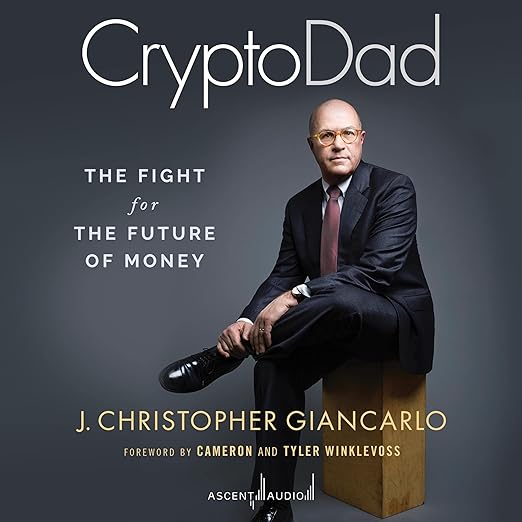
- Voice: Steve Marvel holds the credit, on prose built out of testimony and hearing-room argument that has to stay listenable for thirteen hours.
- Big ideas: Crypto regulation, the Digital Dollar, a career spent arguing an unpopular position from inside government.
- Atmosphere: Briefing-room detail carried by an advocate's urgency.
- Worth it?: The strongest available account of the regulator's side of the crypto fight, told by the person who fought it, so long as you want advocacy rather than balance.
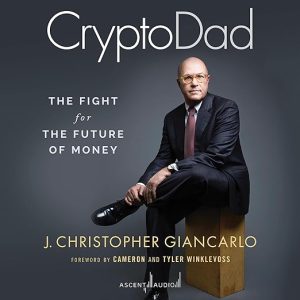
Thirteenth chairman of the Commodity Futures Trading Commission is not a job title that promises much of a story, and yet this audiobook opens on one. A financial regulator went to Congress, argued that cryptocurrency was 'the inevitable product of a fast-growing technological wave and a free marketplace,' and walked out with a nickname that stuck hard enough to end up on a book cover. Christopher Giancarlo gets thirteen hours and seven minutes to explain how somebody who came up in the world of Wall Street ends up making the case for digital money to a room full of legislators. I went in braced for a policy briefing. What arrived is closer to a career reckoning with the policy briefing folded inside it.
What the 4.4 Rating Keeps Invisible
The listing shows 4.4 from 91 ratings, and the arithmetic behind that figure repays a minute of attention. Every one of the five written notices on the page carries five stars. A 4.4 average across 91 ratings cannot be assembled out of five-star ratings alone; the running total has to land somewhere near 400 out of a possible 455, which means a meaningful share of the people who rated without writing anything were less taken with the book than the people who typed. That gap is the most useful signal the page offers, and it stays invisible until you do the multiplication yourself.
What the written notices actually contain is also narrower than five enthusiastic paragraphs suggests. Four of them engage with the argument; the fifth is a gift note, reporting that the buyer picked it up for their father as an introduction to crypto and liked that he got 'a perspective from someone his age.' The earliest notice breaks off mid-sentence on a single stranded letter, so its closing thought is unrecoverable. Two responses predate the recording outright, filed on November 17 and December 1, 2021, against a December 21 release date. They are verdicts on the book rather than on the edition you would be buying.
Steve Marvel Takes On a Testifying Cadence
Underneath the nickname sits a genuine legal fight: whether a digital asset is a commodity, a security, or something the existing statutes never imagined. Giancarlo argues it from inside, tracing his tenure at an agency he pushed to recognize what the publisher's copy calls the digitization of markets, then widening out to the case for a Digital Dollar. The framing device is an analogy he keeps returning to, the coming Internet of Value, where cryptocurrencies do for immaterial things what the internet of information already did, making them 'accessible, distributable, and movable instantly across the globe.' Whether or not you buy the analogy, it organizes thirteen hours of otherwise slippery material.
Reviewers keep circling back to access rather than analysis, and I think they are right about where the value sits. One five-star notice calls it a 'story-driven' account of what has happened to money and signs off with 'Only CryptoDad could deliver here and he did!' Another observes that plenty of people assume crypto 'emerged out of nowhere very recently,' and gives the book credit for showing a government balancing integration against potential. The earliest reviewer goes further and names the live dispute: the definition of crypto as a commodity 'is exactly what is at stake right now,' with Gary Gensler's opposing view sitting in the background of every chapter. Flynnsstone, briefest of the five, lands on the same note from a different angle, praising an excellent description of the power and potential of emerging cryptocurrencies alongside an account of what it takes to succeed where markets and government meet.
Steve Marvel is credited as narrator, and the compliment sitting immediately beside that credit is the interesting part. The reason the earliest reviewer loved the book is that 'he writes as he speaks,' that Giancarlo's own speaking voice survives the transfer to the page. A recording then hands that voice to a different person entirely. Treat it as a production decision rather than a defect: prose engineered to sound spoken either gets read with the testifying cadence it was shaped for, or gets smoothed into the even register that business audio defaults to. Ninety seconds of sample will settle that question faster than any description can.
Advocacy From a Participant, Not a Historian
Before you commit, flag two things about the page itself. The listing title is the bare nickname, while the publisher's own description gives the full title as CryptoDad: The Fight for the Future of Money, which is a considerably clearer statement of scope. That same description then contains a sentence that has lost a word in transit, promising that cryptocurrencies 'will do the Internet of Information did to immaterial things' before a colon arrives to change the subject, and elsewhere running Wall Street together into a single word. None of that is the author's fault and none of it touches the recording, but the description is the only preview most buyers get.
The content caveat is simpler and more important: this is advocacy written by a participant, not a neutral history of the field. Giancarlo argues for a policy direction he spent years fighting for, and the book is shaped by that argument. No reviewer on this page registers a single reservation, which tells you the written page is a friendly room rather than a representative sample; the dissent lives entirely in the unwritten portion of that 4.4. Add the agency process, the committee-room detail and the acronyms, and the runtime asks for somebody who genuinely wants the institutional version of this story.
Also a Career Memoir About Institutional Dissent
Policy watchers are the core buyers here, along with anybody whose working life brushes against the question of what a digital asset legally is: compliance staff, traders, lobbyists, and founders whose company will eventually meet a regulator. It also functions surprisingly well as a career memoir about being the internal advocate for an unpopular position, which is a story that generalizes far beyond crypto. The gift-note reviewer stumbled onto the other real audience: an older listener who has watched several financial manias and wants the regulatory version rather than the evangelical one.
Skip it if you came looking for a technical explainer, a trading thesis, or a balanced survey of the arguments against digital assets. Giancarlo is not neutral and does not pretend to be, and the book assumes you find institutions inherently interesting; a listener who wants the cypherpunk side of this history will find it argued somewhere else. If procedural detail about a federal commission sounds like a chore rather than a window, thirteen hours is a long time to be wrong about that.
Good to Know
Does the CryptoDad audiobook explain cryptocurrency from scratch, or does it assume you already follow the market?
It sits between the two. The publisher pitches it as an introduction to technology in the marketplace, and one reviewer bought it for a relative new to crypto. Even so, the spine of the book is regulatory: agencies, hearings, and the commodity-versus-security question. Total beginners will follow the story and skim the statutes.
Does the audiobook cover the Digital Dollar, or is it mostly about Bitcoin?
Both, in sequence. The early chapters follow Giancarlo's route from markets into public policy and the arguments over how existing law should treat digital assets. The Digital Dollar case arrives as the forward-looking half, framed by his Internet of Value analogy about moving immaterial things instantly.