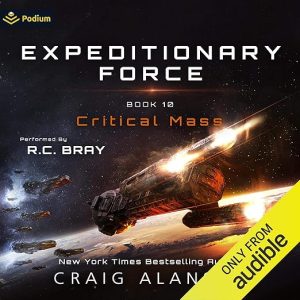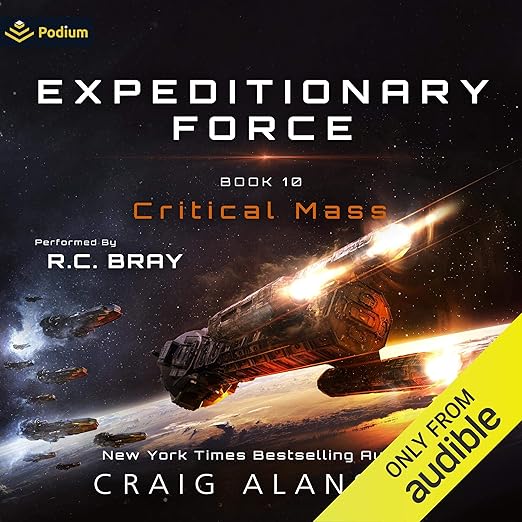
Ten books into a series, most authors are managing a franchise rather than writing a novel. Craig Alanson is doing something more awkward and more interesting in this audiobook: the Merry Band of Pirates come out of their last mission in serious trouble, and hostile aliens have noticed that the galaxy's wormholes behave strangely. Their investigation could hand them a shortcut to Earth. Nineteen hours and twenty-five minutes of consequence follows from that single discovery.
My own surprise was how much of the appeal still rests on two characters talking. Joe Bishop and Skippy the Magnificent, an artificial intelligence of considerable antiquity and even greater vanity, remain the reason to be here. Reviewer Patrick J. O'Connell calls them "absolutely laugh-out-loud hilarious", and after ten volumes that is not a given. Comic double acts usually calcify by this point in a run. This one apparently has not, and holding a joke alive through ten volumes is a harder feat than inventing it was.
What Craig Alanson Delivers
Recovery is the story of this installment, at least according to the reader least inclined to flatter it. SB, at four stars, writes that Alanson "at least leaves the story in a much better place" after the previous book, and adds that it has "also gotten more interesting again after sputtering along in the last couple of books from one disaster to another, ad nauseam". Coming from someone actively annoyed with the author, that is a meaningful endorsement of book ten specifically.
The physics is real enough to matter. Patrick J. O'Connell credits Alanson with "an interesting, imaginative storyline which will interest hard core science and physics enthusiasts" while noting that "he also has a great sense of humor", and holding both at once is the series trick. Laura Merryman describes "philosophical what ifs" alongside the twists, which is a fair account of a book whose central threat is a navigational property of wormholes rather than a fleet on a map. Threats built out of physics rather than firepower age better than most, and they give a comic novel somewhere serious to stand.
What Craig Alanson Gets Right
R.C. Bray narrates, and for once a reviewer here says so directly. Patrick J. O'Connell writes that "RC Bray is an outstanding performer and he makes the audiobook entertaining beyond belief", which is the clearest performance verdict in this pool and the reason many listeners commit to nineteen-hour installments of a ten-book series at all. The same review admits to nearly quitting during book one, recalling the thought that "this is just a weird, cheesy story", and to being glad of sticking with it. Both halves of that are worth hearing.
Satisfaction is the other selling point, and Gordon Lang makes an unusually honest case for it. Five stars went up alongside the admission "I really feel that it should only be 4", with the lift coming from feeling "satisfied and happy with how things progressed and resolved". A second pass through the book had already begun, hunting details missed the first time. A reader going straight back through a nineteen-hour book is a stronger signal than any adjective could be, and it is the kind of detail I trust more than a star rating.
Series momentum is genuinely powerful here, and Joe Rudd's review is the evidence. Starting in September 2024, that reader reports reaching book sixteen of eighteen and finding the whole thing almost impossible to put down. That is a reader consuming a very long space opera at speed, which tells you the installments keep working rather than merely continuing, and no marketing department could manufacture that particular kind of evidence. One practical note as well: the listing states an accompanying PDF comes with the audio, so look for it rather than assuming the recording is everything you bought. Series this dense with hardware and alien factions often use such documents for reference material, and it costs nothing to check.
Where Craig Alanson Loses Some Ground
Do not start here. Book ten opens directly on the aftermath of book nine, and SB's whole reason for continuing was the cliffhanger the previous volume ended on, called there "a cheap and dirty way to treat your readers" even as it plainly worked. A newcomer would arrive with no relationship to Joe, no history with Skippy, and no memory of the disaster being cleaned up. Ten volumes of accumulated running jokes are also load-bearing by this stage, and a joke you have not heard set up is simply a sentence that makes no sense. Gordon Lang's five-star review turns on recognizing a callback the text pointedly declines to explain, which is precisely the pleasure a first-time listener cannot access.
Prose quality is the recurring complaint, and one reviewer puts it in the headline rather than burying it. SB heads that review with the observation that the story is good but the sentence structure needs work, and that is a fair summary of the trade this series asks you to accept: inventive plotting and excellent comic timing wrapped in writing nobody would call polished. Listeners who wince at clumsy construction should know the audio format smooths some of this and cannot hide all of it.
Numbers on this listing are close to meaningless and I would ignore them outright. A 4.7 average rests on four logged scores, which is fewer than the written responses sitting directly beneath it, and by any reasonable measure a tenth volume that readers are consuming at Joe Rudd's pace has reached vastly more people than four. The counter is capturing a sliver of the real audience rather than a verdict from it. Read what people actually wrote and disregard the figure entirely.
Who Should Pick Up Critical Mass
Existing Expeditionary Force listeners have no decision to make, particularly those left stranded by the previous cliffhanger, and the pool suggests this installment repairs some goodwill the preceding volumes spent. Beyond them, the series suits listeners who want military science fiction with genuine comic writing rather than grim competence, and anyone who enjoys hard science handled lightly enough to stay entertaining across nineteen hours.
Newcomers should begin at book one, and be warned that even a devoted reader here nearly abandoned the series early on. Listeners who need polished prose will find the sentence-level work uneven, on the evidence of the review that leads with exactly that complaint. And anyone allergic to serialized storytelling should note this is a tenth installment in an eighteen-book run, on one reader's count, which is a commitment measured in weeks rather than evenings.
The Short Version
- Voice: R.C. Bray draws the only direct performance verdict in this pool, where one reviewer calls him an outstanding performer who makes the recording entertaining beyond belief.
- Big ideas: wormhole physics as a weapon, a comic double act under pressure, humanity's exposure, long-form space opera
- Atmosphere: Funny and fast for nineteen hours, with the stakes tightening underneath
- Worth it?: A recovery installment that wins back readers the previous volumes tired out, and no place at all to start.
Can I start this audiobook at book ten?
No, and nothing in it is designed to let you. Events pick up straight from the previous mission with no reintroduction of the crew or the situation they are digging out of. One five-star response even hangs on spotting a wink back to an earlier book, deliberately left unexplained, and that is a pleasure no newcomer can reach.
Does the series feel tired by this point?
The reviews suggest the opposite for this volume. SB, the most critical voice here, says the story lands in a much better place and had gotten more interesting again after a couple of weaker books. Laura Merryman calls it one of the best in the series, and Gordon Lang went straight back for a second pass.
What do listeners say about R.C. Bray's audiobook narration?
Patrick J. O'Connell calls him an outstanding performer and credits him with making the audiobook entertaining beyond belief. No other reader in this group grades the recording at all, but that verdict is emphatic, and it comes from someone who freely admits he almost gave up on the series during the first volume.
Should the rating on this listing influence my decision?
Not really. Only four scores sit behind it, fewer than the written responses on the same page, and one reader reports racing deep into the run within a year of starting. That points to an audience far larger than the counter has captured, so judge this one on what people wrote rather than what the number says.