- Performance: Jayne Entwistle is exceptional with child protagonists, bringing Maeve and her companions to life with emotional restraint and genuine warmth rather than performed cuteness.
- What it covers: Friendship, loyalty, found family, the ethics of magical power, and the specific courage required of children navigating adult-scale crises in a Victorian world.
- Feel: Warm and adventurous, with genuine tension and enough wit in Berry's prose to keep adult listeners as engaged as the younger audience the book is written for.
- Our call: A strong sequel that benefits from established characters and a narrator who elevates the material; the audiobook format is the best way to experience this series.
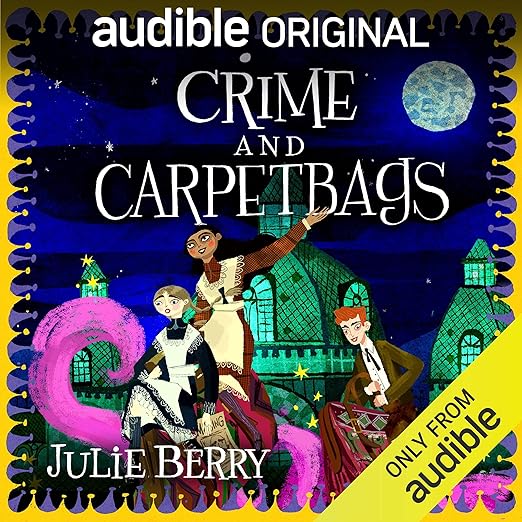
Julie Berry's series craft shows in how the second Wishes and Wellingtons audiobook opens: the world already built, the characters already known, and Maeve Merrit's voice already carrying the weight of a protagonist who has learned something since book one. Crime and Carpetbags is narrated by Jayne Entwistle, who brings to Maeve the same quality she brings to other child protagonists in the audiobook space: an emotional presence that is fully felt without being overcalculated. Entwistle does not perform childhood; she inhabits it, and the distinction matters across nine hours of Victorian adventure fiction.
What We Made of It
Maeve Merrit has surrendered Mermeros, the djinni she found in a sardine can in the first book, and expects to return to the ordinary dullness of Victorian London. Mermeros has other plans. When Tommy's newly adoptive father attempts to use one of the djinni's wishes, both father and djinni vanish, leaving Tommy without a guardian and facing return to the orphanage. Maeve, Tommy, and Alice launch into an adventure involving magic, danger, and the novel's titular flying carpetbags to rescue both Tommy's father and the djinni they have come to care about. Berry's structural achievement in this series is that the magical elements are genuinely playful and inventive rather than formulaic, and the mundane elements, including lessons, sisters in courtship, and London street life, are woven into the adventure with enough specificity to make the world feel grounded rather than merely decorated. The second book, as several reviewers have noted, benefits from the reader's already-established affection for the characters; Berry spends less time on setup and more on movement, which improves the pacing considerably over book one and allows the adventure to begin in earnest without the world-building overhead of a series opening. The djinni Mermeros has developed enough character of his own across both books that his disappearance functions as a genuine loss for the reader as well as the protagonists, which is a harder trick to accomplish than it appears.
Why Crime and Carpetbags Works as an Audiobook
Entwistle's narration is the critical ingredient that elevates this audiobook above a simple middle-grade adventure. Her work with child protagonists is consistently marked by a quality of emotional restraint that allows the characters to feel genuinely young without being condescending. Maeve's combination of confidence, cleverness, and occasional miscalculation comes through in Entwistle's reading as something textured and real rather than a collection of stock middle-grade traits. The Victorian setting is rendered through word choice and period-accurate detail rather than heavy exposition, and the result is a listen that works for both children and adults who enjoy well-constructed historical adventure fiction. Reviewers have noted Berry's fun wordplay and language, and Entwistle delivers that wordplay with the timing it requires. The flying carpetbags of the title are pure invention, but they are grounded in enough magical logic that they function as genuine plot devices rather than whimsy for its own sake. The combination of a specific historical setting, a magical system with clear rules, and protagonists who feel like real children navigating adult-scale problems gives this audiobook a satisfying density that middle-grade fiction does not always achieve.
What Might Not Land
Listeners who haven't listened to the first book in the Wishes and Wellingtons series should start there. While Crime and Carpetbags recaps the essential backstory reasonably efficiently, the emotional investment in Maeve, Tommy, Alice, and Mermeros is substantially richer when built from the beginning. The series is not long; starting at book one is the right approach and not a significant time commitment relative to the payoff. The mystery elements, while genuinely engaging, are pitched at a middle-grade level; adult listeners expecting complex crime plotting in the vein of adult historical mystery fiction will find the narrative mechanics appropriately simplified. The book's warmth and wit are its primary virtues rather than suspense or narrative complexity, and listeners who come for those qualities will not be disappointed. Entwistle's narration is the audiobook's strongest argument over the print edition; if you plan to experience this series in any format, audio is the version that makes the most of what Berry has built.
Should You Listen to Crime and Carpetbags?
Middle-grade readers, roughly ages eight to thirteen, who enjoy Victorian adventure fiction, magical elements grounded in period settings, and ensemble casts will find this a deeply satisfying listen. Adults who enjoy listening to well-narrated children's fiction will find Entwistle's performance alone worth the time. The series sits in good company with Frances Hodgson Burnett's work and with contemporary middle-grade authors like Eva Ibbotson for its combination of adventure, magic, and genuine emotional stakes. If you have already enjoyed the first Wishes and Wellingtons book, Crime and Carpetbags is the clear and confident continuation you should expect, and Entwistle's narration makes this the rare sequel that improves on the audio experience of its predecessor. Berry has also given this series something that middle-grade adventure fiction frequently lacks: a genuine sense of consequence. The orphanage as a threat to Tommy's future is not abstract; it is a specific, period-accurate institution with the weight of a real place where real children ended up, and Berry's willingness to let that threat carry its full gravity gives the adventure stakes that feel genuine rather than genre-safe. Entwistle's narration handles those tonal shifts between whimsy and genuine stakes with the same restraint she brings to the character work, never allowing the darker undercurrents to overwhelm the book's fundamental warmth but never softening them into mere decoration. The Wishes and Wellingtons series deserves a wider audience than middle-grade fantasy typically receives, and the audiobook format, with Entwistle at its center, is the best argument for that broader attention. Listeners who have not yet encountered this series have something genuinely worthwhile ahead of them.
A Few Questions About Crime and Carpetbags
Do I need to listen to the first book before this audiobook?
Yes, strongly recommended. Crime and Carpetbags provides some recap, but the characters' emotional weight and the world's rules are best established by starting with the first Wishes and Wellingtons audiobook.
Is this audiobook appropriate for adult listeners or is it strictly for children?
Adults who enjoy well-crafted historical adventure fiction and middle-grade literature will find this genuinely satisfying. Entwistle's narration adds value for listeners of all ages, and enjoyment of the series is not limited to its target age group.