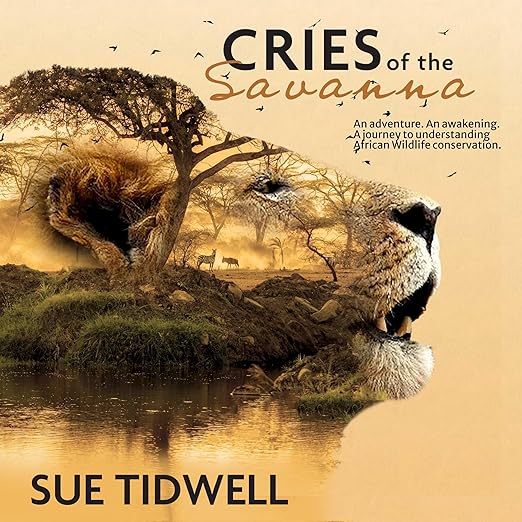
In Brief
- Voice: Sue Tidwell reads her own memoir with warmth and dry self-awareness; the embedded ambient sounds of lions, hippos, and elephants add genuine atmosphere without feeling gimmicky.
- Big ideas: Wildlife conservation, hunting ethics, outsider perspective
- Atmosphere: Vivid and thought-provoking, laced with humor
- Worth it?: A safari memoir that earns its complexity by refusing to take easy positions on hunting, conservation, or the Africa of the imagination.
I came to Cries of the Savanna with every expectation of a familiar kind of travel writing: the wide-eyed Westerner arrives on the continent, has some transformative animal encounters, goes home changed. I was halfway through a Saturday afternoon, doing the aimless housework that earns an afternoon of listening, when the story's real subject finally clicked. Sue Tidwell is not writing about Africa as spectacle. She is writing about the moment when everything you thought you believed gets tested against unforgiving ground, and about what survives that testing.
Tidwell traveled to Tanzania as a self-described non-hunter, deeply conflicted about her husband's three-week big game safari. She does not pretend that conflict resolved itself cleanly or quickly. That honesty is what sets this memoir apart from both the conservation-advocacy genre and the hunting-adventure genre. She is too honest for either camp to claim her fully, which is exactly the right place from which to tell this kind of story.
A Closer Look at Cries of the Savanna
The set pieces in Cries of the Savanna are genuinely tense. Cape buffalo are described in the hunting literature as among the most unpredictable and lethal animals a person can track on foot, and Tidwell conveys that physicality with real skill. The middle-of-the-night warning her husband delivers, a simple quiet sentence about getting ready to run, lands with exactly the low-key dread it deserves. She does not inflate it into melodrama. She trusts the situation to carry the weight, and it does.
The audiobook production uses ambient sounds from the African bush at several points, including lions, hippos, and elephants. I was skeptical of this choice before I started listening, half-expecting something cheap and distracting. In practice the sounds are deployed with restraint and work better than anticipated. They ground the listener in the landscape without pulling focus from Tidwell's voice, which is unhurried and conversational in a way that suits the memoir perfectly. She also notes that a companion PDF is available in your Audible Library, which adds visual material for listeners who want to see the places she describes.
What Makes Cries of the Savanna Worth Hearing
What lifts Cries of the Savanna above a simple adventure account is Tidwell's sustained engagement with the ethics of what she is witnessing. The argument several reviewers highlight, and the one the book develops most carefully, concerns how conservation funding actually works in Tanzania. Subsistence farmers whose crops are routinely destroyed by elephants and lions have no economic reason to protect those animals unless the animals represent direct value to the local community. Regulated hunting safaris, when managed properly, create exactly that value through licensing revenue, local employment, and meat distribution to communities that need it.
Tidwell is careful not to present this as a settled debate. She came in skeptical and her skepticism never entirely dissolves. But she does come face-to-face with Tanzanian perspectives she had never previously considered, particularly from the people of Masimba Camp, and she reports those perspectives with the same honesty she brings to her own discomfort. One reviewer described the book as equally recommendable to his hunting buddies and to his mother, which captures the unusual tonal balance Tidwell achieves. That balance is genuine rather than performed.
Things to Know Before Starting Cries of the Savanna
Author-narrated memoirs live or die by whether the author can actually read aloud. Many cannot. Tidwell can. Her pacing is natural rather than performed, and the self-deprecating humor that runs through the prose comes through clearly in her delivery. There are moments of genuine comedy, particularly in the early sections when her non-hunter's ignorance puts her at odds with the expectations of the professional hunting guides around her, and Tidwell reads those passages with exactly the right touch of wry understatement.
The memoir does not pretend to resolve the hunting debate, and listeners who arrive expecting either a ringing endorsement or a conversion-narrative rejection will find neither. What they will find is a sustained and honest reckoning with a world most readers will never visit. At nearly fifteen hours, the runtime is substantial, but Tidwell earns it. The journey through Tanzania's remote valleys and open savanna unfolds at a pace that feels lived rather than compressed.
Who Sue Tidwell Is Writing For
Listeners who enjoy travel memoirs with real ethical substance, the kind of book that sits closer to Ryszard Kapuscinski than to a glossy safari brochure, will find Cries of the Savanna rewarding. Readers drawn to African wildlife conservation debates from any angle, whether hunting background or environmentalist, will find that Tidwell is genuinely engaging with their concerns rather than dismissing them. Listeners who are firmly opposed to hunting in any context will encounter arguments here they may not have expected to find worth considering, which is either a selling point or a warning depending on where you stand.
Do I need to support or oppose hunting to get value from Cries of the Savanna?
No. Tidwell herself entered the safari as a non-hunter opposed to hunting, and the book tracks her genuine uncertainty rather than arriving at a clean verdict. Readers on both sides of the debate have praised it, often for different reasons.
How are the ambient African bush sounds integrated into the audiobook?
The production includes authentic sounds of lions, hippos, and elephants at select moments. Tidwell notes in the synopsis that listeners should try the sample to hear them. Most listeners find the sounds atmospheric rather than distracting.
Is this the first book in the African Safari Adventures series, and does it work as a standalone?
Yes on both counts. It functions as a complete standalone memoir and requires no prior reading, though Tidwell has indicated the series continues with additional African experiences.
How does Tidwell handle the economics of wildlife conservation versus subsistence farming?
It is one of the book's central threads. She examines how regulated hunting creates financial incentives for local communities to protect wildlife, in contrast to situations where large animals are seen only as threats to crops and livelihoods.