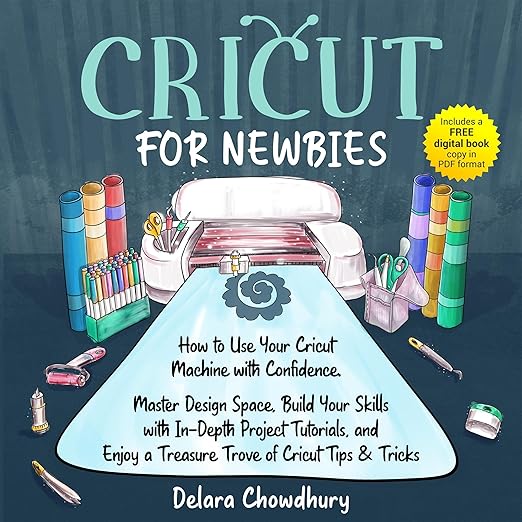
Cricut crafters buy a machine first and a manual second, and the manual usually gets bought after the machine has already been shoved in a cupboard. That sequence is what this audiobook is built around. Delara Chowdhury's guide runs five hours and twenty-six minutes, is read by Jessie Clark Funk, and treats the Joy, the Explore Air 2, the Explore 3, the Maker and the Maker 3 as five different machines with five different sets of quirks. It is a manual, and somebody decided a manual should become a recording.
One Counted Vote Somehow Produces a 4.6
Five written responses sit under this listing, dated between May 2022 and January 2026, which is nearly four calendar years of accumulation. The rating badge reads 4.6 across a counter that says one. A single vote can only be a whole number of stars, so 4.6 is not something one person gave; that number is describing a population the page is not showing you. Read the five you can see and they average 4.8 between them, which puts the readable column on the high side of the number it supposedly produced, and that is the opposite of how these mismatches usually run. Whatever the counter is measuring, it is not the people who bothered to write, and a buyer scanning for social proof will see the number rather than the column.
Design Space is the real subject here, more than the machines are, and the most recent response on the page makes the necessary caveat without being asked. That five-star, filed in January 2026, states that the software has been updated since the book was written and calls the explanations helpful and relevant anyway. It is an honest thing to know before buying a 2022 guide to a program that ships changes continuously. The publisher field on this record carries the author's own name, which means no revised edition was ever going to arrive on somebody else's schedule. The series field calls this The Cricut for Newbies Collection and numbers it one, which is an optimistic label for a shelf that currently holds a single title.
Funk Turns Menu Clicks Into Spoken Sequence
Reading a software manual aloud carries a specific difficulty, and Jessie Clark Funk is the one handling it: panel names, button labels, menu positions and an ordered sequence of clicks all have to arrive as speech, in order, at a speed a listener can hold in their head. The description was clearly adapted for the format rather than dumped into it, because the pitch line reads in these minutes where the print version would have said in these pages. Small sign, real one. Somebody looked at this text and thought about what it was becoming. Whether that thinking extended past the pitch line is the open question, because the contents the description advertises include go-to cheat sheets and step-by-step projects, which are formats rather than passages.
One five-star from May 2022 is the best argument on the page for the book's approach. It describes buying a Cricut on impulse as a lifelong crafter, failing to make the thing work, leaving it to gather dust in an office, and finally deciding it was use it or sell it. That is precisely the emotional position this guide is written for, and it explains why the opening chapters spend their time on reassurance rather than on features. The book is aimed at guilt as much as at ignorance, which is an unusual and rather generous thing for a technical manual to do. The five topic promises the copy makes are ordered the same way: machines first, operation second, software third, and only then the projects that most buyers actually want.
Even the Print Reader Got a Little Lost
Datedness is one risk; the other is that some of this material simply cannot be heard. The pool's only four-star, from June 2022, praises the coverage of machine types and the author's introduction about getting lost, then says plainly that a bit of getting lost still happened while reading it. If a reader with the text in front of them lost the thread, a listener without it is working at a disadvantage. The description does promise an accompanying PDF delivered alongside the audio, which helps considerably, though a PDF is a separate file you have to open, and the entire promise of this format was that your hands would be free. Anyone buying this expecting to craft while listening should plan for the PDF to be open on something with a screen anyway.
Australia supplied the most enthusiastic response of the five, an August 2022 five-star recommending the book to beginners, experienced users, people who have just bought a machine and people who are only thinking about buying one. Enthusiasm that broad is not a sharp signal. It is also worth noticing what every one of the five responses is describing: a book, pages, reading, following along in print. The cheat sheets and the step-by-step tutorials are the components most likely to have lost something on the way into audio, and they are also the components the pool praises most warmly. The description closes with an instruction to click the add to cart button, which is retail copy for a storefront rather than anything a narrator can usefully say aloud, and it survived the crossing untouched.
Wait for a Screen When You Reach Design Space
Owners who already have a machine on the table and want one orientation pass are the clear audience. A July 2024 five-star describes buying a first Cricut three days earlier, wanting more explanation than the box supplied, and finishing this book in a single sitting, which five and a half hours comfortably allows. If you want the difference between the Joy and the Maker explained in plain language before you commit to blades, mats and vinyl, this does that job well and without condescension. The promise of free creative resources is the other genuinely portable part, since knowing where to look costs nothing to hear.
Wait for a screen if what you actually need is Design Space itself. Software instruction is a visual discipline, and no amount of clear speech replaces watching where a menu lives and what happens when you drag one shape onto another. Buy this to understand the machines, the materials and the vocabulary, then open the PDF and the software together when you reach the projects. Treated as an introduction rather than as a workbench companion, it holds up considerably better than a 2022 date on a software guide has any right to.
Before You Press Play
- Performance: Jessie Clark Funk takes on a text made of menu names and click sequences, one of the harder briefs in instructional audio.
- What it covers: Cricut machine selection and setup, Design Space fundamentals, beginner project walkthroughs
- Feel: Reassuring and hand-holding, aimed squarely at the intimidated
- Our call: A genuinely warm beginner orientation whose most useful chapters are the ones a screen would serve better.
Are the cheat sheets and project instructions part of the audiobook?
The description promises an accompanying PDF delivered with the audio, which is the only plausible home for the printable material it advertises. Nothing on the record describes that file's contents or length, so treat it as unverified until you have it open in front of you. The audio alone will not walk you through a cut.
Which Cricut machines does this audiobook actually cover?
Five are named in the description, running from the smallest of the Joy models up to the largest Maker. Coverage extends to setup, materials and the accessories that ship in the box. Machines released after July 2022 fall outside its scope, since that is when this edition was published.