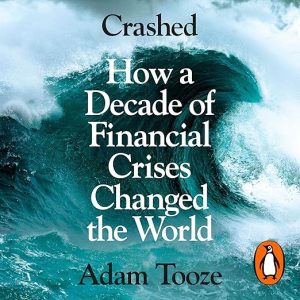
September 2008, and the floor gives way. In the days after Lehman Brothers collapsed, Adam Tooze's eventual subject became visible in a new way: not just a banking failure but a stress test for the entire post-Cold War financial and political architecture of the West. The audiobook edition of Crashed is read by Simon Vance across 25 hours and 27 minutes, with an introduction read by Tooze himself - an arrangement that pays off, because Tooze's own voice anchoring the framing gives the extended performance a sense of authorial intention before Vance takes over the work of making 600-plus pages of economic history legible in audio. Vance is equal to that task in ways that matter considerably for this particular book.
Tooze Refuses to Treat This as Only American
What separates Tooze from other writers who have covered the 2008 crisis is his refusal to treat it as primarily an American story with European footnotes. The book covers the collapse through the lens of political economy, tracing how the Federal Reserve, European Central Bank, and national governments in Germany, France, Greece, and Ukraine all had different and often competing definitions of what rescue meant, what it should cost, and who should bear those costs. As one reviewer accurately described it, Tooze handles "economics, finance, politics, diplomacy, public policy, housing, discrimination, trading platforms" - and this comprehensive scope is both the book's greatest strength and its most significant demand on the listener.
The Eurozone sections are particularly valuable for American audiences. Listeners who absorbed the crisis through domestic media will find the European dimension illuminating in ways that complicate any simple narrative of rescue and recovery. The disputes between Germany and peripheral Eurozone nations over austerity conditions, the ECB's institutional constraints, and the political fallout in Greece all receive sustained treatment. By the time Tooze connects the crisis to Brexit and the rise of nationalist politics on both continents, the argument feels earned through accumulated evidence rather than imposed as a conclusion. This is not hindsight analysis - Tooze is mapping a chain of cause and consequence that holds up to scrutiny.
Several reviewers note the book could be shorter, and in a narrow sense this is accurate - there are passages of institutional detail that feel more encyclopedic than argumentative. But the length is also precisely what makes Crashed authoritative in a way that shorter accounts cannot be. Tooze is not interested in the compelling condensation that most crisis journalism provides. He is interested in showing how the full system worked, and how it failed, which requires accounting for more moving parts than most writers are willing to track simultaneously across multiple continents and institutions.
Vance Carries Authority Without Pomposity for 25 Hours
Simon Vance is one of the few narrators who can sustain listener engagement across a 25-hour dense nonfiction text without the performance becoming either rote or theatrical. His voice carries authority without pomposity - he reads Tooze's most complex sentences with the clarity of someone who understood the text before recording it, placing emphasis at structurally meaningful points rather than simply stressing dramatic words. The author's introduction, read in Tooze's own voice, provides a useful contrast: Tooze reads with the cadence of an academic used to addressing rooms full of experts, and Vance's professional precision is not just preference but functional necessity for a text this analytically demanding.
The political horror story framing in the synopsis is not hyperbole. Tooze traces how the billions conjured to prevent complete collapse did not vanish after stabilization but continued reshaping political landscapes - austerity politics, sovereign debt crises, and eventually the electoral disruptions of 2016 in the UK and US. For listeners trying to understand why democratic institutions seemed to fracture in the decade following the financial crisis, Crashed provides the most rigorous connective tissue available in audio form. The argument is not that the bailouts caused the political ruptures directly, but that the conditions they created - who bore costs, who received protection, which institutions survived intact - shaped the political terrain in ways that had specific electoral consequences.
Swap Lines and Repo Markets Demand Attention
Listeners who are not already comfortable with macroeconomics vocabulary - swap lines, repo markets, sovereign spreads, current account deficits - will find the early chapters demanding. Tooze does not write for a general audience in the way that Michael Lewis does. This is economic history written for people who are willing to do the work, and the audio format does not flatten that complexity. However, listeners who have bounced off other accounts of the 2008 crisis for being too simplified may actually find Crashed more accessible than expected - Tooze's explanatory instinct is strong even when his vocabulary is technical, and he constructs arguments that reward effort rather than just delivering information.
The sheer runtime is the most honest warning this review can offer: 25 hours and 27 minutes is a commitment, and listeners who start it as background audio will lose the thread quickly. It rewards full attention, and the reward is commensurate with that attention. Treating it as a week-long sustained reading rather than background listening is the correct approach.
Those Curious About Europe's Debt Crisis Benefit Most
This audiobook is for listeners who want a historian's account of the 2008 crisis and its political aftermath rather than a journalistic narrative or a personal story of individual bankers and traders during the collapse. It is particularly valuable for those curious about the European dimension - how the Euro crisis, Greek debt, and austerity politics emerged directly from the same dynamics that produced the American banking failures. Listeners seeking a quick overview, an emotionally engaging character-driven narrative, or a book that resolves into clear moral judgment will find Tooze's structural approach too demanding. Those willing to give 25 hours to the most complete available account will find that investment repaid across multiple rereads.
Key Details
- Performance: Simon Vance is the benchmark for serious nonfiction audiobook performance, and Crashed is one of his strongest readings. Tooze's dense prose requires a narrator who can manage clause-heavy sentences without losing the listener's thread, and Vance does this with uncommon consistency across 25-plus hours.
- What it covers: The 2008 financial collapse, political consequences of economic rescue, democracy under stress from financial crisis
- Feel: Dense and relentless, like a very good long-form investigation that refuses to simplify
- Our call: For listeners who want the fullest single-volume account of how the 2008 crash happened, who managed it, what it cost, and what it left behind in European and American politics, Adam Tooze's 25-hour audiobook is the most complete treatment available.
A Few Questions About Crashed
Is the Crashed audiobook suitable for listeners without a finance background?
It is a demanding listen for anyone unfamiliar with macroeconomic concepts, but Tooze is a skilled explainer who defines his terms carefully. The greater challenge is the density of political and diplomatic history running in parallel with the financial analysis. Dedicated general readers who are willing to stay attentive across a long runtime have managed it - the technical vocabulary is a hurdle but not an absolute barrier.
How does Simon Vance handle the technical density of Crashed in his narration?
Vance is one of the few narrators with the technical precision this kind of text requires. He manages long, complex sentences without losing listener orientation, and his pacing gives difficult passages space to land. At 25-plus hours, maintaining this consistency is a genuine performance achievement and one of the primary reasons this audiobook is worth choosing over reading the print edition.
Does this audiobook cover both the American and European responses to the 2008 financial crash?
Yes - and this is one of the book's defining qualities. Tooze treats the Eurozone crisis, Greek debt politics, and the divergent policy choices of Germany and peripheral European nations with the same depth he gives the American Federal Reserve response. This dual-continent scope is what makes Crashed distinctive relative to other accounts of the same period.
Is the audiobook of Crashed still relevant given it covers events from 2008?
Substantially yes. Tooze's core argument - that the political consequences of the financial rescue continue to shape democratic instability in Europe and the US - has gained rather than lost relevance since publication. The book was released in 2018 and its analysis of Brexit and nationalist politics remains accurate as a structural account of how those movements gained their fuel.