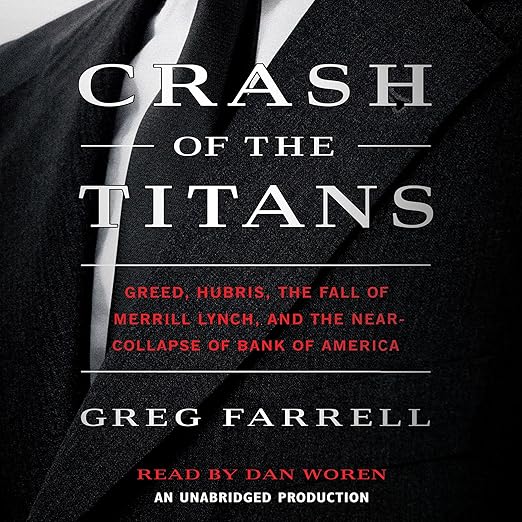
Crash of the Titans
Audiobook & Ebook

Crash of the Titans by Greg Farrell | Free Audiobook

By Greg Farrell

Narrated by Dan Woren

🎧 16 hours and 24 minutes 📘 Random House Audio 📅 November 2, 2010 🌐 English
🎧 Listen Free on Audible 📖 Read on Kindle

Free 30-day trial · Cancel anytime

About This Audiobook

The intimate, fly-on-the wall tale of the decline and fall of an America icon

With one notable exception, the firms that make up what we know as Wall Street have always been part of an inbred, insular culture that most people only vaguely understand. The exception was Merrill Lynch, a firm that revolutionized the stock market by bringing Wall Street to Main Street, setting up offices in far-flung cities and towns long ignored by the giants of finance. With its “thundering herd” of financial advisers, perhaps no other business, whether in financial services or elsewhere, so epitomized the American spirit. Merrill Lynch was not only “bullish on America,” it was a big reason why so many average Americans were able to grow wealthy by investing in the stock market.

Merrill Lynch was an icon. Its sudden decline, collapse, and sale to Bank of America was a shock. How did it happen? Why did it happen? And what does this story of greed, hubris, and incompetence tell us about the culture of Wall Street that continues to this day even though it came close to destroying the American economy? A culture in which the CEO of a firm losing $28 billion pushes hard to be paid a $25 million bonus. A culture in which two Merrill Lynch executives are guaranteed bonuses of $30 million and $40 million for four months’ work, even while the firm is struggling to reduce its losses by firing thousands of employees.

Based on unparalleled sources at both Merrill Lynch and Bank of America, Greg Farrell’s Crash of the Titans is a Shakespearean saga of three flawed masters of the universe. E. Stanley O’Neal, whose inspiring rise from the segregated South to the corner office of Merrill Lynch—where he engineered a successful turnaround—was undone by his belief that a smooth-talking salesman could handle one of the most difficult jobs on Wall Street. Because he enjoyed O’Neal’s support, this executive was allowed to build up an astonishing $30 billion position in CDOs on the firm’s balance sheet, at a time when all other Wall Street firms were desperately trying to exit the business. After O’Neal comes John Thain,the cerebral, MIT-educated technocrat whose rescue of the New York Stock Exchange earned him the nickname “Super Thain.” He was hired to save Merrill Lynch in late 2007, but his belief that the markets would rebound led him to underestimate the depth of Merrill’s problems. Finally, we meet Bank of America CEO Ken Lewis, a street fighter raised barely above the poverty line in rural Georgia, whose “my way or the highway” management style suffers fools more easily than potential rivals, and who made a $50 billion commitment over a September weekend to buy a business he really didn’t understand, thus jeopardizing his own institution.

The merger itself turns out to be a bizarre combination of cultures that blend like oil and water, where slick Wall Street bankers suddenly find themselves reporting to a cast of characters straight out of the Beverly Hillbillies. BofA’s inbred culture, which perceived New York banks its enemies, was based on loyalty and a good-ol’-boy network in which competence played second fiddle to blind obedience.

Crash of the Titans is a financial thriller that puts you in the theater as the historic events of the financial crisis unfold and people responsible for billion of dollars of other people’s money gamble recklessly to enhance their power and their paychecks or to save their own skins. Its wealth of never-before-revealed information and focus on two icons of corporate America make it the book that puts together all the pieces of the Wall Street disaster.

🎧 Listen Free on Audible

Free 30-day trial · Cancel anytime

Quick Take

  • Narration: Dan Woren delivers a composed, authoritative read that suits the boardroom drama well, though he keeps emotional distance even during the book’s most operatic moments.
  • Themes: Corporate hubris, Wall Street culture, institutional failure
  • Mood: Dense and propulsive, with the slow-burn tension of watching a wreck unfold in real time
  • Verdict: If you want the most detailed account of Merrill Lynch’s fall and its chaotic merger with Bank of America, this is the one to reach for.

I came to Crash of the Titans after a weekend spent rewatching old documentary footage of the 2008 financial crisis. There is something about seeing those September days replayed that made me want the granular, behind-closed-doors version rather than the broad economic narrative I had already absorbed from a dozen other books. Greg Farrell promised exactly that, and I loaded up Dan Woren’s narration on a long train ride between cities, figuring 16 hours was about the right span for a story this sprawling. I underestimated how quickly those hours would pass.

What I found was something closer to a Shakespearean character study than a policy treatise. Farrell is not particularly interested in explaining credit default swaps. He is interested in the people who let $30 billion in CDOs accumulate on Merrill Lynch’s books because nobody had the authority or the backbone to stop it. That framing turns what could have been a dry financial autopsy into something genuinely propulsive, even if it occasionally loses the thread of the wider crisis in favor of insider gossip and personal detail. The subtitle, a Shakespearean saga of three flawed masters of the universe, is not marketing hyperbole.

Three Flawed Men at the Center of the Storm

The book’s real engine is its trio of protagonists, none of whom emerge well. E. Stanley O’Neal’s arc from the segregated South to the corner office of Merrill Lynch carries genuine weight, and Farrell does not gloss over the structural barriers he navigated on the way up. But O’Neal’s fatal error, endorsing a smooth-talking executive who then built a catastrophic CDO position without real oversight, reads as a failure of intellectual humility rather than malice. The contrast between his careful rise and his reckless exit is stark and unsparing in Farrell’s rendering.

John Thain, hired as rescue CEO in 2007 and nicknamed Super Thain after rehabilitating the New York Stock Exchange, gets a less sympathetic treatment. His belief that markets would rebound led him to chronically underestimate the depth of Merrill’s losses at the very moment when honesty was the only viable strategy. Then there is Ken Lewis, the Bank of America CEO who agreed over a single September weekend to acquire a business he, by Farrell’s account, barely understood, writing a $50 billion check that nearly dragged his own institution under. One reviewer compared the book to Wizard of Lies, noting both are ultimately about ego-driven power trips that masquerade as business decisions, and the comparison is exactly right.

The Cultural Collision That Nobody Prepared For

Where the book becomes almost darkly comic is in its portrayal of the post-merger culture clash. Farrell describes BofA’s Charlotte-based leadership as a good-ol’-boy network where loyalty to the hierarchy mattered more than competence, and Merrill’s slick New York bankers suddenly finding themselves reporting to people they privately compared to characters from the Beverly Hillbillies. This is blunt writing, and not everyone will find it entirely fair, but it captures something real about how organizational culture becomes a competitive disadvantage when circumstances change suddenly and radically.

Farrell’s sourcing is impressive throughout. One reviewer on Audible noted that you find yourself wondering how the author even obtained some of this information. The answer is that Farrell had unparalleled access to figures at both firms, and his details are specific enough to feel authoritative rather than reconstructed. When he reports that two executives were guaranteed bonuses of $30 million and $40 million for four months of work while Merrill was simultaneously shedding thousands of employees to reduce losses, the specificity of those numbers makes the reader stop and sit up straight.

What Dan Woren’s Narration Adds and Where It Holds Back

Dan Woren is an experienced narrator and he does not let the material down. His delivery is measured, never sensationalized, which is probably the right call for a book whose subject matter is already sensational enough on its own. He differentiates characters well enough that the shifting perspectives stay legible across 16 hours, and his pacing sustains momentum even through the denser financial passages. That said, in the more emotionally loaded moments, I occasionally wished for a slightly warmer register. Woren reads the whole thing as if testifying to a Senate committee, which is professionally appropriate, but the material sometimes calls for a touch of outrage or even black humor that he tends to smooth over. It is a minor complaint about a competent performance.

Who Should Listen and Who Should Pass

This audiobook rewards anyone who wants the ground-level, character-driven account of Merrill Lynch’s collapse and the Bank of America acquisition. It pairs well with Andrew Ross Sorkin’s Too Big to Fail and Michael Lewis’s The Big Short, filling in the Merrill-specific chapters those books only sketch. If you are already deeply versed in 2008 crisis literature and hoping for fresh economic analysis or systemic critique, you may feel that Ken Lewis remains frustratingly opaque throughout; Farrell acknowledges Lewis was less forthcoming than his colleagues, and the gap shows. But for anyone wanting to understand how a firm that epitomized American optimism could collapse in a matter of months, Crash of the Titans delivers with uncommon specificity and narrative drive. It is the book that focuses most tightly on the people responsible and what they were actually thinking as the walls came down around them. The Shakespearean framing in the subtitle is not an accident; this is a story about character flaws playing out at civilizational scale, and Farrell is a capable guide to why that matters beyond the financial numbers.

Frequently Asked Questions

Do I need to know the details of the 2008 financial crisis before listening to Crash of the Titans?

Not really. Farrell focuses on the personalities and internal decisions at Merrill Lynch and Bank of America rather than on broad macroeconomics, so the story is accessible even if your knowledge of CDOs and mortgage-backed securities is limited. That said, background familiarity will deepen your appreciation of the stakes involved.

Is this book sympathetic to any of its three central figures: O’Neal, Thain, or Lewis?

Farrell gives O’Neal the most nuanced treatment, acknowledging the structural barriers he overcame before reaching the top. Thain and Lewis come off considerably less well. The book is investigative journalism rather than advocacy, and Farrell does not shy away from depicting all three as men whose blind spots contributed directly to the catastrophe.

How does Crash of the Titans compare to other 2008 crisis audiobooks like Too Big to Fail or The Big Short?

It is narrower in scope and deeper on its specific subject. Where Sorkin covers the full cast of Wall Street actors and Lewis focuses on the short sellers who saw the collapse coming, Farrell stays tightly focused on Merrill Lynch and Bank of America. It is the best single account of that particular institution’s fall.

Does Dan Woren’s narration work for a book covering so many named executives and internal meetings?

Yes, largely. Woren keeps the large cast of characters distinct and his pacing makes 16 hours manageable. He is a composed rather than dramatic narrator, which suits the journalistic tone of the writing, though listeners who enjoy more performative readings may find him a touch flat in the book’s most charged scenes.

Ready to listen?

🎧 Listen to Crash of the Titans for free

Free 30-day trial · Cancel anytime

What Listeners Are Saying

★★★★★

detailed but very readable recollection of the demise of ML

Very enjoyable book. Detailed to the point that you wonder how the author even got this information and wonderfully written and tone and content to keep you reading. Really enjoyable. Would have been good to learn more about Ken Lewis but I'm guessing he wasn't as forthcoming as some of…

– Kevin H
★★★★☆

Hubris once again destroys a career and reputation, not to mention a storied company.

Farrell has written a very detailed and insightful overview of the events around Bank of America's purchase of Merrill Lynch. As with many of the books written on the financial crisis it details how ignorance around the basic principles of prudent risk management resulted in catastrophic events. Whether the ignorance…

– G. Elston
★★★★★

A Blue Chip Book – Triple A Rated!

If you have any interest in the inner workings of a major Wall Street firm, how certain people make it to the top of a cutthroat, backstabbing business, and how they manage to stay on top; then this is the book you must read. I have read several books about…

– Joe in New York City
★★★★★

Great Sad Account

Well written financial read. I highly recommend especially if you have ties to Merrill Lynch or BofA. You will recognize many of the players from those dark financial days of 2008.

– Ann Loper
★★★★★

Excellent story of the BofA / Merrill Lynch saga

This book is a well written and detailed account of how Ken Lewis and his corporate culture turned the mighty BofA into a basket case on the public dole, partially by buying Merrill Lynch. This book does not have a strong novel-like storyline like Michael Lewis's books, but it's still…

– Amazon Customer

Start Listening: Crash of the Titans


Free 30-day trial · Cancel anytime

Alexandra Reed

Written by Alexandra Reed

Founder & Literary Critic