Quick Take
- Voice: Michael Fenton Stevens is credited as reader; no listener reviews are attached yet to confirm pacing or how many voices the recording handles.
- Big ideas: Wrong-bus mishap, alien boarding school, exam pressure with real consequences
- Atmosphere: Fast, comic, low-stakes peril dressed up in high-stakes trappings
- Worth it?: A low-risk pick for testing whether a young listener takes to audiobooks, though the 4.9 rating currently has no visible reviews behind it.
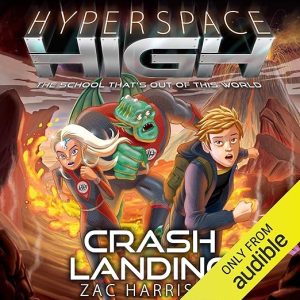
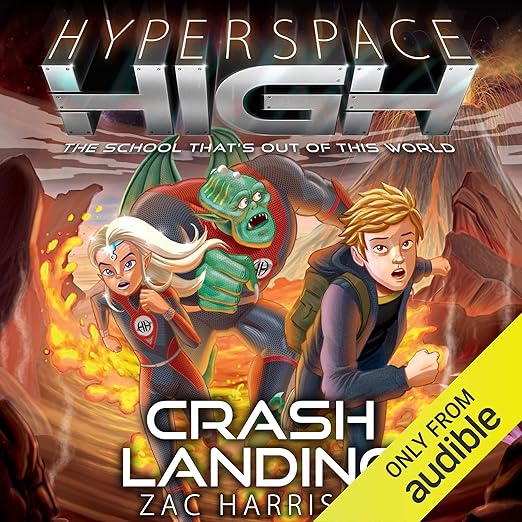
Crash Landing is a middle-grade audiobook built around one of the oldest engines a school story has: the wrong bus. John Riley boards it expecting an ordinary day and instead ends up at Hyperspace High, an academy tucked inside an enormous spaceship where the classmates are aliens, the food is described as disgusting, and failing an exam apparently carries real consequences. At three hours and fifty-five minutes, it asks for less than a single school week of car rides.
The setup does a lot of work in a short amount of time: a bus that takes a wrong turn, an academy in orbit, and stakes that sound genuinely uncomfortable for a middle-grade audience, the synopsis specifically calls the exam penalty harsh, not detention-harsh. That combination, school anxiety dressed up as an alien boarding-school comedy, is a dependable formula for readers around eight to eleven, kids who already know what it feels like to worry about a test without needing a spaceship to make the metaphor land. The synopsis doesn't explain how Riley ends up on that particular bus in the first place; it simply tells us he does, and the story picks up once the door closes on the wrong destination. Hyperspace High itself runs on a fairly ordinary school logic transplanted onto extraordinary furniture: exams, classmates, expectations, just with a nonhuman student body and a much higher ceiling for what a bad grade might cost him. Calling the food merely disgusting rather than describing a specific dish is a small choice, but it keeps the humor open-ended instead of locking the joke to one gag a listener either finds funny or doesn't; a narrator gets to decide how much disgust to put into that word every time it comes back around.
Michael Fenton Stevens is credited as the narrator, and that credit is essentially all the listing offers on the audio side. No customer reviews are attached to this title, leaving nothing to weigh against the name itself: no note on pacing, no note on how many distinct voices the story asks the reading to hold across a cast that includes at least one human boy and an unspecified number of alien classmates. For a book this short and presumably this dialogue-heavy, that is a real gap for anyone deciding whether to spend a credit here rather than sampling the clip first.
The Best Parts of Crash Landing
Length is the most practical selling point. At under four hours, Crash Landing asks for less commitment than the average middle-grade audiobook, which tends to run six hours or more once a story has earned itself a sequel. That makes it a reasonable pick for a parent who wants to find out whether a particular eight- or nine-year-old actually likes being read to through headphones before betting a whole series on the format. Nothing in the listing points to a sequel: no series name or number is attached to this title, so Crash Landing reads as a complete, contained story rather than the opening chapter of something longer. At $7.97, it is also priced like a low-stakes experiment rather than a full-series buy-in.
The premise carries most of the engagement on its own. John Riley is dropped into a school where he does not obviously belong, human at an alien academy, and the story leans on two concrete, kid-legible sources of tension: food he cannot stand and an exam system with real teeth. Those are easy-to-picture stakes rather than abstract ones, which tends to matter more for a listening audience than a reading one, where a wandering mind has no page to flip back to. A spaceship setting also hands a narrator plenty to work with vocally, alien classmates, in theory, invite distinct voices, even if nothing in what I was given confirms how well that opportunity actually gets used here.
Before You Commit to Crash Landing
A few things are worth flagging before you buy. The listing carries a page count of 155 and an ISBN, both print-book fields rather than audiobook ones, attached to what is otherwise an audio listing. That is not necessarily an error, print and audio editions sometimes share catalog data, but it means the page count is not a substitute for runtime; the number that actually matters here is three hours and fifty-five minutes. The publisher field (Stone Arch Books) and the language field (English) also carry a stray leading character that looks like a formatting leftover rather than intentional content, harmless, but a sign the underlying listing data hasn't been fully cleaned up.
More relevant to an actual buying decision: the 4.9 rating is built from 42 counted ratings, but none of the written reviews behind that number are visible in what I had to work with. That means I cannot tell you whether listeners are responding to the story, the reading, or something else, only that the aggregate number is high and the sample size behind it is real rather than a handful of early raters. If you want more than a number before committing a credit, the audio sample is your best bet, since the review text that would normally back up a 4.9 simply is not on the page.
Should You Listen to Crash Landing?
Crash Landing suits young listeners roughly eight to eleven who like school stories with a twist, kids who have outgrown picture books but still want something short enough to finish without pausing for days. It works well for a car trip, a rainy afternoon, or a first attempt at getting a reluctant reader interested in stories through their ears instead of their eyes; the runtime alone keeps the experiment low-risk. Caregivers looking for content that stays light should find comfort in a synopsis built around bus mix-ups and cafeteria complaints rather than anything heavier. The academic-pressure angle, real consequences for failing exams, gives the story a touch of stakes without tipping into anything a parent would need to preview first, and it gives a young listener something to actually root for beyond simple survival.
Pass on it if you are shopping for a young reader who wants a big, ongoing universe to sink into across multiple books: nothing here points to a sequel, and no listener reviews are attached yet to tell you how, or whether, this world expands beyond a single adventure. If your household needs some reassurance about pacing or read-aloud quality before spending a credit, the total absence of customer reviews on this listing means you will be relying on the sample clip alone, not on anyone else's experience.