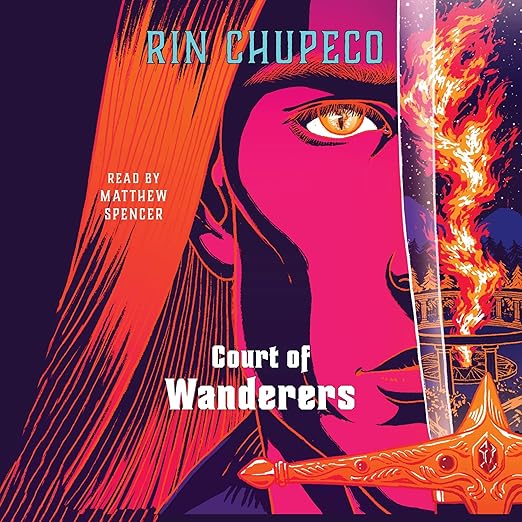
- Narrator: Matthew Spencer is credited by Simon & Schuster Audio for a cast running from a hunter to an empress who appears mostly in dreams.
- Subjects: Vampire court politics, a polyamorous alliance, a family legacy split between two parents.
- Tone: Gothic, bloody and talkative.
- Bottom line: Strong for readers of Silver Under Nightfall who want intrigue ahead of monsters, and a poor place to begin.
Fifteen hours and fifty-five minutes is a long stretch to spend with three people who cannot decide whether they are at war or in love, and that is the offer being made here. Rin Chupeco's second Reaper book puts a vampire hunter and two royal vampires back on the road through Aluria, with Simon & Schuster Audio crediting Matthew Spencer for the reading. This audiobook is also, on the evidence of its own listing, shelved under a single category that describes about half of what it is.
What We Made of It
Xiaodan is badly injured and has lost the powers that let her fight the Night Empress's new superbreed, so the journey works as a medical errand as much as a military one: reach Fata Morgana, seat of the Third Court, and try to restore her. MK French, writing five days after release and disclosing that the review first appeared at Girl Who Reads, lays all of that out cleanly and treats the book as a successful ending. Injury as a plot engine is an old device and a good one, because it puts a clock on a journey that would otherwise be scenery.
Remy Pendergast carries the harder thread. His father, the arrogant Lord of Valenbonne, turns up on the road, and dreams of the Night Empress keep arriving with too much detail to be dreams, because he has long suspected the Empress of being Ligaya Pendergast, his own mother. Family legacy as a literal choice between two parents drives the emotional plot, and it is a better structure than most middle volumes in this register manage to build.
Somebody should have proofread the description. It gives the vampire lord three separate spellings inside four paragraphs: Malekh when he is introduced, Malehk when his court is named, and Malek when Remy poses as his human familiar. On a page that is largely how a buyer decides, that is careless. In a recording it stops mattering, since a listener hears one name throughout, which is among the few advantages audio holds over print here.
Why Court of Wanderers Works as an Audiobook
Court politics is what this volume actually delivers, and the two most substantial accounts agree about that even where they disagree about whether it works. K. Bird Lincoln, at four stars in April 2024, describes the jockeying over who will take the highest seat of all the vampire courts, the Allpriory, and what that would do to the fragile human-vampire alliance, ending on a cheerful admission that yes, this book contains a great deal of politics.
Matthew Spencer holds the reading credit, and the cast this recording has to carry is unusually demanding: a hunter, two royal vampires, a cruel father, an empress who exists mostly inside dreams, and a court packed with political rivals. A three-way relationship at the center means three voices in constant negotiation rather than a protagonist and a foil to bounce off. A book this size is a genuine test of range.
Queerness here is structural rather than decorative. The description calls it a queer, bloody Gothic epic fantasy and points at readers of The Priory of the Orange Tree and at Castlevania, which places the register accurately: a polyamorous central relationship inside a court intrigue, with the monsters real and the romance load-bearing. That combination is rarer than the shelf suggests, and it is the main reason to choose this series over its neighbors. Nobody in this trio is a prize to be won, which is the structural difference between this arrangement and a love triangle.
What Might Not Land
Christopher Monceaux, filing three stars on release day and disclosing a review copy from Saga Press by way of NetGalley, writes the most useful warning on the page. Readers who loved the monster-hunter energy of Silver Under Nightfall will be disappointed, because the action thins out considerably and the mutated creatures that dominated the first book have far less to do, with vampire politics taking up the space they left behind.
The series label on this listing reads Reaper, volume two, which matches nothing else anywhere on the page. The description calls it book two of a series. Two of the written responses call it a duology and treat this as the ending. The first book, Silver Under Nightfall, gets named only inside a review and never in the publisher's copy, so a buyer who has not read it learns the title from a stranger rather than from the seller.
Classification here reads simply lgbtq-plus, with the tag list left entirely empty. A Gothic vampire epic of this length, full of courts, sieges and a superbreed of monsters, is being shelved by its romance and not at all by its genre, which is a discoverability problem for exactly the fantasy readers most likely to want it. The written record has gaps too: one response runs to two words, and another is entirely about a parcel arriving quickly and in good condition.
Who Should Pick Up Court of Wanderers
Anybody who read the first book is the primary audience, and the copy assumes exactly that reader without apology anywhere in its four paragraphs. Fantasy listeners who want political maneuvering rather than continuous combat get a second volume that shifts deliberately in that direction. Anyone looking for a central relationship among three people, written as a relationship rather than as a configuration, gets one of the few epic fantasies currently attempting it at this scale. For readers who want that arrangement given room to develop, the length is a feature rather than a tax.
Steer clear if you came for the monster hunting, because this volume moves its weight from creatures to courts and never really moves it back. As an entry point it fails anybody new, since the description opens mid-journey with a wounded companion and a peace already fraying, and explains neither of them. Listeners who dislike dream sequences as a delivery mechanism for backstory should know that a good deal of the family history arrives that way.
Duologies get judged on whether the second book lands the ending, and my own reading is that this page usefully holds both verdicts at once: one account calls the ending a success and another calls it a failure, filed five days apart by people who each finished the book. That spread is honest and it is genuinely useful to a buyer. Set a long recording, one credited reader and a court plot against the monster hunt you may have been promised, and buy accordingly.
Frequently Asked Questions
Can I start the Reaper series with the Court of Wanderers audiobook?
You should not. The copy begins in the middle of a road trip, with a battle already fought, a peace already fraying and a companion already wounded, and it explains none of that. The opening volume, Silver Under Nightfall, is named only inside a review on this page.
Is Court of Wanderers the end of the story or is more coming?
The page cannot tell you. Publisher copy describes a second volume in a continuing series, while two written responses call the pair a duology and read this as the conclusion. The series label says Reaper, volume two, with no total attached. Anyone needing certainty will have to look elsewhere.
How long is the Court of Wanderers audiobook, and does the pace hold?
Just under sixteen hours, the longest kind of commitment epic fantasy asks for. The pacing question is a real one: Monceaux's three-star account reports that the action thins in favor of court maneuvering, so the middle stretch depends on whether political scheming holds you on its own.