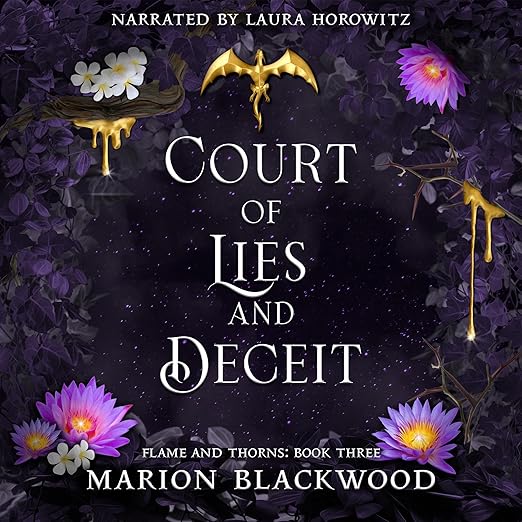
At a Glance
- Narration: Laura Horowitz handles the fae court's treacherous register well, conveying the emotional weight of Selena and Draven's dynamic without overselling the tension.
- Themes: Trust under pressure, the cost of ambition, romantic bonds tested by impossible circumstances
- Mood: Tense and emotionally charged, with a cliffhanger ending that resets the series stakes significantly
- Verdict: A third installment that prioritizes emotional development and relationship complexity over plot velocity, rewarding series readers while functioning less well as a standalone entry.
I came to Court of Lies and Deceit having not read the first two books in Marion Blackwood's Flame and Thorns series, which turned out to be a reasonably efficient way to discover that this is not a series you can enter at book three. The Unseelie Court, the Iceheart Dynasty, the group dynamics among Selena and her friends, Draven's significance as a character, all of it requires the prior books to mean what Blackwood needs it to mean. I went back and filled in enough context to proceed, which I mention only because the listening experience improved substantially once I understood who was at stake.
The premise of this installment is structurally familiar for fae fantasy: a desperate mission sends the group into the Unseelie Court, the Unseelie King forces a bargain, and the group must beat him at his own game to survive and advance their larger goal of taking down the Iceheart Dynasty. The scaffolding is familiar enough that genre readers will orient quickly. What Blackwood does inside that scaffolding is where the book gets interesting and, depending on your preferences, where it either earns or frustrates.
What We Made of It
The strongest element of this book is the relationship between Selena and Draven, which the fandom appears to discuss with the kind of intensity that suggests Blackwood has built something the readers feel invested in at a bone-deep level. One reviewer's summary of Draven as someone who would burn the world for her, crawl through glass, possessive, his dirty mouth, captures the romance appeal in its most concentrated form. Blackwood uses the Unseelie Court's enforced proximity and the trials' demands to push both characters past the emotional defenses they have been maintaining, and those scenes are where the book's emotional register is strongest.
The trial structure itself generated some mixed responses. One reviewer noted that one set of trials per series might be enough, and the observation is not unfair. The competition format used to navigate the Unseelie King's bargain creates episodic momentum but can feel like a delay of the larger story. Blackwood's use of the trials to develop character relationships partially addresses this, but listeners who prioritize plot architecture over emotional development may find the middle section slow.
What Makes Court of Lies and Deceit Worth Hearing
Laura Horowitz's narration handles the fae court atmosphere with enough control that the theatrical register of the Unseelie scenes doesn't tip into camp. The emotional scenes between Selena and Draven are where her performance earns the rating, managing the tension between Selena's suppressed emotional history and Draven's intensity without letting either character become a type.
With only fifteen ratings at the time of review, this is a newer audiobook release, which means the listener community is still building around it. The 4.3 rating reflects some divergence in reader response: series devotees who are deeply invested in the Selena and Draven dynamic are very satisfied, while readers who found the trial structure repetitive or who prefer more plot momentum have cooled toward this volume. Both responses are honest, and which one you will share depends largely on what draws you to fae fantasy in the first place.
What Might Not Land
The ending of this book is where Blackwood makes her most significant move, and multiple reviewers flag it as a genuine shock that resets the series stakes considerably. One reviewer described being devastated by what happened and immediately anticipating the fourth book; another called the cliffhanger very, very good after a book that had felt slower than its predecessors. The twist operates as a payoff for the slower middle section in a way that retroactively justifies some of what preceded it.
Selena's character arc in this installment centers on her relationship to her past trauma and her questioning of the mate bond, and one reviewer raised the legitimate point that her uncertainty and self-doubt can become frustrating across a long listening session. Blackwood seems aware of this tension; the book doesn't resolve Selena's growth as neatly as some readers want, but it does move her in a direction that the fourth book will presumably complete.
The Right Listener for Court of Lies and Deceit
Listen if you have read the first two Flame and Thorns books and want to continue Selena and Draven's story through the Unseelie Court. Listen if you prioritize romantic tension and emotional character development over tight plot architecture. Skip if you are new to the series, and skip if you prefer fae fantasy that resolves cleanly rather than building toward a cliffhanger that requires the next book.
Is the romance between Selena and Draven the main focus, or does the plot take equal weight?
The romance is probably the primary draw for most readers of this series. The Unseelie Court mission provides the external structure, but what drives the emotional content of the book is Selena and Draven working through their dynamic under pressure. Readers who are primarily plot-focused will likely find the balance tilted toward the relationship.
Does Laura Horowitz's narration suit the fae court atmosphere of the Flame and Thorns series?
Yes, particularly in the court scenes where the tone needs to carry both menace and a kind of theatrical formality. Her performance of the romantic scenes between Selena and Draven is the strongest element, navigating emotional intensity without excessive dramatization.