- Narrator: Sybil Johnson reads with the kind of clear, warm authority that suits a book asking young children to consider big concepts like courage and racial injustice without condescension.
- Subjects: Faith-driven courage, racial justice, historical women as models for children
- Tone: Inspirational and gently reverent
- Bottom line: A well-intentioned introduction to ten significant women of faith that works best as a conversation starter for children in the four-to-seven range.
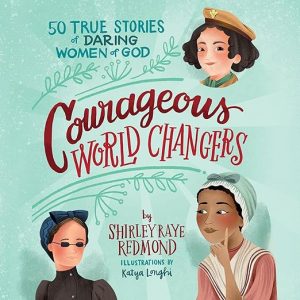
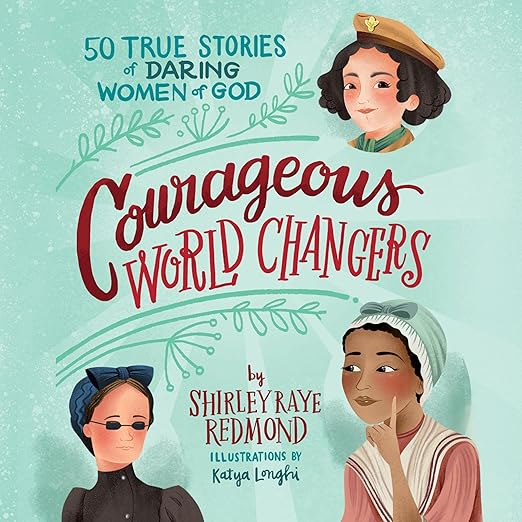
Shirley Raye Redmond's audiobook Courageous World Changers, narrated by Sybil Johnson, collects ten brief profiles of women who acted on their faith at personal cost. The book is formatted as a board book and runs under two hours in audio, which means each profile is genuinely short, a mini-biography rather than a full narrative account. The ten women include Corrie ten Boom, Harriet Tubman, and Rosa Parks alongside seven others whose specific inclusion reflects the book's faith-centered framing. Redmond's stated goal is introducing children to real-life superheroes who used their God-given talents alongside courage and conviction, and the audio format makes that introduction accessible to children who may not yet read independently.
Johnson's narration brings warmth and deliberate pacing to material that could easily feel didactic or rushed. The challenge of reading a board book aloud is that the content is designed for visual accompaniment, and Johnson handles the absence of images by reading with enough vocal weight that each name and each act of courage registers as something worth remembering. The reviewers who have engaged with this title note its value in church ministry contexts and as a conversation starter, which suggests the book functions best as a catalyst for discussion rather than a comprehensive account of any of the ten women's lives. At under two hours for ten profiles, no single figure gets more than a sketch.
God-Given Talents Link Very Different Women
The book's particular contribution is its age-targeting. Most content about Harriet Tubman, Rosa Parks, or Corrie ten Boom that is genuinely accurate requires some prior emotional vocabulary to engage with fully. Redmond's approach is to introduce the key facts and emotional orientation, offering a child a first encounter with these figures rather than a complete account. The framing of each woman as someone who used God-given talents to stand up against racial injustice gives the profiles a through-line that connects women from very different contexts, from the Holocaust to the American civil rights movement to earlier periods of faith-driven activism.
The faith framing will be the primary variable in recommending this audiobook. The profiles are organized around conviction and belief as motivating forces, which is historically accurate for many of the women included but also means the book is explicitly Christian in its interpretive lens. For families within that tradition, the framing adds a layer of meaning that connects historical courage to present faith formation. For families outside it, the profiles of individual women are still factually grounded enough to be useful, but the devotional framing will be more visible throughout. This is not a book that brackets its religious orientation as background context.
Johnson's Narration Holds Ten Profiles Together
The audiobook format serves this collection particularly well because children in the target age range, roughly four through seven, often engage more deeply with heard content than with text they or a parent must read. Johnson's vocal consistency across the ten profiles gives the audio version a cohesion that varied visual treatments in a board book might dilute. Parents can queue up one profile at a time for a short session focused on a single figure, or let the full collection run as a continuous listen. At under two hours total, the commitment is low even if a child wants to re-engage with specific profiles multiple times.
A reviewer described the collection as the perfect way to introduce conversations about these women, which captures the book's actual function accurately. It is not a substitute for deeper reading about any of the ten figures but rather a first introduction that gives children a name and an emotional context to attach to figures they will encounter again throughout their education. That introductory function is genuinely valuable, and the audio format makes it accessible to children who are years away from reading these histories themselves. The short format also makes it easier to return to specific profiles when a child encounters a figure in school for the first time.
Tubman's Story Reduced to a Heroic Outline
The board book format means that the audio listener is receiving text designed to accompany images they cannot see. Johnson's narration compensates for this effectively, but parents should know that some of the book's specific visual detail, which in the print version communicates alongside the text, is absent in the audio version. The audio works as a standalone, but having the physical book available for a follow-up reading session would give children access to the full experience as the author designed it.
The profiles are brief by design, which means nuance and complexity are necessarily absent. Harriet Tubman's story, for instance, is reduced to its essential heroic outline. This is appropriate for the age range but means the audiobook should be understood as a first encounter rather than a complete account. Children who come back to these figures in later school years will benefit from having had this early positive framing, even as their understanding of the historical complexity deepens. The value of planting the name and the emotional association early is real, even if the account itself is necessarily abbreviated.
Church and Sunday School Are the Natural Fit
This audiobook is for families with young children, specifically in the four-through-seven age range, who want age-appropriate introductions to historical women of courage. The Christian faith framing makes it an especially natural fit for church, Sunday school, and faith-formation contexts, as one reviewer noted. Families looking for profiles that do not center religious motivation may find this less suitable than secular alternatives covering similar historical figures. For its target audience and context, the narration is clear and warm and the content does the introductory work it sets out to do.