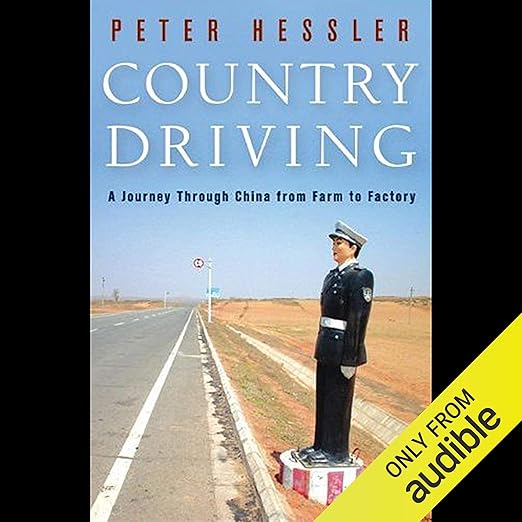
Quick Take
- Read by: Peter Berkrot's unhurried, observational delivery matches Hessler's own reportage style well across a long runtime.
- At its heart: China's automobile-driven transformation, rural-to-urban migration, individual lives inside sweeping economic change
- Vibe: Patient, immersive, reportage-paced rather than plot-driven
- Short version: A rewarding but substantial listen for anyone wanting a grounded, human-scale account of modern China, best approached with the patience its sixteen-plus hours demand.
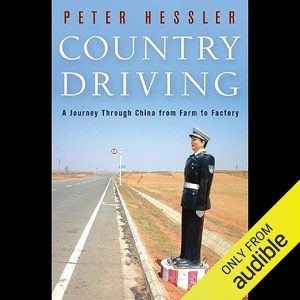
What does seven thousand miles along the Great Wall actually teach you about a country reinventing itself overnight? Peter Hessler spent the better part of a decade finding out, and Country Driving, the audiobook closing out his China trilogy after River Town and Oracle Bones, is the record of that decade: a cross-country drive along the wall's crumbling route, six years embedded in a single mountain village outside Beijing, and two years tracking a new expressway's effect on a small manufacturing city in the southeast.
The Review
Hessler's method throughout the China trilogy has always been patient accumulation over grand thesis, and Country Driving is the fullest expression of that approach. The three-part structure, road trip, village, city, lets him track the same underlying story, China's automobile boom reorganizing rural and urban life alike, at three different scales without repeating himself. A farmer deciding whether to keep working land his family has held for generations reads very differently next to a factory owner betting everything on a new government expressway, and the book earns the right to sit with both.
One reviewer, assigned the book for a Chinese Civilization course, called it assigned reading gone right, and that captures something real about how the book functions: dense enough with specific, lived detail to reward academic attention, but built from individual human stories rather than policy abstraction, which is exactly what makes sixteen and a half hours feel earned rather than padded.
Hessler's background as The New Yorker's Beijing correspondent shows up less in stylistic polish than in access and patience: the kind of extended embedding, six years returning to the same village, that a beat reporter on deadline could never justify but a book-length project can. That distinction between magazine journalism and this kind of sustained narrative nonfiction is part of why Country Driving reads as more intimate than a typical foreign-correspondent dispatch.
The driving-school chapters specifically, Hessler navigating a Chinese driver's-license exam built around memorized rules rather than practical road skill, work as comedy and as social commentary simultaneously, an early sign of the book's larger interest in how new systems, licensing bureaucracy, road infrastructure, get grafted onto a country that didn't have mass car ownership a generation earlier.
Hessler's own fluency in Mandarin, developed as an adult rather than a heritage speaker, shapes the book's access in ways worth naming specifically: village conversations and bureaucratic negotiations that a translator-dependent journalist couldn't have captured directly happen here in real time, without the flattening effect of interpretation. That linguistic investment is part of what separates Country Driving from more surface-level expatriate travel writing about China.
What Makes Country Driving Worth Hearing
Peter Berkrot's narration carries this material at a register that matches Hessler's own prose: observational, unhurried, willing to let a scene, a driving-school exam, a village dinner, a factory floor, play out at its natural length rather than rushing toward a summarizing point. That patience matters over sixteen hours of material that builds its argument cumulatively rather than through a single dramatic turn.
The book also rewards listeners with zero prior China expertise. Hessler translates cultural and bureaucratic specifics, the mechanics of getting a Chinese driver's license in 2001, the informal economics of a village guesthouse, what a new expressway actually does to land values, into scenes any listener can follow, which is part of why it keeps showing up on university syllabi outside pure China-studies departments.
Readers of Hessler's wife, Leslie T. Chang, whose own book Factory Girls covers migrant workers in southern Chinese factory towns during roughly the same period, will find real thematic overlap here, particularly in the book's final section on Lishui. The two books make an interesting paired listen, two different observational methods, one embedded in a single village, one following individual migrant workers, converging on the same underlying transformation from different angles.
Berkrot also handles the wide cast of recurring characters, village neighbors, factory bosses, fellow drivers on a cross-country trip, with enough vocal distinction to keep a large nonfiction cast easy to follow across sixteen hours, without tipping into performed characterization that would feel out of place in reportage this grounded.
The Caveats
At over sixteen hours, this is a genuine commitment, and it rewards sustained attention more than the kind of background, half-listening mode some nonfiction tolerates well. The three sections also have real tonal differences, road-trip travelogue, slow-building village portrait, urban development reporting, so a listener expecting one consistent register throughout should recalibrate: this shifts gears, fittingly, as it goes.
This is also the third book in a loose trilogy, and while Country Driving stands alone content-wise, listeners who've heard River Town and Oracle Bones will recognize recurring concerns, migration, generational change, the gap between official narrative and lived reality, that deepen with the fuller context of the earlier books.
One reviewer, identifying as Chinese and reflecting on the book from inside that perspective rather than as an outside observer, praised its sensitivity while also noting that any single writer's account, however careful, has to be triangulated against other sources to build a full picture of a country this large and varied. That's a fair caution worth carrying into the listen: Hessler's specific vantage points, one stretch of the Great Wall, one mountain village, one southeastern city, are deep but not comprehensive by design.
Compared to more touristy or exoticizing Western writing about China, a genre with plenty of entries to compare against, Hessler's approach can feel almost anti-dramatic by design: he's more interested in a village committee meeting about road maintenance than in staged cultural spectacle, a real strength for readers wanting substance but a real adjustment for anyone expecting a more conventionally adventurous travel narrative.
Who Should Listen to Country Driving
Listen if you want one of the most respected English-language accounts of China's twenty-first-century transformation, told through individual lives rather than macroeconomic data, and you're comfortable with a long-format, patiently built narrative.
Listen too if you appreciated Hessler's later, more essayistic work, Other Rivers or the New Yorker pieces collected in Strange Stones, and want to go back to the more sustained, immersive reporting style that established his reputation in the first place.
University courses on modern China and journalism programs studying long-form narrative nonfiction will both find this a genuinely durable, citable text more than a decade after its original publication, and it pairs naturally with Evan Osnos's Age of Ambition for readers who enjoyed that book's coverage of similar territory.
Skip it, or at least start elsewhere in the trilogy, if you're looking for a fast, plot-driven travel narrative; Hessler's approach is closer to sustained reportage than adventure writing, and sixteen hours of that register isn't for every travel-audiobook listener.
Do I need to listen to River Town and Oracle Bones before the Country Driving audiobook?
Not strictly. Country Driving stands on its own content-wise, though listeners who've heard the earlier two books in Hessler's China trilogy will recognize recurring themes that carry extra weight with that fuller context.
Who narrates the Country Driving audiobook, and is it Peter Hessler himself?
Peter Berkrot narrates this edition, not Hessler himself. His observational, unhurried delivery matches Hessler's own prose style closely across the full sixteen-and-a-half-hour runtime.
How long is the Country Driving audiobook compared to the rest of Hessler's China trilogy?
At sixteen hours and thirty-five minutes, it's a substantial, full-length listen consistent with serious long-form nonfiction, appropriate for a book closing out a decade-spanning reporting project.