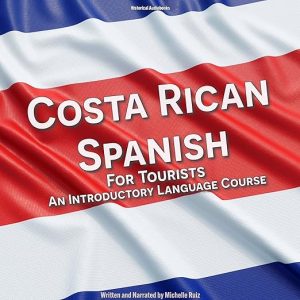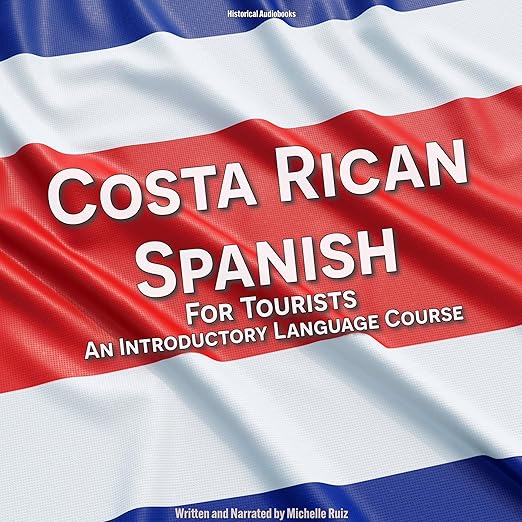
Eight sessions in three hours and one minute works out to roughly twenty-two minutes each, which is the first genuinely useful fact about this audiobook and the one the description never states. Michelle Ruiz wrote the course and reads it, and the promise is narrow enough to be credible: greetings, ordering food and drinks, everyday vocabulary, and a closing set of comprehension exercises built around situations a visitor will actually hit. Nobody is claiming fluency. Whether twenty-two minutes per topic is enough depends entirely on what you plan to do with it.
Scope is the thing this course gets right. The list of what it covers is short and it is honest about being short, which puts it ahead of most travel language products, where the marketing implies conversation and the content delivers a phrasebook read aloud. Greetings, restaurant transactions and common words are the three situations that account for most of a tourist's speaking, and building eight sessions around them rather than around grammar is the correct call for a two-week trip.
Regional specificity is the differentiator. Costa Rican Spanish carries vocabulary and idiom of its own, and a visitor arriving with textbook Latin American Spanish will understand the sentences and miss the flavor entirely. The description leans on Pura Vida as shorthand for that, which is fair enough, since the phrase functions as a greeting, a farewell, a thank-you and a general statement of outlook depending on where it lands. A course that spends its time on those local turns is more useful in a market in San Jose than a broader one would be.
Where the ambition outruns the runtime is comprehension. The course closes with exercises meant to test understanding in real tourist situations, and exercises in audio require you to stop, answer out loud, and restart. Three hours of content becomes five or six hours of actual study if you do that properly. Anyone treating this as background listening on the flight down will arrive with recognition rather than production, which is to say they will understand the waiter and still point at the menu.
Why It Works in Audio
Audio suits this goal better than a book would. Pronunciation is the whole problem with tourist Spanish, and nothing on a page fixes it, so a course that exists only as audio is solving for the right constraint. The writing and the reading come from the same person, which means the instructional voice and the model voice never diverge, and a learner who spends three hours with one speaker gets consistency instead of the cast changes that make some language products harder to follow than they should be.
Three hours is also a length people finish. Language courses fail at the abandonment stage far more often than at the content stage, and a program a traveler can complete in a week of commutes before a trip has a real advantage over a forty-hour system that gets deleted in month two. The eight-session structure gives that week a shape, and finishing the thing at least once matters more here than depth does.
Cultural framing is a genuine bonus here rather than filler. The description ties the language to conservation, sustainability and the way Costa Ricans talk about their own country, and while that reads as marketing on the page, it points at something real: the vocabulary a visitor needs in a national park or at a small family restaurant is not the vocabulary of a resort. Learning the words for the second setting is what turns a trip into a conversation.
What to Watch For in Costa Rican Spanish for Tourists
Trouble starts in the description's first sentence. It offers to teach the basics of the Costa Rican language, and no such language exists. What exists is Spanish as spoken in Costa Rica, with a distinct accent, a distinct set of idioms and the voseo that trips up learners trained elsewhere. The rest of the description gets this right and repeatedly says Spanish, so the opening line reads as sloppy rather than dishonest, but it is the line a browsing buyer reads first.
Stranger still is the publisher field. It reads Historical Audiobooks, which has no visible relationship to a contemporary language primer for travelers, and no explanation appears anywhere on the record. Take it as a cataloging artifact rather than a signal about content, but a buyer trying to judge production standards from the imprint will get nothing usable out of it.
Structure imposes a ceiling too. A single speaker cannot run a dialogue, so a course built entirely on one voice can model sentences and cannot rehearse exchanges: you hear how to ask where the bus leaves from, and you never hear the four ways the answer might arrive. That is the hardest part of real travel Spanish and the part a three-hour solo recording is structurally unable to cover. The rating field on this record sits empty, with no counter beside it and nothing posted since the April 2024 release, so none of this can be checked against another buyer's experience.
Recommended For
Anyone with a Costa Rica trip booked, no Spanish to speak of, and about a week of commuting time before the flight will get value out of this. It covers greetings, a restaurant and a market, and it hands over the local idioms that make those exchanges land as friendly rather than transactional. Travelers who already hold basic Spanish from another country and want the regional layer are served even better, which is the use case where three hours goes furthest.
Leave it alone if you want structured grammar, a written component to review, or a course that will still be teaching you something in month three. It fails anyone who cannot stop and repeat, because the exercises assume you will. Read the runtime as a floor rather than a total: the eight sessions take three hours to play and considerably longer to learn.
Frequently Asked Questions
How long does each of the eight sessions run?
The record gives a total of three hours and one minute and never breaks it down, which averages to about twenty-two minutes a session. Expect that to be play time rather than study time. The closing comprehension exercises assume you stop and answer aloud, so a realistic pass through the whole course takes considerably longer.
Will this audiobook help if I already speak some Spanish?
Yes, and arguably more than if you speak none. The value sits in the regional layer: Costa Rican idioms, local vocabulary and the everyday expressions that textbook Latin American Spanish leaves out. A learner with basic grammar already in place can absorb that layer in three hours and use it immediately.
Does the audiobook prepare you for conversation or only for speaking?
Mostly for speaking. One voice reads the whole course, so you learn how to ask a question and never hear the range of replies a real exchange produces. Ordering food and greeting people will go well. Understanding a fast answer in a market is the part you will still be working on.