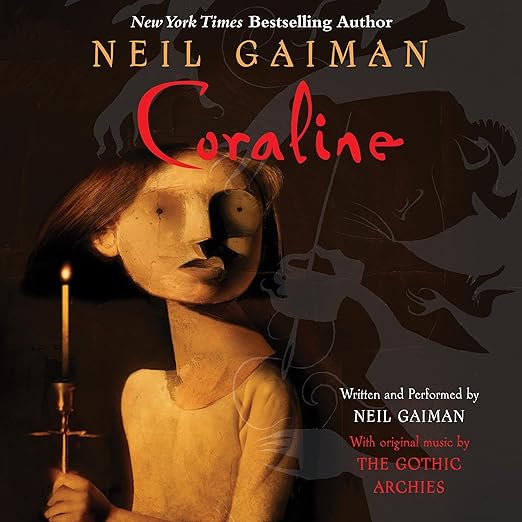
Four periods and a doubled pair of quotation marks are how this description presents the most famous sentence in the book: Coraline discovered the door a little while after they moved into the house.... The punctuation is scrape damage rather than intent, and it is a small warning about how much of this audiobook page to read as considered copy. Three hours and thirty-five minutes, HarperCollins, November 7, 2003, and a single name doing duty as both writer and reader. Those are the parts that hold up.
First, the Big Picture
Coraline steps through a door and finds another house strangely similar to her own, only better, in the description's phrasing. Then comes the other mother, and the other father, and the wish that she stay and be their little girl. They want to change her and never let her go. That is the entire engine, stated in three sentences on a product page, and the reason it still works is that the threat on offer is not being eaten. The threat is being kept.
The byline and the reading credit belong to one person, which for a book paced this precisely is worth noticing. Coraline runs on withheld information and on sentences that turn at exactly the right moment, and the person who placed those turns is the person delivering them. Three hours and thirty-five minutes is short enough to take in a single sitting. A self-read children's horror story at that length sits closer to being told a story than to being read one.
The Best Parts of Coraline
Jennifer C. supplies the detail that sells this better than the publisher copy does: a new home with twenty-one windows and fourteen doors, thirteen of which open and can be passed through, and a fourteenth with only a brick wall behind it. Or does it, the response adds. That is the exact texture the book runs on, arithmetic turned uncanny, counting as a form of dread. A child who likes counting things will find it unbearable in the best available sense.
Zachry Wheeler's response is the longest here and the most interesting, and it stops mid-word. Four decades of reading, this account says, teach you that anything can get boring, donuts and roller coasters included, and then an apathy wall arrived partway into a new book by a favorite author: The prose was great and the story was intriguing, but I couldn’t shake th. That is where the text cuts. The headline promises a reading tonic sorely needed. The body never reaches the part explaining why this one worked.
Sam Chap's headline is two reviews welded into one: the story is amazing, and do not buy from a named seller. The body splits along the same seam, opening with a real assessment, captivating and eerie and unique, plus a recommendation to read the book even after seeing the film because the differences run deep, and then breaking off at Fi. A shipping complaint and a literary judgment sharing one five-star rating is a common shape on a listing page. It also means the score is measuring two unrelated things at once.
A Few Reservations
Every visible grade on this page is a five and the badge reads 4.7. Twenty-three ratings sit behind that number, so whatever pulled the average down arrived without words attached, and anyone reading the column will form a rosier impression than the figure supports. Not a serious discrepancy by any measure. Worth knowing all the same, because five perfect scores on a page rarely means five perfect scores in the tally underneath it.
Age guidance is the real question, and the description hands over a range: readers aged eight to twelve, plus adults who want something smart and spooky. Jennifer C. calls it a scary story for the whole family. Both descriptions are fair, and both understate how genuinely frightening the other mother becomes for a younger child, particularly heard aloud in the dark with no page to look away from. Audio removes the escape hatch a book quietly provides. Judge the eight in eight to twelve carefully.
Two of the five responses describe reading rather than listening. Nat Bernal, writing from Mexico, recommends it as comfortable to carry and read despite its small size, which is a verdict on a paperback. sebaue's German entry reports finishing the novella in roughly five hours, the better part of an hour and a half longer than this recording runs, and a plain reminder that these five people were not all consuming the same version of the thing.
Credentials in this description arrive fused together as well. New York Timesbestselling runs into itself with no space at the join, Newbery Medal-winning sits alongside it, and the listing's own tag reads Growing Up and Facts of Life, a category that fits a story about a child crawling through a door into a trap only if you squint hard at it. None of that misleads anyone in substance. It is simply evidence that nobody has read this page aloud to themselves, which is a peculiar condition for a page selling a recording of somebody reading aloud.
The film turns up twice on this page, once in the description as an Academy Award-nominated adaptation and once in Sam Chap's insistence that the book is nothing like it. sebaue makes the same comparison and prefers the book's tighter line through the story. For a listener who arrived by way of the movie, that is the useful consensus available here: this recording is not the film in another format, and the differences are the reason to bother with it.
Should You Listen to Coraline?
A three-and-a-half-hour horror story for children, told in the voice that wrote it, with a single door doing all the work, matches its format unusually well, and families with children at the upper end of eight to twelve get the most from it. Adults are the second audience and the description says so outright, which is rare enough on a children's listing to be worth trusting. Zachry Wheeler's account of a reading slump broken is the argument for that use, truncated though it is.
Under-eights are the wrong audience whatever the shelf says, and so is anybody wanting a comfortable bedtime listen. The other mother does not become less alarming for being brief about it. Three hours and thirty-five minutes with one voice and one door is the offer, and it holds up.
How long is the Coraline audiobook and who reads it?
Three hours and thirty-five minutes, with writer and reader listed as one and the same, so the book is read by the person who wrote it. HarperCollins issued the recording on November 7, 2003. That length is short enough for one sitting, which suits a story built on sustained unease.
Is this audiobook too frightening for an eight-year-old?
That depends heavily on the child. The description recommends readers aged eight to twelve and Jennifer C. describes it as suitable for a whole household, yet the other mother is genuinely alarming. Audio also removes the option of skimming ahead or shutting the book, which sharpens everything considerably.