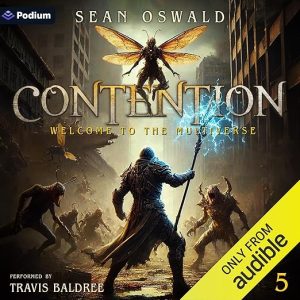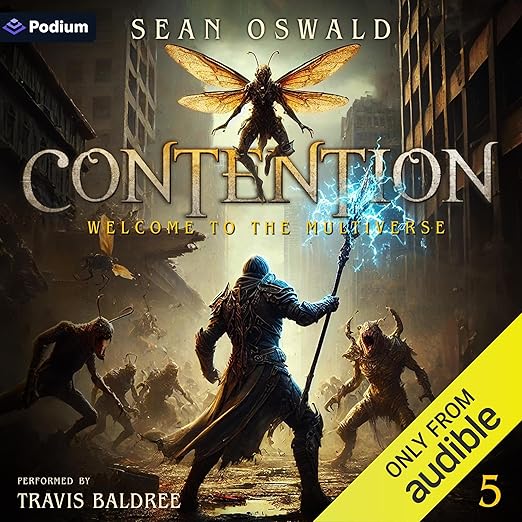
Silas has less than a month left, and Sean Oswald is not interested in letting him spend it quietly. Contention, the fifth audiobook in the Welcome to the Multiverse series, opens with a clock already running and a complication that fundamentally changes the shape of the story: Earth has been declared a contested world, which means the competition is no longer just Earth against its own deadline but at least two separate systems fighting for control of the planet. That structural shift from internal pressure to external conflict is the book's defining move.
Travis Baldree narrates, which will immediately mean something to listeners who have followed this series or encountered his work on other fantasy titles. Baldree has a knack for inhabiting competent, slightly overwhelmed protagonists without losing the humor that keeps LitRPG from becoming a slog of system notifications. He reads Silas's escalating predicament with a kind of resigned wit that prevents the near-constant power escalation from feeling monotonous, even when the character's abilities have reached what one reviewer frankly described as god-like territory.
Is Contention Worth Your Time?
Oswald is doing something structurally interesting here that a positive review identified precisely: this book has the difficult job of ending one section of the series while starting another. The timer framing device, Silas racing against a hard deadline while simultaneously managing an external invasion, creates a sense of finishing up the last little things before a project closes. For longtime series readers that rhythm feels earned. For newcomers, the density of accumulated lore and abilities will be disorienting in ways that are genuinely difficult to compensate for within a single volume.
The honest criticism in the reviews is worth taking seriously. Character development in this entry is intentionally minimal. Oswald's focus is on the mechanics of the contested world situation and the logistics of what Silas can accomplish in the time remaining. One reviewer described caring less about the characters than in earlier books precisely because the constant addition of new spells and abilities crowds out space for the relationships that gave earlier entries their emotional texture. That is a real trade-off, not a failure of craft. Oswald has made a deliberate choice to prioritize plot and system momentum at this juncture in the series, and listeners who are here primarily for worldbuilding payoff will find it. Those who need the character work to stay engaged may feel the book running a little cold in its middle sections.
The Best Parts of Contention
The audiobook's primary appeal is exactly what the synopsis promises: a sense of escalating consequence that builds on four previous books. At fifteen hours and sixteen minutes, Oswald gives the contested world situation room to breathe. The logistics of two competing systems trying to gain control of Earth while Silas works against his own deadline create genuine strategic interest that goes beyond the standard LitRPG ability-check format. There are moments where the scale of what is happening opens up in ways that justify the series length and reward the investment listeners have made across the earlier volumes.
Baldree's narration remains the production's strongest asset. His vocal range is wide enough to differentiate the expanding cast, and he handles the system-notification sequences, those inevitable LitRPG moments where abilities and stats get enumerated, with a deftness that keeps them from stalling the narrative momentum. Whether listening in extended sessions or shorter bursts, his performance maintains energy across a long runtime without resorting to artificial urgency. This is craft-level audiobook narration, and it makes Contention a more rewarding listen than it might be in a less skilled reader's hands.
Before You Commit to Contention
The book's most interesting structural tension is between the time-pressure mechanics and the cosmic scale of what has changed. Silas's individual power, whatever ceiling the series has now given him, is suddenly not the point. The contested world designation means that preparation for a single deadline has become preparation for ongoing geopolitical conflict on a planetary scale. That widening scope is where Oswald plants the seeds for whatever comes next in the series, and listeners attentive to that transition will find the book more satisfying than those reading it primarily as a standalone action entry.
The power escalation issue that multiple reviewers flagged is real but contextual. In a five-book series where each entry has incrementally expanded Silas's capabilities, the god-like quality of his current state is a feature of the series arc rather than a single book's flaw. If the accumulation has been your pleasure across the first four books, Contention delivers more of it with the added dimension of external competition. If you have been hoping for a reset or a meaningful new vulnerability, this entry provides something closer to the former, though the contested world complication introduces strategic limits that the earlier books lacked.
The book's handling of Earth's status as a multiverse newcomer also raises questions that the contested world premise makes newly urgent. Earlier books established Earth as a world catching up to a system it did not choose to join. Contention forces the question of whether catching up is even the right frame once multiple outside parties have decided that Earth's fate is theirs to determine. Oswald does not fully resolve that question in this volume, but posing it clearly sets up the next phase of the series in a way that goes beyond simple power escalation.
Should You Listen to Contention?
This audiobook is for Welcome to the Multiverse readers ready for a series-pivot entry that prioritizes momentum and worldbuilding expansion over character depth. Baldree's narration makes the long runtime approachable for general fantasy audiobook listeners, but the book's emotional rewards are proportional to prior investment in the series. Skip it as an entry point and start at book one. Readers who enjoy progression fantasy where the system becomes geopolitical rather than purely personal will find Contention's contested-world frame a genuine evolution of the premise.