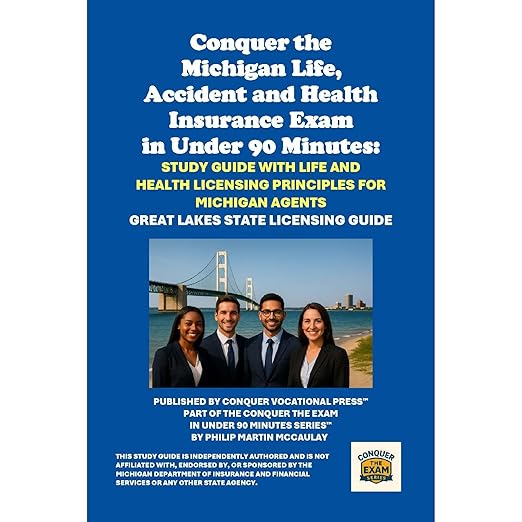
Eighty minutes is what this audiobook actually runs, against a title promising to get you through the Michigan life, accident and health insurance exam in under ninety. That is a rare thing on a product page, a marketing claim the metadata confirms rather than undercuts. What Philip Martin McCaulay has assembled is a compressed review of Michigan's licensing concepts, covering life insurance principles, annuities, health coverage, disability protection, taxation and the state regulations sitting over all of it, delivered in short direct paragraphs built to be finished in one sitting. Whether eighty minutes is enough depends entirely on what you bring to it, and the copy is at least clear about what it is.
Annuities Are the Hardest Topic to Rush
McCaulay's structure is the whole product, and the description explains it plainly enough to judge. Each chapter is assembled from short direct paragraphs that clarify how policies work, what duties producers owe their clients, and how Michigan's insurance code governs fair and ethical conduct. For audio that is the right architecture, because the alternative, a discursive explanation built on worked examples, collapses the moment attention drifts. Short units survive interruption. The topic list is exactly what a first-time candidate needs to recognize on sight: life insurance policy types, annuity structures, health and medical plans, Medicare and Medicaid coordination, consumer protection laws, and the state's oversight of insurers and agents. Nothing exotic, and nothing missing from the headline areas.
Annuities are where guides like this usually lose people, and they are also where a fast review is easiest to defend. Nobody passes a licensing exam by hearing about annuity structures once. What eighty minutes can do is make the vocabulary familiar enough that the real study materials stop reading like a foreign language. Knowing that an annuity has a structure, that structures differ, and that the differences drive the tax treatment is enough scaffolding to make a practice question legible. Used that way this is a primer rather than a review, whatever the description calls it, and primers earn their keep at the start of a study plan.
Play This Before the Official Manual
If you are two weeks out and hunting for a cram tool, this is not the wrong purchase so much as the wrong order. The obvious use runs the other way: play it before opening the official manual, so that the first pass through several hundred pages becomes recognition instead of discovery. The second obvious use is repetition. Eighty minutes fits into a daily commute twice over, which means five listens a week without setting aside a single dedicated study hour, and repetition is what moves definitions into recall. Cheap, short and repeatable beats comprehensive and unfinished, particularly on a fixed timetable.
Medicare and Medicaid coordination may be the most valuable inclusion here, and its presence in the topic list is a genuine selling point. That section is easy to underestimate, partly because it feels like public policy rather than insurance and partly because the coordination rules are fiddly in a way that resists straight memorization. Having them laid out in plain language, early, at low cost, is precisely the edge a short guide can offer. The same goes for the consumer protection material and the duties producers owe clients, which turn up in exam questions dressed as ethics scenarios and become much easier to answer once the underlying duty is clear.
Machine-Read, With No Glossary or Practice Questions
Definitions are what an exam tests, and definitions are what audio handles worst. The reading credit here is machine-generated rather than a named performer, and the material bristles with terms whose exact wording carries the marks: policy types, annuity structures, coordination rules, statutory duties. The listing promises no supporting file at all, so no glossary, no practice questions and no chapter summaries appear to arrive with the eighty minutes. That leaves a listener taking dictation from memory. For a study aid, the absence of anything written down is the most consequential limitation on this page, and it is the one the description never addresses.
Labels are where the listing contradicts itself. The series field reads Insurance and Risk Management Exams. The description then signs off by calling the book a Great Lakes State Licensing Guide, a different series name altogether, presented in the same branded position. A candidate hunting for the equivalent guide covering another line of insurance, or the same exam in another state, now has two labels to search and no numbering under either. The title is a third problem, running past twenty words and naming Michigan twice, which is what happens when a page gets written for a search engine rather than for a buyer. Independently Published sits in the publisher field, which accounts for the absence of an editorial hand across all of it.
Michigan Candidates Get a Sensible First Step
Candidates sitting the Michigan life, accident and health exam for the first time are the intended audience, and for them this is a sensible eighty-minute investment at the front end of a study plan. It also suits producers already licensed elsewhere who are adding Michigan and need the state-specific layer rather than the fundamentals. Career changers benefit most from the vocabulary alone, since the hardest part of a first licensing exam is rarely the concepts and almost always the language they arrive in. Anyone already enrolled in a full course can treat this as revision to run through dead time.
Pair it with the official materials or leave it alone. This cannot be a sole source, and the description does not claim to be one, although the word comprehensive in the second sentence leans closer to that than it has any right to. Drop it if you need practice questions, since nothing on the page suggests any exist, and forget it if you are studying for a different state, because the value here is the Michigan insurance code and none of that transfers. Listeners hoping a machine-read summary can stand in for statutory text will fail an exam that quotes the text. For eighty minutes, placed at the beginning of a plan rather than the end of one, it does exactly what the title promises.