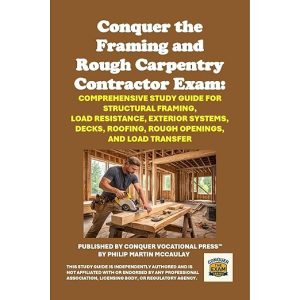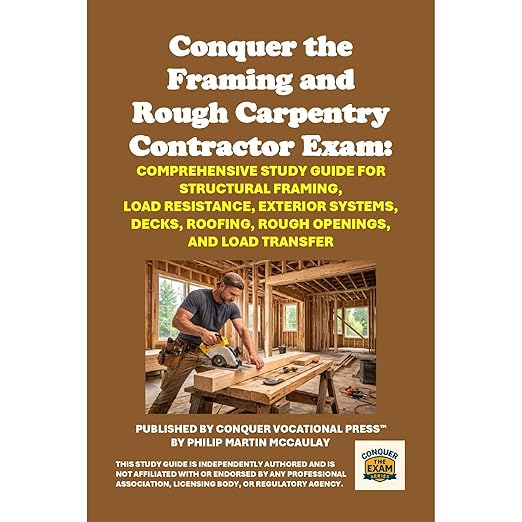
Structural framing is one of those construction disciplines where competence is invisible until something goes wrong. Philip Martin McCaulay's audiobook Conquer the Framing and Rough Carpentry Contractor Exam understands this, and the guide's organizing principle - continuous load paths from roof to foundation - reflects the way structural failures actually propagate in real buildings. This is a 5-hour and 30-minute listen from the Skilled Trades Exams series, narrated by Virtual Voice, aimed at contractors preparing for licensure in structural framing and rough carpentry.
Shear Wall Performance Is a Chain of Decisions
What distinguishes this guide from the generic contractor exam prep resources on the market is its stated commitment to systems thinking over component-level recitation. McCaulay covers gravity load transfer, lateral force resistance, uplift control, shear wall performance, engineered wood integration, connection mechanics, roof valleys and dormers, stairwell openings, ledger attachment, and foundation alignment - but the through-line is always the same: how do these elements work together under combined loading conditions, and what happens when one element in the load path underperforms?
That framing parity - treating the exam as a test of structural reasoning rather than memorized specifications - is exactly right for how contractor licensing exams are actually constructed. The best-prepared candidates are not those who have memorized tables; they are those who can look at an irregular framing condition and reason their way to a compliant solution. McCaulay's explanation of cantilevers, diaphragm-to-wall connections, and the long-term performance implications of shrinkage and deflection gives candidates the conceptual scaffolding to do exactly that. The sections on combined load effects are particularly well-handled, walking through how gravity and lateral forces interact in ways that isolated component analyses would miss.
The treatment of shear wall performance is worth dwelling on. Shear walls resist lateral forces from wind and seismic events, and their performance depends on a chain of decisions - nailing schedules, hold-down anchor placement, boundary member sizing, and diaphragm-to-wall connection details - that must all be correct simultaneously. McCaulay traces these decisions in sequence, explaining why each contributes to or degrades the wall's lateral capacity. That sequential reasoning is exactly what the licensing exam tests and what field experience alone rarely teaches explicitly. Candidates who have built shear walls but never analyzed them will find this section clarifying in ways that go well beyond exam prep.
Ledger Attachment Gets Fastener-Level Exam Attention
Virtual Voice narrates with the steady, unadorned delivery that AI narration typically provides for technical content. There is no interpretive color, no emphasis on key terms that a human narrator might choose to stress - just clean, consistent pacing through dense material. For a study guide, this is more feature than bug. Listeners who are using this audiobook during commutes, on the job site during breaks, or alongside physical note-taking will find the predictable rhythm easier to manage than a narrator who dramatizes content that does not need dramatizing.
The coverage of deck integration and ledger attachment deserves specific mention. These are areas where contractor exam questions frequently concentrate, and where real-world failures are disproportionately common. McCaulay gives the ledger-to-rim-joist connection the kind of detailed attention - fastener patterns, flashing requirements, allowable loads - that reflects how examiners think about this topic. Similarly, the roof geometry sections on valleys and dormers go beyond the standard hip-and-ridge overview to address the more complex framing intersections that appear on harder exam questions.
Engineered Wood Products Reshape Rough Framing Practice
Listeners who prefer a practice-question format will find this guide's explanatory approach requires supplementation. McCaulay builds conceptual understanding rather than simulating the exam format, which means candidates who learn best through repeated question-answer cycles should pair this audiobook with a dedicated question bank. The audio medium also means that load diagrams, span tables, and code references - tools that are available in the print version and useful for certain types of structural reasoning - are not directly accessible during the listen. This is a limitation of the format rather than a content gap, but it is worth knowing before committing to an audio-only study plan.
The section on engineered wood products - LVL beams, I-joists, wood structural panels used as diaphragms - is thorough and reflects how significantly these materials have changed rough framing practice over the past two decades. Candidates who trained or worked before engineered wood was standard in residential construction will benefit from this section's explicit treatment of how these products change connection requirements and span capacities. The discussion of long-span LVL applications and the deflection criteria that govern floor system design adds a layer of precision that distinguishes this guide from simpler overviews.
This Audiobook Turns Field Instinct Into Exam Reasoning
This audiobook is well-matched to contractors with field experience in residential or light commercial framing who are preparing for their first licensure exam and want to move from intuitive construction knowledge to testable structural reasoning. It is also useful for construction technology students who want supplemental audio content to accompany coursework. It is not an entry-level resource for someone with no framing background - the material assumes basic site vocabulary and familiarity with common framing configurations. Those who want practice questions alongside conceptual review should treat this as one component of a broader prep strategy. For experienced framers who need to organize what they already know into exam-ready reasoning, this is a well-built starting point.
A Few Questions About Conquer the Framing and Rough Carpentry Contractor Exam
Does this audiobook cover the full scope of topics that appear on framing and rough carpentry contractor exams?
Yes, the guide addresses all major exam content areas including load resistance, shear walls, roof framing, deck integration, rough openings, and continuous load path principles. It is intended as comprehensive rather than topic-selective prep.
Is this audiobook accessible to someone who has framing experience but has never studied for a licensing exam?
That is arguably its ideal audience. Experienced framers will recognize the concepts from the field and the guide helps translate that practical knowledge into the structured reasoning contractor exams test.
How does listening to this audiobook compare to reading a print study guide for this exam?
The audio format works well for conceptual review and reasoning-based content but lacks access to load diagrams and span tables that a print guide provides. Most candidates will benefit from using both formats together.
Does this audiobook include practice questions?
No, the guide is explanatory rather than drill-based. Candidates wanting practice questions should pair this audiobook with a separate contractor exam question bank.