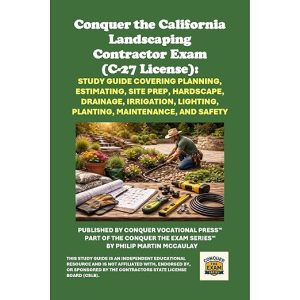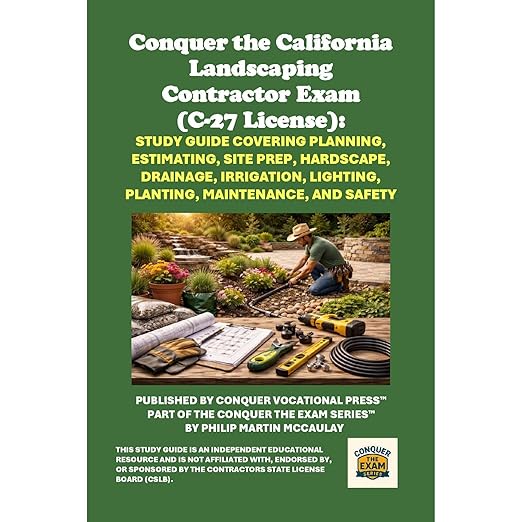
Read the title and you are promised a study session under ninety minutes; check the entry and the audiobook runs three hours and nine. Both figures come from the same listing and neither is hidden. A study guide that advertises speed and then delivers more than double it is not automatically a bad guide, but the gap is the first thing a candidate deserves to know before building a study schedule around it.
Ten Domains Compressed Into One Honest Overview
Nine subject areas get named in the subtitle alone: planning, estimating, site prep, hardscape, drainage, irrigation, lighting, planting and safety. The body copy quietly adds maintenance to that list, making ten. Covering ten domains of a state trade license in one recording means each one gets a pass rather than a treatment, and the description is honest enough about it, calling itself an overview of technical concepts rather than a course. Expect definitions and sequences rather than worked examples, and expect the breadth to come at the cost of anything resembling depth on a single topic.
Wrong Hardscape Answers Map to Failed Installations
Hardscape and drainage receive the most concrete handling, and the copy names the specifics: grading, trenching, retaining walls, surface stabilization. Those are the topics where a wrong answer on the exam maps directly onto a failed installation on a real job, so the emphasis is defensible. Anyone who already works on crews will recognize the vocabulary instantly. Anyone crossing over from a different trade will be doing considerably more work here.
Irrigation and lighting get handled as systems rather than as parts lists, which matters for this exam because the questions tend to test layout logic and water management instead of product recall. The copy promises exactly that framing, describing system layout, water management and lighting fundamentals as the route to landscapes that perform efficiently. Whether the depth suffices depends on how much you already carry, since nothing here teaches the trade from nothing.
Plant Knowledge Deserves Its Own Stop-and-Notes Stretch
Contractors studying for a license rarely have much desk time, which is the whole argument for a spoken study guide. This one runs during a drive between jobs, through a lunch break, or while your hands are busy with something else. The material suits the format too: definitions, sequences and checklists absorb reasonably well by ear, and the subject order in the subtitle roughly mirrors the order of an actual installation project.
Sequencing, estimating, system integration and jobsite safety close the guide out, and grouping them last is the smartest structural decision on offer. Those four are exactly where candidates who know the physical work still lose points, because they are management topics rather than manual ones. Hearing them after the technical material puts them in the right relationship to everything preceding, which is a genuine advantage of a linear recording over a book you would otherwise dip into. Estimating in particular benefits from arriving after you have heard what actually has to be estimated.
Plant knowledge gets a stretch of its own, covering tree, shrub, groundcover and turf installation alongside soil preparation, planting strategy and mulching practice. For a licensing candidate this is often the section least likely to have been learned on the job, since most crews specialize narrowly, and this is the point at which a listener should probably stop and take notes rather than let it wash past. The copy signals breadth honestly without overselling depth.
Virtual Voice Holds the Narration Credit Here
Virtual Voice holds the narration credit on this entry, which is the listing's way of stating that the reading is machine-generated rather than performed by a person. That is a fact about the product, not a verdict on it. For a checklist-dense study guide the practical response is the same in either case: keep a notebook open, because you will want to impose your own structure on ten subject areas arriving in sequence.
Zero ratings and zero written responses sit on this entry. Nothing is available from other candidates about whether the coverage matches the exam as currently administered, which matters because licensing boards revise their content outlines periodically and a December 2025 release date tells you only when the recording appeared. Check the board's published outline against the subjects listed here before treating this as your single source of preparation.
Series naming is the other loose thread worth pulling. The entry places this inside a California Contractors State License Board exams series but leaves the number blank, so nothing on the page tells you how many companion guides exist or where this one falls among them. A candidate who also needs the law and business portion covered would have to go hunting without any assistance from the listing itself.
Outsiders Should Treat This as a Syllabus
Candidates already working in landscaping are the natural fit. If you have installed irrigation, set retaining walls and priced a job, this functions as a structured refresher that converts scattered practical knowledge into exam-shaped categories, which is genuinely useful. Doing that conversion by ear during time you were going to spend driving anyway costs you nothing you were otherwise using, and repetition is the point of a guide this compressed.
Working candidates arriving from outside the trade should treat this as a syllabus rather than a textbook. The subtitle amounts to a checklist of what the exam expects you to know, which has real value by itself, but a recording surveying ten domains cannot substitute for the reference material sitting behind each one. Pair it with the board's outline and a proper study manual rather than betting a license on it. The absence of any candidate feedback on the entry makes that caution more than routine, since nobody has publicly reported sitting the exam after using this.
Nobody should buy this expecting the tidy study session the title advertises, and nobody working toward a C-27 should expect a single overview to carry them across the line. As a spoken index of the territory the exam covers, though, it names the ground clearly and in a sensible order.
Quick Take
- Big ideas: Trade licensing preparation, hardscape and irrigation fundamentals, jobsite sequencing and safety
- Atmosphere: Businesslike and checklist-driven
- Worth it?: A useful spoken syllabus for working crews, not a substitute for the board's own material.
A Few Questions About Conquer the California Landscaping Contractor Exam
Does this audiobook really fit the time the title advertises?
No. The entry lists a running time of three hours and nine minutes, well over double the headline claim. The extra length is not padding, since ten separate subject areas need covering, but anyone planning one quick session before a test should budget from the actual figure rather than the title.
Which C-27 topics get the most attention?
Hardscape and drainage carry the most concrete material, naming grading, trenching, retaining walls and surface stabilization. Water delivery and lighting arrive as complete systems instead of parts lists. Planting receives a full stretch covering trees, shrubs, groundcover and turf, along with soil work and mulching practice.
Is this audiobook enough on its own to pass the licensing exam?
Use it as an inventory of what the test covers rather than a complete course. It names the subjects and organizes practical experience into examinable categories, which genuinely helps working crews. State boards update their published outlines periodically, so check the current one and keep a full manual alongside this.
Does a synthesized reading work for exam material like this?
It carries the words accurately, which is most of what a definitions-and-sequences guide needs. The audiobook credits a text-to-speech system rather than a person, so plan to supply your own emphasis: keep notes, mark what you intend to memorize, and replay the estimating and safety sections rather than trusting one pass.