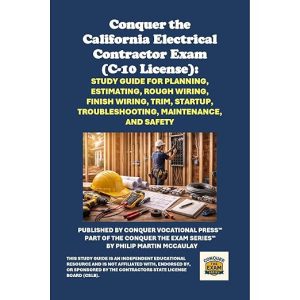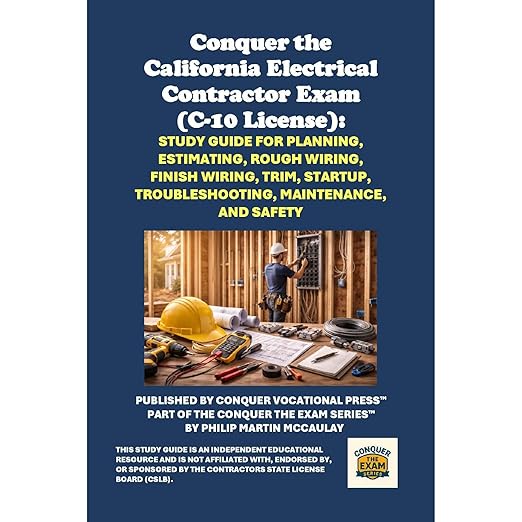
The title promises ninety minutes and the audiobook runs to two hours and fifty, which is the first fact anyone considering this study guide should have. Nearly double the advertised commitment is not a scandal, but it is a broken promise sitting inside the product name, and on a page carrying no ratings and no written responses the listing itself is the only evidence available. Philip Martin McCaulay's guide covers the trade knowledge behind the C-10 electrical contractor license, and it covers a lot of it quickly.
Scope is genuinely broad for the length. Service equipment, distribution, grounding and bonding, lighting and power systems, motors, energy systems, and project coordination from rough installation through final completion all get treatment, alongside troubleshooting, maintenance, and safety in working construction environments. Anyone who has spent time on residential and commercial jobs will recognize the list as a fair map of what a licensed contractor is expected to know before anyone hands them a license number.
What the description never mentions is the exam. It sells trade competence, not test technique, and the difference matters enormously to somebody with a scheduled testing date. No sample questions are advertised, no breakdown of the examination sections appears, and no indication is given of how the material is weighted against what the Contractors State License Board actually asks. A study guide named after a specific license really ought to say.
Sales copy closes the description, urging anyone who has already invested time and money not to leave success to chance. That framing tells you the intended buyer plainly enough: somebody late in their preparation, anxious, looking for one last pass over the material before a test date. Judged as that final pass, the guide is reasonable and well organized. Judged as a preparation program, it was never trying to be one, and it does not pretend otherwise inside the text.
Driving Between Job Sites Becomes Study Time
A spoken recap has one real advantage over a printed one, which is that it occupies otherwise dead time. Driving between job sites, tools in hand, or the evening before a test, hearing the categories recited in order does the work that flashcards do. Recognition is most of what a multiple-choice examination rewards, and repeated exposure to the vocabulary of grounding, bonding, and service distribution builds recognition faster than reading the same material once ever will.
Grouping the material by system rather than by code section helps here. Each stretch of listening covers one coherent subject, and the guide moves in the sequence a job actually follows, from planning through rough wiring to finish work and final completion. That ordering is far easier to follow aloud than a numbered code walkthrough would be, and it is plainly the right choice for a format with no visual structure to lean on.
Repetition is the mechanism doing the real work, and the running time is short enough to allow it. A guide you can get through twice in a week is worth more to an exam candidate than a comprehensive volume you finish once, and the deliberate exclusion of what the description calls unnecessary theory keeps things moving. Plan on several passes rather than one careful listen, and treat the whole thing as revision rather than instruction.
Synthetic Narration Gives Every Term Equal Weight
Reading credit on this edition goes to a synthetic voice. For narrative writing that is merely toneless; for licensing material it changes what you can learn. A human reader marks a defined term with emphasis, slows for a distinction that matters, and signals when a phrase is a term of art rather than ordinary description. A machine reading gives grounding, bonding, and the word and identical weight, which leaves a listener no cue at all about what to commit to memory.
No edition of the National Electrical Code is named anywhere in the description, even though the title advertises NEC concepts. California adopts its own amended version on a fixed cycle, and code answers turn on which cycle applies. A guide that will not state its code year is asking candidates to assume, and assumption is the specific failure mode that costs people a license attempt and the fee attached to it.
Nothing else on this listing fills the gap. Publication is dated December 2025, and no rating and no written response has appeared since, so nothing independent exists to check any of the above against. The series line names a family of Contractors State License Board exam guides but leaves the volume number blank, so nothing indicates what else belongs to the set or where this title sits inside it.
Ninety Minutes Promised, Nearly Three Hours Delivered
Working electricians already deep into preparation are the natural audience, particularly anyone who wants the subject areas recited back while doing something else. It suits somebody returning to the trade after time away who needs the vocabulary reactivated, and it suits anyone who studies best by hearing material repeatedly rather than by working problems, provided other resources are handling the question practice.
It also has real value outside the exam context. The organization of an electrical project, from service equipment through distribution to finish wiring and coordination at completion, is described clearly enough to be useful to apprentices, estimators, and anyone managing trades on a build who needs to follow what the electricians are talking about. The material is not exam-specific enough to be useless elsewhere, which is an accidental virtue.
Pass on it if you are starting from nothing, if you need practice questions, or if you require a stated code edition before trusting a technical source. Pass on it as well if the promise in the title was the reason you clicked, since the real commitment runs to roughly twice what the name advertises. What you get for those hours is a competent spoken outline, packaged as considerably more than it is.
A Few Questions About Conquer the California Electrical Contractor Exam
Does the audiobook include practice questions or a mock exam?
Nothing in the description mentions sample questions, a practice test, or a breakdown of the examination sections. It describes trade knowledge rather than test technique. Anyone with a scheduled testing date should treat this as reinforcement alongside a question bank rather than as a substitute for one.
Is the guide useful outside California?
Partly. The licensing framework, the C-10 classification, and the state board references are specific to California and will not transfer. The underlying trade content on service equipment, distribution, motors, and project sequencing is general enough to help an apprentice or estimator anywhere, which is an accidental rather than intended benefit.
What does a Virtual Voice reading credit mean for material like this?
It means the reading is machine generated rather than performed. Nothing is emphasized, so defined terms arrive with the same weight as ordinary words, and a listener gets no vocal cue about which distinctions are load-bearing. For technical study material that costs more than it would for a novel.
Is the audiobook enough on its own to pass the C-10 exam?
No, and it does not claim to be. The description positions it as a focused review for people who have already invested time in preparing, which is the honest framing. Use it to keep the subject areas fresh in the final weeks, with question practice and current code references doing the heavier work.