Quick Take
- Read by: Virtual Voice delivers the dense regulatory material cleanly, though it lacks a human presenter's ability to stress key terms or signal when a passage deserves extra attention.
- At its heart: California insurance regulation, claims handling, exam readiness
- Vibe: Dense and purposeful, no-filler prep
- Short version: A tightly built audio study guide that covers every domain on the California Independent Adjuster Exam and makes honest use of the under-90-minutes format.
California's insurance licensing landscape is among the more demanding in the country, and the Independent Adjuster exam in particular tests a wide range of knowledge, from personal auto and homeowners claims to commercial package policy structure and workers' compensation. This audiobook study guide arrives with a clear promise: cover the material that actually appears on the California Department of Insurance exam, without padding, without generic content that ignores state-specific requirements, and without the practice-question format that collapses in audio. Having reviewed dozens of exam prep titles, I found that promise worth taking seriously.
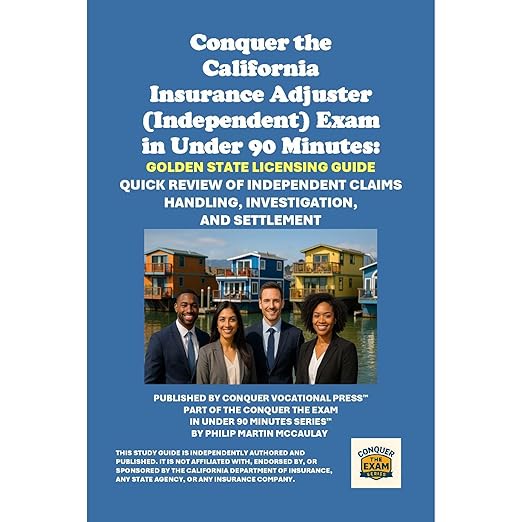
Philip Martin McCaulay's Conquer the Exam in Under 90 Minutes series has a consistent format built around the premise that focused audio review is more effective than a bloated textbook study session. This California-specific edition is directly structured around the official CDI educational objectives, which matters more than it might sound. Many so-called state-specific guides drop a state name into a generic product. This one actually aligns its chapter sequence with what the California exam tests.
Wide California Coverage in a Distilled Review
The coverage is thorough without being encyclopedic. The audiobook moves through the California Insurance Adjuster Act, licensing requirements, bonds, and disciplinary rules; through SIU regulations and fraud prevention duties; through core insurance principles like indemnity, insurable interest, and adverse selection; and on through contract structure, personal auto, homeowners forms HO-1 through HO-8, dwelling policies, commercial package, commercial general liability, commercial auto, farm insurance, workers' compensation in California specifically, ocean marine, surety bonds, and pet insurance. That is a substantial territory for eighty-three minutes of listening time, which means each section receives a distilled treatment rather than an exhaustive one.
The key question for any audio study guide is whether the compression serves the listener or merely truncates the material. McCaulay's approach here is to prioritize topic identification and regulatory specificity over deep explanation. You learn which provisions matter, what the California-specific rules require, and where the exam is likely to test. You do not get the kind of extended worked examples you would find in a classroom setting. For the final review pass before exam day, that is exactly the right calibration.
Virtual Voice Covers Wildfire Rules and SCIF Gaps
The audiobook is most valuable as a structured listening review, the kind you do in the final forty-eight to seventy-two hours before sitting for the exam, when you want to move quickly through every domain and confirm that nothing has slipped. The organization by topic area means you can return to specific sections if a particular domain feels underconfident. The California wildfire protections in the homeowners section, the Fair Claims Settlement Practices Regulations, and the workers' compensation SCIF provisions are areas where candidates often have gaps, and the guide addresses each with enough specificity to be useful.
Virtual Voice narration does the job without distinction. The material is regulatory and technical, and a human voice would be able to add appropriate stress and pacing at key terms. What you get instead is consistent, intelligible delivery without the warmth of a professional presenter. For exam prep material, that is acceptable. The content is dense enough that you will want a pad of paper nearby to note anything that triggers a recognition or a gap.
Forty Years of Precision, With a Caveat
McCaulay has over forty years of actuarial experience and more than twenty years writing exam guides, and that background shows in the precision of the content. The disclaimer is worth reading: this guide is not affiliated with or endorsed by the California Department of Insurance or PSI, and candidates should confirm current exam outlines directly with those bodies before sitting. Insurance regulations change, and any study guide has a publication date beyond which updates may not be incorporated. Use this audiobook as a review layer, not as a substitute for checking the current official exam outline.
The format rewards active listening. Because the guide moves quickly through many topics, passive background listening is not the right approach. Give it your full attention, ideally with an outline in front of you, and use it to flag where your existing preparation has left holes. The chapter on exam preparation strategies at the close of the audiobook includes useful guidance on managing the day-of experience, which is practical rather than generic.
Final Review for Candidates, Field Guide for Adjusters
This audiobook is for candidates who have already done their primary preparation and want a focused final review that covers every tested domain in sequence. It is also useful for professionals returning to licensing after a lapse who need to refresh their knowledge of current California regulatory requirements. Candidates looking for a primary study resource with deep explanations, practice questions, and worked examples will need additional materials. Taken on its own terms, as a fast, targeted audio review built around what the California exam actually tests, this guide does exactly what it sets out to do.
Public adjusters and staff adjusters who deal with California claims but have not formally studied for the Independent Adjuster credential will find the regulatory chapters, particularly the SIU fraud prevention obligations and the Fair Claims Settlement Practices section, a useful professional orientation even outside the exam context. The audiobook doubles as a compact review of California-specific adjuster obligations that practicing professionals may want in their rotation alongside the exam prep use case, making it a more versatile resource than strictly exam-focused study materials tend to be.
Good to Know
Does this audiobook cover California-specific insurance law or is it a generic exam guide?
It is built directly on the official California Department of Insurance educational objectives, so the content is state-specific. The California Insurance Adjuster Act, Fair Claims Settlement Practices Regulations, wildfire protections, and SCIF workers' compensation provisions are all addressed specifically rather than using a generic template.
Is this audiobook suitable as a primary study resource or only as a final review?
McCaulay's own framing positions it as a focused final review rather than a primary study resource. The under-90-minutes format means each domain gets a distilled treatment. Candidates who have not yet done substantial preparation should pair this audiobook with a more comprehensive primary source.
How current is the regulatory content in this study guide?
The guide is authored by an actuary with over forty years of experience, and the disclaimer notes it is not affiliated with the California Department of Insurance or PSI. Candidates should verify the current exam outline directly with those bodies before sitting, as regulations and licensing requirements can change after a guide's publication date.
What topics from the California Independent Adjuster Exam does this audiobook address?
Coverage includes the Adjuster Act, SIU and fraud regulations, core insurance principles, personal auto, homeowners forms HO-1 through HO-8, dwelling policies, commercial package and general liability, farm insurance, workers' compensation in California, ocean marine, surety bonds, and specialty coverages including pet insurance and umbrella liability.