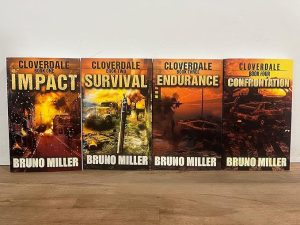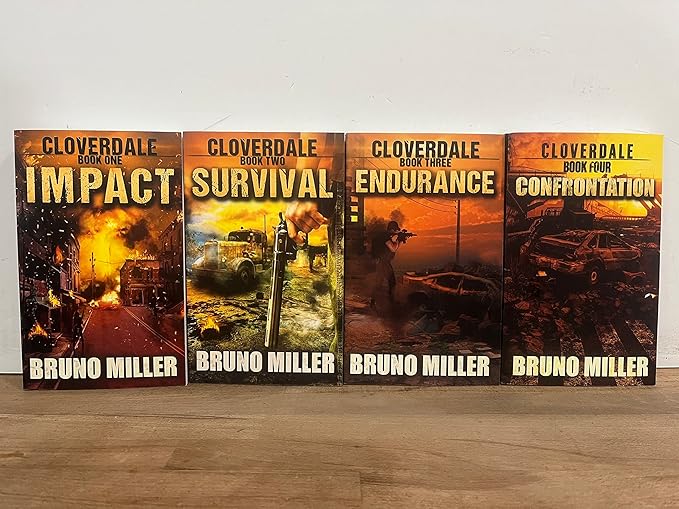
Bruno Miller's Confrontation opens at an airport, which is precisely the wrong place to be when multiple EMPs detonate across the country and the electrical grid ceases to exist. Vince Walker has gone to Indianapolis to pick up his son Cy for what was supposed to be the beginning of a summer together. Instead, the audiobook begins mid-crisis, narrated by B.J. Harrison, as fires spread unchecked, communications collapse, and the two of them must figure out how to get from a major airport to their hometown of Cloverdale, Indiana through a country that is physically and socially disintegrating around them. At four hours and forty-eight minutes, this is a tight, focused opening volume that understands the strength of its premise and does not dilute it with unnecessary world-building apparatus.
The EMP collapse sub-genre of apocalyptic fiction has a well-established set of conventions. The grid fails, infrastructure cannot be restored without the infrastructure to restore it, and society reverts to something closer to the early twentieth century in terms of available tools and social organization. Miller works within those conventions but brings specificity to the Cloverdale setting and to the Vince-Cy relationship that distinguishes this from the more abstract survivalist narratives in the genre. The father-son dynamic at the center is not incidental to the story. It is the engine that drives most of the decisions, the tension, and the emotional stakes throughout the audiobook.
Highlights
The tactical and practical dimensions of the EMP scenario are handled with the kind of detail that readers of this genre expect and reward. Miller thinks through the specific consequences of grid loss in the kinds of environments his characters are navigating: an airport with no power, city streets with no traffic signals or functioning vehicles, the progressive degradation of public order as people realize no emergency services are coming. Vince is not a prepper or a trained survivalist. He is a competent adult who is forced to think systematically about their immediate situation without the resources he would normally have access to, and Miller's writing respects the intelligence of a reader who has thought about these scenarios themselves.
The Cloverdale orientation gives the narrative a geographical focus that the more panoramic EMP novels sometimes lack. Vince and Cy are not trying to save the country or find the source of the attack. They are trying to get home. That constraint makes the journey feel personal and urgent in ways that prevent the apocalypse from becoming abstract. What's left of Cloverdale when they get there, and what they must do to save who and what they can, forms the structural promise the audiobook makes in its first act and begins to deliver on by the end.
B.J. Harrison's narration is well-matched to the survivalist thriller format. He delivers Vince's perspective with appropriate gravitas and urgency, pacing the crisis sequences without rushing them into incomprehensibility or letting them drag. The airport sequence in particular benefits from Harrison's measured delivery: the chaos is communicated through specific detail and character response rather than narrative excess, which is the right approach for a scenario where the horror is systemic rather than supernatural.
The Cloverdale Book series appears to be built around survival, endurance, and confrontation as organizing themes across multiple volumes. As a series opener, Confrontation establishes the world's parameters and the central characters' relationship with enough confidence that the series architecture feels deliberate rather than opportunistic. The four-and-a-half-hour runtime functions as an efficient introduction rather than a rushed one, covering the initial crisis and the first stage of the journey without trying to compress too much into the first volume.
Before You Commit to Confrontation
The absence of reader reviews for this specific volume is a genuine limitation when assessing quality. The series has a five-star average rating but from only two reviewers, which limits statistical confidence. The book's placement in the Cloverdale series suggests it was designed as a launch for an extended narrative rather than a standalone, which means the resolution in this volume is necessarily partial. Readers who want a complete story arc within a single purchase should be aware that Confrontation ends at a point where the larger story is well underway but not resolved.
The EMP scenario, nuclear detonation triggering multiple electromagnetic pulses across the country, is extreme and the audiobook treats it as such rather than softening the implications. The loss of utilities and emergency services is presented as genuinely catastrophic rather than as a dramatic backdrop for adventure. Miller does not use the apocalypse as an excuse for excitement. He uses it as a context for examining what people do when every institutional support structure is gone simultaneously, which is a darker and more honest approach to the premise.
The length of this volume, under five hours, makes it genuinely accessible as a series sampler. If the EMP collapse genre is new to you and you want to test whether Miller's approach suits your sensibility before committing to subsequent volumes, the short runtime makes that a low-cost experiment.
Is This One for You?
This audiobook is for listeners who enjoy post-apocalyptic survivalist fiction with practical detail, a father-son emotional core, and a geographically specific rather than panoramic scope. Readers who enjoyed William R. Forstchen's One Second After or similar EMP-focused apocalyptic fiction will find Confrontation occupying familiar and competently executed territory.
Listeners who prefer apocalyptic fiction with more action and less tactical realism, or who want a complete narrative in a single volume rather than a series opener, may find the scope and ending point frustrating. But for the EMP survivalist thriller reader who wants a character-grounded treatment of a scenario they have thought about seriously, Confrontation is a solid first entry and makes a credible case for following the series.
Questions Listeners Ask
Is Confrontation a standalone audiobook or the start of a series?
It is the opening volume of the Cloverdale series by Bruno Miller. The audiobook establishes the EMP scenario, introduces Vince and Cy Walker, and covers the initial stage of their journey home, but the larger story arc extends into subsequent volumes. The resolution in this volume is intentionally partial.
How does B.J. Harrison's narration handle the technical aspects of the EMP collapse scenario?
Harrison delivers the survivalist and tactical material with measured clarity, pacing the crisis sequences to let the specific consequences of grid loss register rather than rushing through them. The airport opening sequence is particularly well-handled, communicating systemic chaos through character response and specific detail.
Does this audiobook focus on tactical survivalism or on the human relationship at the center?
Both dimensions are present, and Miller keeps them integrated. The father-son dynamic between Vince and Cy Walker drives most of the emotional decisions and stakes, while the practical survivalist detail grounds the scenario in plausible consequence. Neither element overwhelms the other.
Is this audiobook suitable for listeners new to EMP collapse and post-apocalyptic fiction?
Yes. The four-and-a-half-hour runtime makes it a low-investment entry point, and Miller explains the relevant consequences of an EMP attack through character experience rather than technical monologue. Listeners familiar with One Second After by William R. Forstchen will recognize the scenario type; those new to the subgenre will find Confrontation an accessible first encounter.