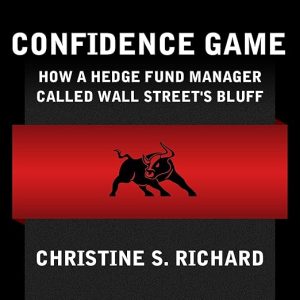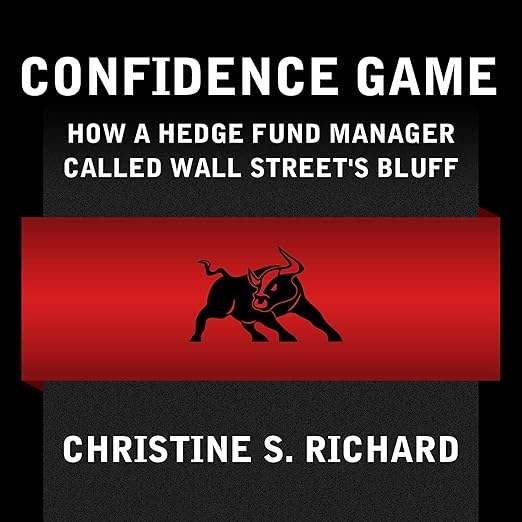
Christine S. Richard’s Confidence Game is financial journalism executed at the level of a sustained long-form investigation: meticulous, fair to its principal subjects, and built around a story that genuinely rewards the patience it demands from its listener. The audiobook, narrated by Caroline Shaffer, runs thirteen and a half hours and covers the extended campaign by hedge fund manager Bill Ackman to short-sell Herbalife, the multi-level marketing company whose business model Ackman publicly declared a pyramid scheme. The investigation centers on how Ackman came to his conviction, how Herbalife fought back, and what the prolonged public dispute revealed about how financial markets contend with contested claims about corporate legitimacy.
Richard Reconstructs Ackman's Research From the Inside
Richard had what few financial journalists achieve: genuine access to her principal subject. As one reviewer noted, Ackman gave Richard impressive access to the internal development of his research and argument, which allowed her to reconstruct the short position with a specificity that most accounts of financial disputes cannot come close to matching. This is not a book that simply observes the public stages of the Herbalife controversy from outside. It brings the listener inside the research process: how Ackman and his team built their case from the ground up, what they examined, where they encountered resistance from the data, and how the argument evolved as Herbalife and other investors pushed back against it publicly.
Richard’s background as a reporter for Bloomberg gave her the forensic vocabulary to handle this material without oversimplifying, and the book maintains its analytical edge throughout without becoming inaccessible to listeners who do not have a finance background. The mechanics of short-selling are explained clearly in the early chapters, and Richard frames the broader context of multi-level marketing regulation carefully enough that listeners can evaluate the competing claims intelligently without needing to have followed the controversy in real time when it was happening.
Shaffer Balances Technical Detail and Emotional Weight
Caroline Shaffer’s narration is well suited to investigative financial writing of this kind. She handles the technical content, which includes discussions of short-selling mechanics, regulatory frameworks, and accounting analysis, with the paced clarity that allows a listener to follow the argument without losing the thread when the detail becomes granular. The emotional texture of the conflict is not flattened by Shaffer’s delivery. She conveys the weight of what is being contested without performing drama that the factual material does not warrant, which is the right instinct for this kind of reporting-driven narrative.
Compared Favorably to Einhorn, Yet Built as Reporting
One reviewer who compared the book favorably to David Einhorn’s account of a similar short-selling dispute noted that Richard’s version is better presented and more immersive, a meaningful endorsement from a reader who has spent time in this specific corner of financial literature. The thirteen hours feel justified by the complexity of the story rather than padded by repetition or unnecessary scene-setting, and Shaffer maintains the investigative momentum across the full length of the recording without the energy dropping in the middle sections where the legal and regulatory details become most dense.
It is also worth noting what kind of audiobook this is not. Confidence Game is not a business biography in the conventional sense, focused on the personality and backstory of its central figure. It is a piece of financial reporting that happens to be structured around a single dramatic campaign, and Richard keeps the focus on the argument and the evidence rather than on Ackman's character as such. Listeners who want deep psychological portrait of the man behind the trade will find that dimension present but secondary. The primary subject is always the logic and the evidence of the short position itself, and that focus is what gives the book its durability as a document beyond the immediate controversy it describes.
The Dispute Richard Documents Stays Unresolved
The book’s length reflects the genuine complexity of the dispute it documents, but listeners should be aware that the Herbalife controversy did not reach a simple legal resolution, and Richard’s audiobook does not offer one either. She documents the case Ackman made and the vigorous response it generated, but the underlying question of Herbalife’s business model remained contested well beyond the book’s publication. Listeners who want a clear verdict delivered at the end will find the book’s conclusion somewhat open, which is honest rather than evasive: the story Richard is telling is the nature of the dispute itself rather than its final adjudication.
The audiobook is also considerably more sympathetic to the complexity of the short-selling position than some listeners might initially expect. Richard does not frame Ackman as a simple corporate antagonist or Herbalife as a straightforward victim, and the book’s evenhandedness is one of its genuine virtues as journalism. Both the strength of Ackman’s research and the legitimacy of concerns raised by Herbalife’s distributors, whose livelihoods were affected by the public controversy regardless of how the corporate questions resolved, are given space and treated seriously throughout the narrative.
Best for Listeners Who Want Real Complexity
This audiobook is built for listeners who are genuinely curious about how Wall Street’s most contentious disputes actually develop from inside the decision-making of the participants, and who want considerably more than the headline version of a famous financial battle. The book rewards patience: the early chapters establish the research methodology and the company’s history in enough detail to make the later confrontations meaningful, and those who skim through the groundwork will miss what makes the eventual conflict resonate as deeply as it does. Listeners who are interested in short-selling as a financial instrument, who follow activist investing, or who are curious about the regulatory and legal frameworks around multi-level marketing structures will find the most specific value here. Those who prefer financial narratives with clear heroes and villains will find Richard’s balanced treatment less satisfying than the subject’s high public profile might lead them to expect, but for anyone willing to sit with genuine complexity, this is among the best-reported audiobooks available on the contested terrain of Wall Street activism.
A Few Questions About Confidence Game
Does the Confidence Game audiobook require a background in finance to follow the investigation?
No. Richard explains the mechanics of short-selling, multi-level marketing structures, and the regulatory landscape clearly enough for general listeners to follow the central dispute. Prior familiarity with financial markets helps but is not required to engage with the book’s core investigation and its competing arguments.
Is this audiobook balanced in its treatment of Ackman and Herbalife, or does it take a side?
Reviewers consistently note that Richard’s treatment is even-handed. She had significant access to Ackman and his team, which gives those sections their depth, but she documents Herbalife’s counterarguments and the genuine complexity of the underlying business model questions rather than framing the story as a straightforward exposure.