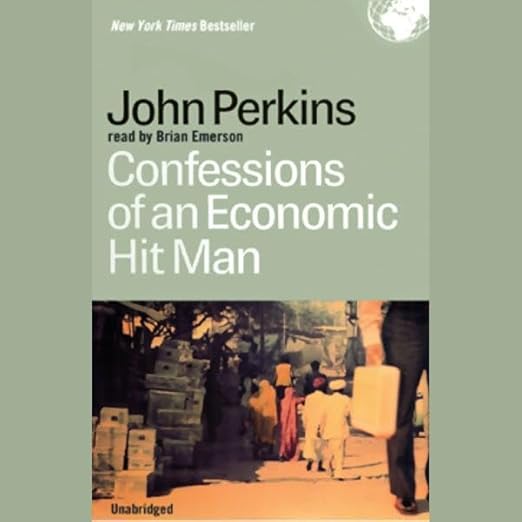
I first heard about Confessions of an Economic Hit Man from a colleague who worked in international development policy. She described it as the book that changed how she thought about the IMF. That was years ago, and when I finally sat down with Brian Emerson's narration on a long flight across the Atlantic, I understood what she meant. John Perkins is not a theorist or a journalist. He is a former practitioner of the thing he is describing, and that difference in position changes everything about how this audiobook lands.
Perkins describes his career as an economic hit man with the straightforwardness of someone who has already made peace with what he did, or is at least trying to. He laid out the mechanism plainly: engineer inflated economic growth projections for developing nations, convince governments to accept enormous loans from institutions like the World Bank, ensure those loans finance contracts for American corporations like Halliburton and Bechtel, and leave the borrowing country in debt so deep that it becomes politically compliant. As one reviewer put it, these methods are not hype, they are happening today.
Where This One Lands
What makes this audiobook stand out is that Perkins does not position himself as a hero. He was complicit. He benefited. The book's power comes partly from that honesty, and partly from the specific, named operations he describes, from Indonesia to Panama to Ecuador. Critics have questioned whether every claim is fully documented, and that is a legitimate point. One listener noted that the harshest critics repeated three concerns: the book is short on hard figures, relies on circumstantial evidence, and yet much of it is probably true. That triangulation of skepticism is itself telling. Perkins is not claiming to write an academic text. He is writing a memoir of a system, and the system's broad outlines are visible enough in public record to make the account credible in its bones if not in every detail.
The audio format serves this material particularly well. Emerson's narration has a confessional quietness that keeps the tone from tipping into polemic. There are moments where Perkins describes specific decisions, turning away from an opportunity to blow the whistle, choosing money over conscience, and Emerson lets those moments sit without editorializing. That restraint is exactly right. A more theatrical narrator might have turned this into something that felt like agitprop. Instead it feels like testimony. The 9-hour running time is appropriate for the scope of what Perkins covers, and the pacing rarely drags. He moves between personal narrative and structural analysis without losing the thread of either.
Weak Spots in Confessions of an Economic Hitman
Listeners coming to this expecting a tightly argued policy book will find the personal narrative more dominant than they might expect. The early chapters covering Perkins's recruitment and training are the strongest, because they ground the abstract mechanisms in specific human decisions. The later sections, which touch on the connections between economic coercion and geopolitical events, move faster and with less firsthand specificity. If you are already well-read on global finance and American foreign policy, you may find some of the framing familiar. If you are coming to this fresh, the framework Perkins offers, the distinction between economic hit men, jackals, and military intervention as escalating rungs on a ladder of coercion, will stay with you. It is a lens that is hard to un-apply once you have it.
Who Will Get the Most From It
This audiobook is a strong fit for listeners interested in global economics, the history of US foreign policy, or international development who want a firsthand account rather than a textbook. It works equally well for general readers curious about how large financial institutions actually function in the developing world. Those who need every claim sourced and footnoted will find it frustrating. But listeners who are willing to engage with a memoir on memoir's own terms, as a personal account of a specific kind of work inside a larger system, will find it genuinely illuminating. The running length and Emerson's measured pace make it an ideal listen for long commutes or travel.
The Short Version
- Narration: Brian Emerson delivers Perkins's confessional tone with calm authority, which suits the material well, the absence of dramatic flourish makes the claims land harder.
- Themes: Corporate imperialism, financial coercion, American foreign policy
- Mood: Unsettling and sobering, with the cadence of a reluctant confession
- Verdict: For anyone who has wondered what really drives international loan agreements and infrastructure deals, this firsthand account is unlike anything written from the inside.
Questions Listeners Ask
Is Brian Emerson's narration objective enough given Perkins is both author and subject?
Yes. Emerson keeps his delivery level and confessional in tone, which actually strengthens the material. He does not push the outrage; he lets Perkins's own account do the work.
Is this audiobook still relevant given it was originally published in 2004?
Very much so. Reviewers writing as recently as 2008 noted the methods described are happening today, and the fundamental dynamic of debt-for-influence in developing economies has not changed substantially.
Is this audiobook appropriate for someone with no background in economics or geopolitics?
Yes. Perkins writes in plain language and explains financial mechanisms as he goes. The personal narrative structure means you do not need prior knowledge, just willingness to sit with uncomfortable conclusions.