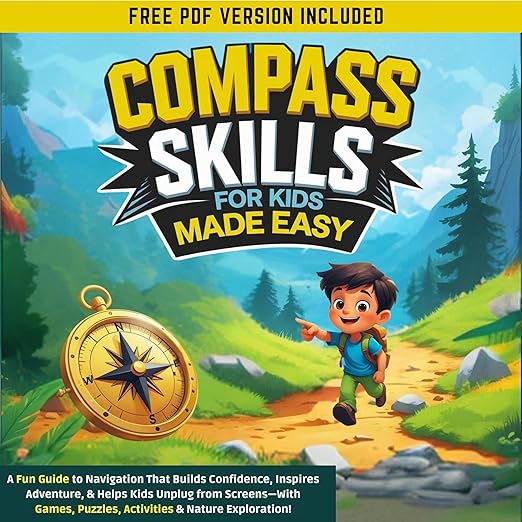
Navigation anxiety starts early. My niece once stood at the edge of a trailhead parking lot, phone battery dead, genuinely unsure which way to walk to rejoin the trail she had been on fifteen minutes before. Caleb Foster's Compass Skills for Kids Made Easy is an audiobook aimed at exactly that gap, the space between theoretical map literacy and actual outdoor confidence. Harold Erwin narrates at a pace that keeps young listeners engaged, and at three hours, the book is sized to hold attention without exhausting it. I listened through most of it on a drive back from a family camping weekend, which felt appropriately on-theme.
History of Navigation Sets Up the Compass Lessons
Foster structures the book as a practical curriculum with a storytelling frame. He opens with the history of navigation, moving from Chinese compasses through Viking wayfinding to modern orienteering, which is a smart choice: children engage with historical narrative before they engage with technical instruction, and this sequence gives them a reason to care about what follows. The compass mechanics, reading declination, triangulating position, using landmarks alongside magnetic bearings, are explained in plain language with repeated practical examples. The orientation toward real-world scenarios rather than abstract theory is one of the book's genuine strengths.
A companion PDF is available in your library alongside the audio, and that pairing is worth noting for parents and educators. The audiobook works as a standalone listen, but it is designed to pair with hands-on practice. One reviewer described the book as successfully helping children 'step away from screens and discover the outdoors with confidence,' and another noted that their child worked through the activities and emerged with genuine navigation confidence rather than just theoretical knowledge. That kind of practical transfer is exactly what Foster is aiming for, and the structure here is designed to produce it.
The activities embedded throughout are designed to be done outdoors rather than just imagined. Games, challenges, and real-world navigation missions build progressively from basic orientation to more complex triangulation exercises. The progression feels considered rather than arbitrary, moving from 'what is a compass' through to 'how do I use this to find my way back' in a sequence that most children in the target age range should be able to follow independently or with minimal adult guidance.
Harold Erwin's Measured Pace Suits Young Listeners
Harold Erwin's narration has the warm, measured quality that works well for instructional children's content. He does not perform excitement artificially or condescend with exaggerated enthusiasm. The pace is measured enough for young listeners to follow along with activities if they are listening while practicing, which is clearly the intended use. For car listening without activity access, the narration holds attention through the storytelling passages and slows naturally during the more technical segments, which is probably unavoidable given the material. The historical sections, covering real explorers and the development of navigation tools across cultures, are where Erwin's storytelling register comes through most clearly and keeps momentum up.
The digital literacy argument embedded in the synopsis is worth taking seriously rather than dismissing as anti-technology posturing. Batteries die, GPS signals fail in canyons and dense forest, and the ability to orient without a phone is a genuine safety skill. Foster makes this case without alarmism, which is the right register for children's instruction. The framing is about capability and adventure rather than fear, and the narration carries that optimistic orientation throughout.
Passive Car Listening Delivers Less Than Practice
This is an instructional audiobook, not a narrative one. Listeners expecting a story will need to adjust expectations. The book is educational content in audio form, and it functions best when paired with physical compass practice rather than treated as passive background listening. Parents who listen with children and pause to try activities between chapters will get significantly more from it than those who queue it up for solo car listening without any follow-up outdoor practice.
Very young listeners, below roughly age seven, may find the technical sections harder to follow without a visual component. The companion PDF contains illustrations that supplement the verbal descriptions of compass parts and map orientations. Without those visuals, some of the more spatial explanations require more effort to translate into mental images. For the target age range of eight to twelve, the verbal descriptions are generally sufficient, particularly after one listen through the historical context chapters.
Foster's own framing of compass skills as a 'lifelong adventure skill' rather than a survival necessity is worth noting. The book is not written from a preparedness or survivalist angle but from the perspective that knowing how to navigate opens the world in ways that GPS dependence quietly closes off. Children who learn to read a compass and a topo map before they have any reason to need those skills are simply more capable of independent outdoor movement than those who reach adulthood with only digital navigation. That argument underlies the entire curriculum, and it is a reasonable one to build a children's instructional audiobook around.
Families With Kids Age Eight to Twelve Benefit Most
This audiobook is a strong fit for families with children between roughly eight and twelve who spend time outdoors and want to build real navigation skills. It works well for homeschooling contexts, outdoor education programs, and camping trip preparation. Parents who listen alongside their children and work through the activities together will get the most from it. Adults with no compass background would learn the fundamentals from this content, though they might prefer a more adult-toned instruction resource for the same material. The target audience is genuinely younger learners building from little or no prior experience, and the book serves them well.
What age range is this audiobook designed for?
Foster targets roughly ages eight through twelve, though the content is accessible to younger children with parental guidance. The language is clear and the pacing is patient enough for elementary-age listeners.
Does the audiobook work without the companion PDF?
It works as a listen, but the PDF contains illustrations of compass parts and map orientations that supplement the verbal descriptions. For the most technical sections, having both available is better than audio alone.
Can children use this audiobook to prepare for a camping trip or hiking outing?
Yes, and that is essentially the book's primary use case. Foster builds from history through mechanics to practical outdoor scenarios, with activities designed to produce real-world confidence.
Is this audiobook appropriate for adults who want to learn basic compass skills?
The content is solid; the register is aimed at children. Adults with no orientation background would learn the fundamentals, but they might prefer a more adult-toned instruction resource for the same material.