In Brief
- Narrator: George Guidall reads Fisher's text with the measured clarity of someone who understands that good financial writing should not be performed, authoritative and easy to absorb.
- Subjects: Growth investing principles, the scuttlebutt research method, long-term conviction over market timing
- Tone: Dense but accessible, like a patient conversation with someone who has thought carefully about money for fifty years
- Bottom line: Essential listening for growth investors who want to understand where Buffett's qualitative thinking came from, compact at under three hours and substantively richer than the runtime suggests.
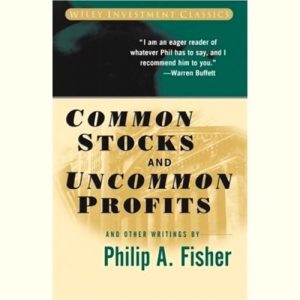
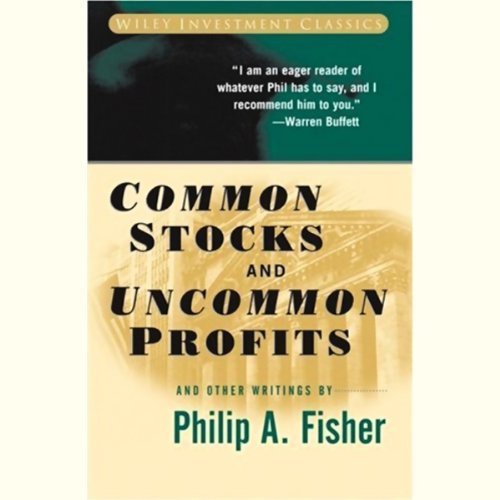
I first read Common Stocks and Uncommon Profits as a physical book years before audiobooks became my primary format for this kind of material. Coming back to it through George Guidall's narration, I was struck by how well Fisher's writing holds up as spoken text. The sentences are clean, the logic is sequential, and the examples are concrete enough that you do not need to be looking at a page to follow them. This is not always true of investment classics. The audiobook format suits Fisher in a way that it does not suit Benjamin Graham, whose Security Analysis is almost impossible to process by ear.
Fisher published this book in the late 1950s, and Warren Buffett's citation of it as a major influence is well known. What is less often noted is precisely what Fisher gave Buffett that Graham did not: the qualitative dimension of investing, the understanding that numbers alone cannot tell you whether a company is worth owning for the long term. That addition to Graham's quantitative rigor is what made Buffett into the investor he became, and Fisher is where it came from.
Is Common Stocks and Uncommon Profits Worth Your Time?
The scuttlebutt method, Fisher's term for the practice of talking to competitors, suppliers, customers, and employees of a company you are considering investing in, is the book's most practically distinctive idea. Most investment frameworks tell you to analyze the numbers. Fisher tells you to have conversations. The information that matters most about a company's quality, he argues, is rarely in the financial statements. It is in what the people around the company think about its management, its research culture, and its ability to adapt. This was a radical claim in the 1950s and remains an unconventional one today.
The 15-point checklist Fisher developed for identifying outstanding companies is the other pillar of the book, and it holds up remarkably well. Points about management's willingness to acknowledge mistakes, about the company's labor relations record, and about the research and development pipeline as a signal of future capacity are as relevant to evaluating a contemporary technology company as they were to evaluating the defense contractors and chemical companies Fisher was analyzing at the time of writing.
The Best Parts of Common Stocks and Uncommon Profits
The audiobook runs under three hours, which makes it one of the most time-efficient investments you can make in financial education. At 221 ratings averaging 4.3, this is not a book that divides its audience sharply. The core audience of serious investors consistently rates it highly, while skeptics tend to come from readers who expected something more radical or more comprehensive. What Fisher delivers is a concentrated argument, elegantly structured, and the brevity is a feature rather than a limitation.
Guidall narrates with the composed authority that his decades in the business have earned. He does not editorialize or inject enthusiasm where the text does not call for it, which is appropriate. This is a book that should sound like a considered argument, not a sales pitch.
Before You Commit to Common Stocks and Uncommon Profits
The most substantive criticism in the reviews comes from a reader who describes the book as overrated and reduces Fisher's philosophy to a formula that sounds appealing but is harder to implement than it reads. That criticism has some force. The scuttlebutt method is practically difficult. It assumes access to company insiders, competitors, and customers that individual investors may not have. Fisher was writing for professional investors with networks. The democratizing effect of the internet has addressed some of that gap, but not entirely.
The book was also written before the era of modern financial disclosure, and some of the specific situations Fisher discusses feel dated not just in their companies but in their assumptions about information availability. The principles are timeless; the specific applications require updating. Treating the book as a framework rather than a procedure will serve you better than trying to apply it literally to 2026 conditions.
Should You Listen to Common Stocks and Uncommon Profits?
This is required listening for anyone who wants to understand the intellectual history of growth investing, specifically the qualitative tradition that counterbalances the quantitative approach Graham established. Beginning investors will find the framework accessible and the principles clear. Experienced investors who have not read Fisher will occasionally recognize ideas they already hold and understand, now, where those ideas came from. Readers expecting a tactical trading guide or a book filled with stock picks will be disappointed. Fisher's contribution is philosophical, not prescriptive.
Good to Know
At under three hours, is this audiobook an abridged version of the full text, or is the book simply short?
Fisher's original text is a focused, lean argument rather than an expansive treatise, approximately 227 pages that read quickly. The audiobook is consistent with the book's natural length rather than a compression. George Guidall reads at a measured pace, and the nearly three-hour runtime reflects a complete rather than abridged text.
Is the scuttlebutt method Fisher describes practically applicable for individual investors today?
Fisher wrote for professional investors with access to company insiders and competitors through established networks. Individual investors have more access to information today through earnings calls, analyst reports, customer review platforms, and industry forums than Fisher's original readers did. But the direct conversation approach he describes still requires relationship-building that most retail investors cannot easily replicate. The method is best understood as a framework for thinking about information sources rather than a literal procedure.
How does this book hold up given that it was first published in the late 1950s?
The core principles hold up well precisely because they address human and organizational qualities that change slowly: whether management acknowledges mistakes, whether the company invests in research, whether employee relations are functional. The specific industries Fisher discusses are dated, but the framework for evaluating any company's qualitative merits is as applicable today as it was then.