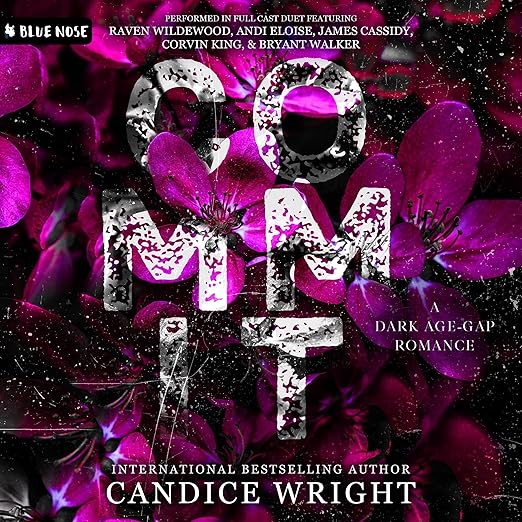
Pete next door seems harmless: the kind of neighbor who waves from his porch and remembers your name. Everyone on the street would vouch for him without hesitation. So how does a man that trusted become the person his own son's girlfriend should fear most? Candice Wright's Commit spends nine hours answering that question through the alternating first-person voices of a serial killer hiding in plain sight and the young woman he has decided belongs to him, and this audiobook edition does not soften a single one of the book's sharp edges.
Pete the Neighbor Is Secretly Hudson the Killer
The double-identity structure is the whole engine of this book. Pete, the friendly neighbor everyone trusts, is secretly Hudson, a man who kills for the thrill of it and, in the book's own blunt phrasing, sleeps like a baby afterward. Starling, an orphan everyone pities as a perpetual victim, is secretly Birdie in his private accounting of her, and the third entry in the Death in Bloom series follows what happens once his obsession with his son's girlfriend stops staying contained.
The author's own closing note sets expectations plainly and should be taken at face value: no heroes exist in this story, no sweet declarations of love, no hard-earned redemption arc. As the note puts it, 'some girls don't need a hero to save them, they need a villain willing to burn right along with them.' That's an accurate description of the book's actual moral architecture, and listeners should walk in already knowing that no character arc here resolves into anything conventionally romantic or safe.
What makes the predator's chapters genuinely unsettling rather than cartoonish is the craft challenge Wright takes on directly: writing a first-person antagonist who is charming on the surface and monstrous underneath, without ever letting the charm curdle into camp. That balance is harder to sustain across nine hours than a single shocking chapter.
Forbidden Fruit Was Always His Favorite
The series title itself, Death in Bloom, does real work as a piece of wordplay: bloom typically signals growth and romance in genre fiction, and pairing it directly against death signals from the outset that this series inverts the conventions readers usually expect from a flower-adjacent romance title. Commit, as this third entry's title, carries its own dark irony given what the word usually promises inside a romance story versus what Hudson's private version of commitment actually looks like once the plot unfolds.
The alternating first-person structure, Hudson's chapters followed by Starling's, forces a specific and uncomfortable reading experience: listeners get intimate access to a killer's justifications for his own obsession right alongside the woman he's targeting, rather than being kept at the safer narrative distance a third-person telling would allow. That structural choice is doing real work, not just alternating perspective for variety's sake.
Hudson's own line, that forbidden fruit was always his favorite, does specific work beyond a throwaway boast: it frames his predation explicitly through the lens of transgression itself as the appeal, not attraction in spite of the forbidden context but attraction because of it, a more unsettling and more psychologically specific claim than a generic dangerous-love-interest trope would make on its own.
Raven Wildewood Leads a Five-Voice Cast
This listing credits only Raven Wildewood, but the production is actually a five-voice cast, Wildewood alongside Andi Eloise, James Cassidy, Corvin King, and Bryant Walker, released through Blue Nose Publishing. For a dual-identity, multi-character dark romance like this one, that matters directly: distinct performers for Hudson and Pete's public and private registers, for Starling and Birdie's, and for supporting named characters, giving this closer to a dramatized production than a single-narrator reading.
Reader reaction is visceral in a way that tracks with the book's intent. One listener called it 'a rollercoaster ride' finished in three days; another admitted the book had them 'pretty sucked in from the very beginning' even while hating some of what was happening on the page, which is exactly the uncomfortable pull dark romance built around a predator protagonist is supposed to produce.
A multi-voice cast handling this specific predator-and-prey structure gives each perspective its own distinct emotional register in a way a single narrator switching tones would have to work much harder to achieve.
A five-person cast for a book this psychologically claustrophobic is a genuine production choice worth noting on its own terms: rather than one narrator carrying the entire predator-and-prey dynamic through vocal shifts alone, distinct performers let Hudson's public warmth and private menace exist as two genuinely different voices instead of a single actor's interpretation of the gap between them.
Hudson's Control Tightens Scene by Scene
This needs a direct content note: the central relationship is built on a predator-and-prey power imbalance, an older man targeting his own son's girlfriend under a trusted-neighbor disguise, with no redemption arc softening it by design. Listeners sensitive to grooming dynamics or morally irredeemable love interests should know exactly what they're walking into before pressing play.
Series entry point is more flexible than usual but not entirely open. One reviewer confirmed they hadn't read the first two Death in Bloom books and didn't need to, while another noted that previous characters are mentioned throughout. This reads clearly enough as book three to follow the plot, but the emotional weight lands harder with the earlier volumes already under your belt.
This sits squarely inside established dark romance convention, where a morally irredeemable love interest is the entire point rather than a flaw the plot eventually corrects; readers newer to the subgenre should know that convention going in, since judging Commit by the standards of a typical contemporary romance's redemption arc will produce a frustrating listen.
Wright builds tension less through traditional thriller pacing, chase sequences or ticking clocks, and more through the slow, dread-inducing accumulation of Hudson's control tightening around Starling scene by scene, which means listeners expecting fast external plot mechanics may find the book's real tension operating on a quieter, more psychological register instead.
Skip It If You Need a Redemption Arc
This is built for established dark romance readers already comfortable with morally irredeemable love interests and taboo power dynamics, particularly fans of the villain-protagonist subgenre who want their antagonist genuinely dangerous rather than dangerous-with-an-asterisk.
This also rewards listeners who appreciate morally complex first-person villain narration generally, in the tradition of unreliable narrators used to unsettle rather than reassure, since Hudson's chapters never once ask for sympathy even while demanding sustained attention.
Skip this one if you need any redemption arc or moral throughline for a love interest, or if predator-and-prey grooming dynamics are a hard limit rather than a genre convention you can engage with at a fictional distance; this book gives you no relief valve on either front.
Common Questions
Is this audiobook narrated by one performer, or does Commit use a full voice cast?
Although this listing credits only Raven Wildewood, the production is actually a five-voice cast released through Blue Nose Publishing, giving major characters their own distinct performers rather than one narrator voicing everyone.
Does this audiobook give Hudson and Starling distinct narrating voices?
Yes. With five credited performers across the production, the predator and prey perspectives are voiced by different people rather than one narrator switching registers, which sharpens the split between the two viewpoints.