Quick Take
- Performance: Hunter Wolfe takes on a genuinely demanding dual-register assignment, no prior track record to confirm how well Daniel's guarded anxiety shifts into Daniella's open pleasure.
- What it covers: gender transformation and forced feminization, alien abduction, permission and shame
- Feel: Intimate and concentrated, one continuous scene rather than a sprawling plot
- Our call: An efficient, genre-faithful entry for established Feminine Fate readers, not the place to start if transformation content specifically isn't your interest.
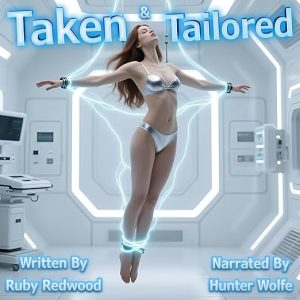
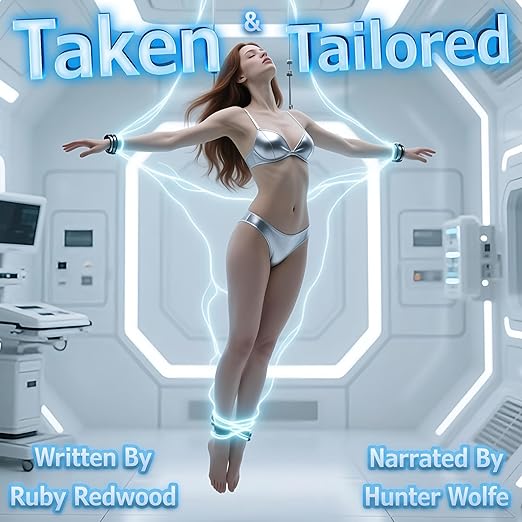
Daniel's whole identity is a performance of normalcy in this audiobook's opening pages, one his own desires have been straining against for years before an alien abduction forces the issue entirely. Taken and Tailored is part of Ruby Redwood's Feminine Fate series, built specifically around male-to-female gender transformation stories, and this entry wastes little time establishing its premise: Daniel is taken aboard a vessel commanded by Vexa, leader of an all-female alien species with a unique anatomy of their own, who offers him a proposition rather than forcing an outcome outright, a complete, reversible transformation into the woman she believes he's always wanted to become.
Permission and Shame Drive the Real Arc
Gender transformation, or forced feminization, is a well-established erotica subgenre with its own specific conventions, and Redwood follows the genre's core structure closely: a protagonist who's spent the story's opening pages suppressing a desire he can't admit aloud, an outside force that offers permission rather than simple compulsion, and a transformation process narrated in physical, sensory detail as it happens rather than summarized after the fact. The reversibility Vexa promises Daniel is doing real narrative work here too, a common device in this specific subgenre that lowers the stakes just enough to let the fantasy proceed without the story having to resolve bigger identity questions the premise otherwise raises.
Underneath the explicit transformation content, the actual emotional arc is about permission and shame rather than plot mechanics: Daniel spends the setup hiding what he wants, and Daniella's eventual acceptance of her new existence is framed as the payoff of finally being allowed to want something openly. That's a fairly sophisticated emotional throughline for a book running under an hour and a half, worth naming directly, since a reader coming to this expecting pure physical description without any interiority would actually be undersold on what the book is trying to do.
Tailored Means Bespoke Craftsmanship Not Violation
The alien framing specifically is doing more narrative work than it might first appear. Making the transformation an advanced biological procedure performed by an alien commander, rather than magic, a curse, or an unexplained mystery, gives the story a strange kind of internal logic: Vexa can speak with total authority about what the process will feel like and how far it goes, because it's presented as something closer to established alien science than an experiment neither party fully understands. That confidence in the world's own rules is part of what lets the erotica move quickly without needing pages of setup to justify itself.
The word 'Tailored' in the title is worth a second look too, since it frames the transformation less as a violation and more as bespoke craftsmanship, closer to how a tailor reshapes a garment to fit its wearer than how a punishment reshapes a body. That word choice does real work setting the book's tone before the story even starts: this is erotica interested in the pleasure of being precisely fitted to a new self, not primarily in cruelty or degradation for its own sake, a meaningful distinction within a subgenre that can lean either direction.
Hunter Wolfe Shifts From Daniel to Daniella
Hunter Wolfe narrates without any confirmed performance history to point to here, so the honest assessment has to be about the demands of the material rather than a track record. This is a genuinely difficult single-narrator assignment: Daniel's guarded, anxious register in the opening pages has to shift convincingly into Daniella's more open, pleasure-forward voice by the end, all within one credited performance and a tight runtime that doesn't leave room to ease into the transition gradually. How well that dual arc lands is the real craft question for anyone considering this specific title.
For readers already invested in the gender transformation subgenre specifically, being one entry in an established, ongoing Feminine Fate lineup from the same author means this can be judged against a body of comparable work rather than as an isolated one-off. The alien-commander framing also gives the transformation a clean, low-stakes justification, an advanced, reversible alien technology rather than anything requiring the story to engage with real-world gender identity themes directly, which keeps the fantasy contained to its own premise.
Because each entry in this series appears to center a different protagonist's own transformation rather than following one continuing couple, readers can also sample individual titles based on which particular fantasy or character setup appeals most, rather than needing to track an overarching plot across entries. That structure, common in erotica series generally, lowers the commitment required to try Redwood's work for the first time.
Vexa's Proposition Is a Soft Dubious Choice
At 1 hour and 25 minutes, this reads closer to a single extended scene than a full novella with multiple acts, so anyone expecting a longer, slower-building arc around Daniel's transformation should recalibrate expectations toward the short-fiction end of the format rather than a full-length story. No listener reviews or rating are attached to this title yet, so nothing here can be checked against outside listener reaction beyond what the synopsis itself promises.
The premise also leans on a soft dubious-consent framing typical of the genre. Vexa's proposition is presented as a choice, but one shaped heavily by her own persuasion and existing knowledge of Daniel's private fantasies, worth knowing going in if that dynamic isn't your preference within transformation erotica specifically. Because the series groups these as standalone entries built around a single shared premise rather than a continuous plot, don't expect much ongoing worldbuilding about the alien culture Vexa leads; the focus stays tightly on Daniel and Daniella throughout.
The tight runtime also means the aftermath, what Daniella's life actually looks like once the transformation is complete, gets comparatively little room next to the transformation process itself, clearly where the book puts most of its energy and attention. Readers more interested in post-transformation daily-life fantasy than in the transformation sequence itself may find this entry front-loaded toward the part they care about less.
Curious Readers Get a Low-Commitment Entry
Existing readers of Ruby Redwood's other Feminine Fate entries, or anyone specifically drawn to gender transformation and forced feminization as an erotica subgenre, are the clear intended audience, and this entry delivers the genre's core beats efficiently within its short runtime. It also works as a low-commitment way to sample the subgenre for a curious reader who hasn't tried it before and wants a single, self-contained scene rather than committing to a longer series first.
This isn't the entry point for anyone uninterested in gender transformation content specifically, or uncomfortable with the alien-commander premise doing double duty as a soft dubious-consent setup. The short runtime also means minimal plot or worldbuilding exists beyond the central transformation itself, so readers wanting a fuller story around the premise, rather than one concentrated scene, should look toward a longer entry in the genre instead.
Questions Listeners Ask
How explicit is the content in this audiobook?
Very explicit, centered on Daniel's physical and psychological transformation into Daniella, with the gender transformation itself, not just the sexual content, forming the core of the book's fantasy.
How long is the Taken and Tailored audiobook, and does that runtime cover a full story?
It runs just 1 hour and 25 minutes, closer to a single extended scene than a full novella, so don't expect an elaborate plot beyond the central transformation premise.