In Brief
- Voice: Ruby M. Stevens brings a calm, non-performative delivery that matches the book's practical, conversational tone and keeps the material feeling instructional rather than theatrical.
- Big ideas: communication as the foundation of BDSM, consent and safety frameworks, navigating vulnerability with a partner
- Atmosphere: Direct and reassuring, demystifying without being clinical
- Worth it?: A practical, jargon-light guide for couples or individuals ready to start an honest conversation, though listeners seeking advanced techniques or detailed protocols will need to look elsewhere.
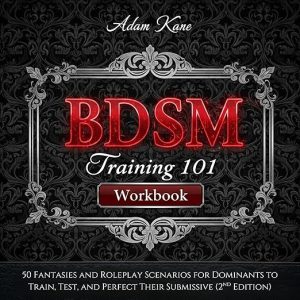
Adam Kane's BDSM Training 101 Workbook (2nd Edition), narrated by Ruby M. Stevens, leads with its most important tool: the conversation that has to happen before anything else. The audiobook's framing from the very first chapter is that the biggest obstacle to introducing BDSM into a relationship is not equipment or expertise. It is the moment of saying the thing out loud to someone you trust and care about. Kane centers that moment, sits with why it is so terrifying, and then offers something more useful than reassurance. He offers a structure for the conversation itself.
In a genre crowded with books that either treat BDSM as an edgy novelty or drown readers in technical specificity, this 5-hour-and-45-minute audiobook positions itself deliberately in the middle. It is aimed at couples who are already curious but have not started the conversation, and at individuals who want to bring something new to a relationship without the cold-plunge of arriving with a list of demands. The second edition refines the approach of the first without abandoning its core accessibility, and Stevens's narration underscores that accessibility throughout.
Workbook Structure Built Around One Conversation
The workbook structure adapts reasonably well to audio format, though not perfectly. Kane has designed this as an interactive guide, with prompts and exercises that ask you to pause and engage rather than simply absorb. Stevens handles this by reading the prompts at a pace that gives them room to breathe, and the practical tone of the narration reinforces that this is not entertainment but a tool. Listeners who treat this audiobook as passive background listening will get significantly less from it than those who actually stop when invited to reflect.
The approach Kane takes to the opening conversation is specific and useful. He does not just say "talk to your partner." He gives you a setting, a low-stakes evening away from moments of conflict or sexual anticipation, an opening line that is vague enough not to overwhelm, and a framework for reading the initial response and deciding how much further to go. That level of practical granularity is what the book does best, and it sustains through several chapters covering bondage basics, sensation play, and establishing roles without requiring a rehearsal space or specialized tools. Kane also dedicates substantial attention to safety protocols and the use of safewords, treating consent not as a disclaimer but as the foundation the entire practice is built on.
Stevens's Steady Voice, Grounded in Application
Ruby M. Stevens's narration is well-chosen for this material. A more theatrical or seductive reading would undermine the book's practical credibility. Stevens sounds like someone walking you through something useful rather than performing it, and that distinction matters enormously in a guide that is asking listeners to lower their guard and engage honestly. When Kane's text addresses anxiety and the fear of judgment directly, Stevens reads those passages without condescension, which makes them land rather than bounce off.
The audiobook earns its title as a workbook rather than a manifesto by staying close to application throughout. Kane does not spend significant time on the history or sociology of BDSM communities, and he does not get into debates about categories and labels. He stays with the practical question of how to begin with the person in front of you, which is exactly what the target audience needs. The safety and consent framework is woven through the material rather than siloed into a single disclaimer chapter, which gives it appropriate weight without becoming a lecture. The discussion of aftercare, which is the practice of tending to each other's emotional and physical state following a scene, is handled with particular care and represents one of the book's more mature contributions to the genre.
Built for Beginners, Not Advanced Practitioners
The workbook structure creates a genuine audio challenge. Exercises that ask you to write, to discuss, or to physically practice what you have just heard are difficult to engage with while the audio continues. This is not a criticism of the audiobook's production. It is a structural reality of translating workbook material to audio, and listeners should come prepared to pause frequently and to treat this as a conversation starter rather than a single-sitting listen. Playing certain sections with a partner rather than solo will considerably increase the book's practical value.
Advanced practitioners or those already comfortable with BDSM frameworks will find little new here. Kane writes for the genuinely uninitiated, and the second edition maintains that focus. The protocols, techniques, and community knowledge that experienced practitioners are interested in are not the subject of this book. Similarly, those expecting detailed guidance on specific implements or advanced bondage techniques will find the coverage lighter than they want. The book is a beginning, not a comprehensive reference, and it is stronger for knowing its scope and staying within it.
Opening a Door, Not Jumping Off a Cliff
This audiobook is most useful for couples who are curious but stuck at the stage of not knowing how to begin the conversation. It is also genuinely valuable for individuals who want to understand their own desires better before bringing them to a partner. The practical, non-judgmental framing makes it accessible to listeners who carry anxiety about what their curiosity means about them, and Kane addresses that anxiety directly rather than brushing past it.
Listeners looking for explicit content or fantasy-driven erotica will not find it here. This is a how-to guide, not a novel. Those already comfortable in BDSM communities will find the foundational scope limiting. But for the listener who has been sitting on a conversation with a partner for longer than feels comfortable, this audiobook provides a structure that makes starting that conversation feel less like a cliff jump and more like a door that can be opened carefully, at whatever pace both people are ready for.
Can you listen to the BDSM Training 101 Workbook audiobook solo, or does it require a partner?
You can listen solo, and many of the exercises around self-reflection and identifying your own desires are designed for individual engagement. However, the sections on conversation and practice are significantly more useful when shared with a partner, and some prompts are explicitly couple-directed.
How explicit is the BDSM Training 101 Workbook (2nd Edition) audiobook?
It is instructional rather than explicit. Kane writes about BDSM practices with frankness and specificity but without erotic narrative content. If you are looking for explicit fiction or erotica, this book is not that. It is a practical guide focused on communication, safety, and beginning practice.
Is the audiobook version as useful as the print workbook, given that it has interactive exercises?
It is useful but requires more active engagement than typical audiobooks. You will need to pause frequently to do the reflective and practical exercises. Treating it as background listening will significantly reduce its value. A notebook alongside the audio session is a reasonable approach.