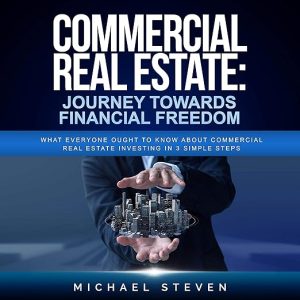
The commercial real estate market has a persistent reputation problem for individual investors: it seems categorically inaccessible, scaled for institutional players, and requiring expertise and capital that most people who invest in stocks or residential property simply do not have. Michael Steven's audiobook Commercial Real Estate, narrated by John Fehskens across three hours and thirty-two minutes, is specifically designed to challenge that assumption. It is an introduction in the most generous sense of the word, covering the fundamental differences between commercial and residential real estate, the key financial metrics that determine property value, and several financing strategies that do not require a millionaire's down payment.
The context that shapes this audiobook is important to establish early. One reviewer who came to it curious about commercial real estate after previous experience with residential property notes that they would have been really in trouble if they had assumed the fundamentals were the same and dipped a toe without reading this first. That is an honest and useful endorsement of what the book is actually providing: not a comprehensive operational guide, but a sufficiently detailed orientation to help someone understand what they are actually getting into before they get into it.
Cap Rates, REITs and Seven Passive Options
The book's most valuable contribution is its treatment of the structural differences between commercial and residential real estate that matter for an investor rather than a developer or operator. The tenant quality and lease length advantages that commercial properties carry over residential, the calculation of net operating income and capitalization rates as valuation tools, and the distinction between asset types within commercial real estate, office, retail, industrial, multifamily, are covered with enough depth to build a usable mental model without overwhelming a first-time reader with complexity they cannot yet apply.
One reviewer notes accurately that the book positions you better to start learning rather than to move confidently into commercial real estate after a single read. That is the right calibration. Steven is not writing a manual for someone ready to acquire their first commercial property; he is writing for someone who does not yet have a framework to understand what questions they should even be asking. That is a distinct and genuinely useful contribution, and the audiobook delivers it clearly.
The seven passive investment vehicles the book covers, including REITs and real estate crowdfunding platforms, are among the more practically useful sections for listeners who want exposure to commercial real estate without the operational complexity of direct ownership. Steven presents these not as lesser alternatives but as legitimate portfolio tools with distinct risk and return profiles, which is a more balanced treatment than many introductory real estate books that focus exclusively on direct acquisition. For a listener at the beginning of their real estate education, understanding that the asset class is accessible in multiple ways, not just through property ownership, is genuinely valuable orientation.
Fehskens Keeps Financial Content From Drying Out
John Fehskens's narration suits the material well. This is expository financial content, and the primary narration requirement is clarity and consistent pacing rather than dramatic range. Fehskens does not let the material become dry despite its subject matter, which is the relevant risk for a three-plus-hour audio guide to investment vehicles. The chapters are structured to move through discrete concepts in sequence, which means the audiobook translates well to listening in sessions and works naturally as background for attentive listening during commutes or exercise.
The runtime of three hours and thirty-two minutes is appropriate for an introductory text. There is nothing padded here; Steven covers what he covers with economy. Listeners who need more depth on any individual topic, financing structures, due diligence, specific property types, will need additional resources, and the audiobook is honest about this rather than pretending to be exhaustive. That self-awareness about scope is one of its better qualities.
A 12.7% Return Number Worth Doubting
The due diligence checklist that Steven includes is one of the audiobook's most practically useful features. While audio is not the ideal format for working through a checklist in real time, the act of hearing what due diligence on a commercial property actually involves, zoning verification, lease review, environmental assessment, rent roll analysis, tenant credit evaluation, gives a first-time listener a realistic picture of the operational complexity involved before they are deep into a transaction. Knowing what questions to ask is different from knowing the answers, but it is the prerequisite, and Steven provides it clearly.
The statistical claim in the synopsis, that commercial real estate has returned an average of 12.7% annually over fifteen years versus 8.8% for the S&P 500, is sourced to the NCREIF Property Index, which measures the performance of institutional-grade commercial properties. This is not the same universe of assets that an individual investor with limited capital would be accessing, and the gap between institutional-quality commercial property returns and what a smaller investor can expect is a distinction the audiobook does not dwell on. Listeners should hold that figure with appropriate skepticism about its applicability to their own situation.
The book was written as a general introduction rather than a jurisdiction-specific guide, which means some of the regulatory, tax, and financing specifics will vary significantly by country and state. Listeners outside the United States, or those in states with unusual real estate regulatory environments, will need to verify that the framework translates to their context before acting on any specific guidance.
For Residential Investors Eyeing Commercial Property
This audiobook is best suited to investors who have some experience with residential real estate or traditional market investing and are wondering whether commercial property deserves a place in their portfolio. It gives them the conceptual vocabulary and the structural framework to have informed conversations with brokers, lenders, and advisors without feeling entirely out of their depth. Experienced commercial real estate professionals will find nothing new here, and listeners who want to move quickly to operational detail or deal analysis should seek out more advanced resources. As a first step for a curious and motivated beginner, it does exactly what it sets out to do.
Frequently Asked Questions
How does John Fehskens's narration handle the financial and technical content in this audiobook?
Clearly and at a pace that allows the concepts to land without needing to rewind frequently. For expository financial content, clarity and consistent pacing are the primary requirements, and Fehskens delivers both. The material is not dramatized or inflated, which suits the practical, information-forward register of the book.
Does this audiobook cover creative financing strategies for investors without large amounts of capital?
Yes, this is one of its most frequently cited useful sections. The book covers four creative financing methods that do not require a large personal down payment, as well as passive investment vehicles that allow exposure to commercial real estate starting at relatively low minimum investments. These sections are what differentiate it from a purely institutional perspective and make it relevant for individual investors.