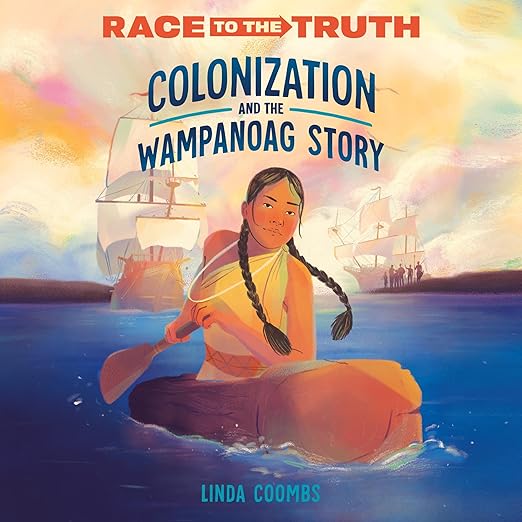
Every American schoolchild learns the same opening scene: three ships in 1492, then buckled hats and shoes stepping off the Mayflower, ready to start a country. This audiobook begins by pointing out that the people doing the stepping arrived to find nations already living on the land they were about to disrupt, and that almost everything told since has been carefully misrepresented. Listening Library released Linda Coombs's account on 12 September 2023, read by Carolina Hoyos, at five hours and twenty-five minutes, as part of a series the record names Race to the Truth.
A Tag That Is Accurate and Unhelpful at Once
Correction rather than survey is the premise. Instead of narrating early America and adding an Indigenous chapter, the book takes the New England Indigenous Nations as the point of view and lets the familiar version become the thing under examination. The copy names its targets by name, Christopher Columbus, the Pilgrims and the Colonists, and singles out the first Thanksgiving as the episode that has been handled worst. That is a narrow, deliberate scope, and it is what makes five and a half hours a sufficient length rather than a compromise.
A March 2026 entry gives the shortest useful summary of what the book achieves: educational and engaging, presenting history in an accessible way for young readers, and a good addition to learning about early American history. It also puts the level at middle school. That matches the runtime and the register of the copy, which addresses its reader directly and assumes nothing beyond a standard classroom account of the founding.
Where a listener is left slightly stranded is on placement. The record files this under children's audiobooks with a History tag, which is accurate and unhelpful at once: the two labels together suggest something gentler than a book whose subject is dispossession and the deliberate misrepresentation of it. Parents shopping the children's shelf on label alone should read the description first, because the book is not difficult so much as unsparing.
The Arrival, Narrated From the Shore Rather Than the Deck
Construction is what the December 2023 response gets at, and that is the most valuable thing anyone has written here. Each section, it says, opens with a story set before colonization, easy to relate to and easy to understand, and then moves into the factual nuts and bolts. The child listening alongside preferred the factual parts. That alternation is precisely what carries in audio: a scene establishes the stakes, then the information arrives with somewhere to land.
Length is part of the design. Five hours and twenty-five minutes is roughly the span of a school unit, short enough to finish across a week of car journeys and long enough to do more than assert a thesis and move on. Set that against the adult histories covering the same ground at three times the runtime and the calculation behind this edition becomes obvious: it is built to be finished, including by someone who did not choose the subject themselves.
Perspective is the whole product, and it is worth being precise about what that delivers. This is not a book arguing that the standard account is incomplete; it is a book narrating the arrival from the shore rather than from the deck. Communities living in harmony with land they had inhabited for thousands of years, and then outsiders who disrupted everything they saw. A listener gets the sequence in that order, which is the reversal the title promises.
A Pledge to Buy a Copy for Every School
Oddest of all is a five-star headlined Good read whose entire body says it just did not have what the buyer was looking for. Filed on 7 November 2025, it is the cleanest available demonstration that a star on a page like this is not a verdict on the book. Two others treat it as a printed object rather than as a file. Every one of the five is grading a book, and the edition on sale here is a different object; nothing on this page reports on it.
One entry from November 2024 is about the book's reception rather than its contents. It describes an effort to have the title reshelved out of non-fiction, objects to that effort in strong terms, and closes by pledging to buy a copy for every elementary school in a Michigan county. Whatever a reader makes of the argument, it is useful information: this is a book that has attracted organized objection, which is context a parent or teacher may want before assigning it.
Production questions sit unanswered on this record. The series field names Race to the Truth but leaves the number blank, so nothing here tells you where this volume sits in the set or what the other entries cover. And Carolina Hoyos carries the file alone across material that keeps switching between a storyteller's register and a straightforwardly factual one. Sampling a passage that crosses from one into the other is the fastest way to hear whether the change is signaled or simply happens.
Teachers Get No Chapter Breakdown to Plan Around
Take it if you have a listener between roughly nine and fourteen who is getting the standard founding story at school and deserves the other half. Take it also if you are an adult who never got the other half: the 8 November entry, which simply appreciates learning more about this group of people, is not a child's response, and the book works perfectly well at that level.
A classroom copy is the obvious use, and the one caution is scale: five hours and twenty-five minutes is a commitment for a unit, and the record gives no chapter breakdown to plan around. Teachers wanting a single lesson rather than a full arc should sample and time the sections before building a plan on them.