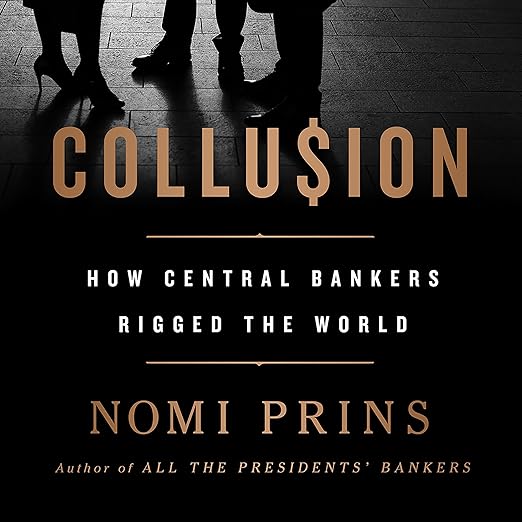
I came to Collusion on a rainy Sunday afternoon, already partway through a stack of post-crisis financial books I had been working through for months. I had read the canonical accounts of 2008, the insider memoirs from Treasury officials, the academic post-mortems. What I had not read was a book that tried to stitch together what happened next, in the decade of ultra-loose monetary policy that followed the collapse. Nomi Prins, a former Goldman Sachs managing director turned financial journalist, does exactly that, and she does it with a level of on-the-ground reporting that makes the difference between a book that explains and one that merely theorizes.
The core argument of Collusion is deceptively simple: after the financial crisis, central bankers in the US, Europe, Japan, China, and the emerging world began coordinating in ways that had no real democratic mandate and no meaningful oversight. The result was an unprecedented flow of fabricated money into global asset markets, a process that enriched the already wealthy while leaving structural economic problems largely untouched. Prins traveled to Mexico, Brazil, China, Japan, and across Europe to document how this played out on the ground, and the reporting gives the book a texture that most financial non-fiction simply does not have.
Central Bankers Form a Closed Circuit at Retreats
What Prins does particularly well is translate the language of central banking into something that feels real. The names that populate the book, Janet Yellen, Mario Draghi, Ben Bernanke, Christine Lagarde, are familiar to anyone who follows financial news, but Prins shows them in a different light, as participants in a closed circuit of elite coordination that happens at retreats like Jackson Hole and Davos, far from any parliamentary chamber or public accountability. The detail about the exclusivity of Jackson Hole as a venue for the world most consequential monetary conversations lands with quiet force.
One reviewer warned that the book is highly technical and that it rewards perseverance. That is accurate. The first few chapters are dense with acronyms and institutional names, and listeners without a background in macroeconomics will need to lean on the glossary. But multiple reviewers noted that once you push through the early density, the architecture of the argument becomes clear, and with it a real sense of what is actually going on. The analogy to needing two master degrees to follow the first third before it smooths out is not entirely unfair, but it undersells what Prins achieves in the back half of the book.
Prins Connects Central Bank Decisions to Brexit
The geographic structure of Collusion is one of its genuine strengths. Rather than treating the post-crisis monetary world as a story centered on the Federal Reserve, Prins dedicates significant space to Mexico navigation of its fraught relationship with Washington, to Brazil role in challenging dollar hegemony through the BRICS framework, to China long game of building financial infrastructure outside the existing US-led system, and to Japan extraordinary experiment with negative interest rates. Each section functions almost as a standalone essay, grounded in interviews and local reporting, and the cumulative effect is a picture of a world actively reorganizing itself around the fissures created by 2008.
The Brexit chapter, which argues that the European monetary response to the crisis created precisely the kind of populist resentment that produced the 2016 vote, is particularly strong. Prins connects abstract central bank decisions to concrete political outcomes in a way that feels both rigorous and urgent. It is the kind of analysis that would be easy to make glibly but that Prins earns through the weight of evidence she has assembled.
Archer's Steady Delivery Never Editorializes the Acronyms
Ellen Archer handles the narration with the kind of steady, even delivery that dense non-fiction demands. She does not editorialize, does not punch up language that is already punchy, and does not stumble over the technical vocabulary that would trip up a less prepared narrator. At fourteen and a half hours, this is a commitment, and Archer consistency matters. The only genuine challenge is that the book contains extended passages of institutional names and acronyms that are difficult to absorb aurally, regardless of how well they are read. This is a book that rewards a second listen, or at minimum the habit of pausing to let a particularly layered passage settle.
Lords of Finance Fans Get a Global Follow-Up
Listeners who come to Collusion expecting a polemic will be surprised. Prins is not writing fear journalism. As one reviewer specifically noted, she does not sensationalize or create fear around her material. The argument is serious and the evidence is carefully marshaled, and it respects the reader intelligence even when it demands a lot of it. If you have already worked through books like Lords of Finance or The Big Short and want something that picks up the story after the crisis and takes it global, this is precisely the book that fills that gap. If you are new to financial non-fiction and have not built up a working vocabulary of central bank mechanisms, you may find the early going difficult enough to discourage you from reaching the more accessible later sections.
Key Details
- Narration: Ellen Archer brings measured authority to dense financial material, keeping the prose from becoming impenetrable even when Prins moves into technical territory.
- Themes: Central bank coordination, post-crisis geopolitics, inequality and money creation
- Mood: Serious and methodical, with an undercurrent of slow-burning alarm
- Verdict: Essential listening for anyone who wants a ground-level account of how global central banks reshaped the world order after 2008, though patience with financial terminology is required.