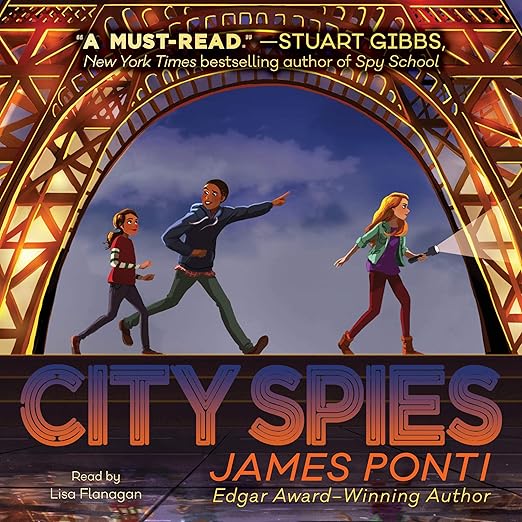
Sara Martinez opens this audiobook facing years in a juvenile detention facility for the crime of proving her own foster parents were cheats and lawbreakers. Instead of a cell, she gets an unlikely rescue: a British operative one review nicknames Mother pulls her out of the system entirely and offers her a bed inside a secret MI6 operation disguised as a boarding school in Scotland. Within a few chapters she is dangling thirty feet off a Paris building trying to stop a rival team from winning a million euros at an international youth summit. That whiplash, from foster-care bureaucracy to international espionage, is City Spies in miniature: grounded trouble followed by an enormous, cheerful escalation.
A Handler With Three Passports and Three Names
James Ponti builds the premise around five kids pulled from different countries, each given a new identity built around a city name once they join the program, which is where the title comes from. One review, from Lois Fisher, fills in details the synopsis leaves vague: the team's base gets nicknamed the FARM, Sara's own new code name becomes Brooklyn, and the operative running the whole operation is described in that same review as a weird British guy with three passports and three different names. None of that lands as heavy espionage fiction. Fisher's review names the comparison outright: Think Spy School. That is a fair description of the tone, adventure plotting with real stakes kept just light enough for a middle-grade audience.
Before any of the espionage begins, the five recruits spend their days at what looks like an ordinary boarding school and their evenings training in skills the synopsis lists specifically: sleight of hand, breaking and entering, observation, and explosives. That structure, ordinary school by day, spy academy by night, gives Ponti two very different registers to alternate between, and it sets up the book's biggest set piece cleanly. Sara is sent to Paris for the summit, tasked with hacking a rival school's computer system to stop it from winning that million euros, and ends up dangling off the side of a building before the sequence resolves. None of the five reviewers dwell on this scene specifically, but it is the clearest evidence in the synopsis itself that the series earns its Action & Adventure tag instead of just wearing it.
Reviewers consistently single out the ensemble as the book's real strength. J. Dieterle, already a fan of Ponti's FRAMED series, calls the cast of kids fantastic and diverse, and notes that even some of the adults get their own backstory instead of staying purely functional. SBentley's review adds an unusually specific detail: reading the book aloud to a rising seventh grader over a summer, the reviewer found the accent work genuinely challenging, since the cast pulls kids from multiple countries and each needs a distinct voice. That is precisely the job a narrator inherits with this material, worth remembering that this particular account describes reading a print copy aloud, not listening to the audiobook itself.
Flanagan's Accent Work Goes Unconfirmed by Reviews
Lisa Flanagan takes on a genuinely demanding assignment here: five kid protagonists from different countries plus a rotating cast of adult handlers, all needing to stay distinct across nearly seven hours. Nothing in the attached reviews comments on the narration directly, so no outside account yet exists to confirm how the accent work actually lands, but the material itself, per SBentley's own experience trying to do the same thing out loud, sets a real bar. A single-narrator middle-grade spy adventure lives or dies on exactly this kind of differentiation, since young listeners need to track five new characters quickly without the dialogue tags a printed page provides.
The pedigree stacked around this book is specific, not generic jacket-copy puffery: an Edgar Award for Ponti, a New York Times bestseller tag, a GMA3 Summer Reading Squad Selection, and a blurb from Beth McMullen, author of Mrs. Smith's Spy School for Girls, asking so when do I get the sequel. Stuart Gibbs is quoted calling it a must-read. For a first installment competing in a crowded field of kid-spy series, that is an unusually credentialed launch.
Two Votes Can't Average to 4.7
What to watch for starts with the number on the page, and it is worth walking through plainly. The badge reads 4.7 across a counter of exactly two ratings. Two whole-star votes can only average to 2.0, 2.5, 3.0, 3.5, 4.0, 4.5, or 5.0, since two integers divided by two always land on a whole number or a half; 4.7 is not on that list under any combination, which means the displayed figure cannot describe the two votes the counter claims to hold. Meanwhile five full written reviews sit on the same page, every one of them four or five stars. The gap between a two-vote counter and a five-review comment section, on a book carrying an Edgar Award and a bestseller tag, says more about how this listing's numbers were assembled than about the book itself.
Two of the five attached reviews break off before finishing their point, J. Dieterle's list of praise and Lois Fisher's account of Sara's hacking skills both stopping short, so anyone reading them for a full account should expect incomplete testimony instead of a rounded verdict. Newcomers should also know this is the first entry in a numbered series: Nikki Leisten's review already anticipates book two, so the ending is built to continue, not close.
A Shared Listen That Rewards a Diverse Cast
At six hours and fifty minutes, the runtime sits at the longer end of what a middle-grade audiobook usually asks of a young listener, closer to a chapter-a-night commitment than a single free afternoon, which is worth factoring in before starting it with a reluctant reader. Middle-grade listeners who like their adventure fast and international, plus parents looking for a shared listen that rewards a genuinely diverse cast, are the clearest audience. Nikki Leisten's review specifically credits the book's popularity in a middle school library, and Fredamichelle's review describes enjoying it together with two sons at home, which suggests it holds up as a family listen as much as a solo one.
Listeners who want grounded realism instead of boarding-school spy fantasy, or who need a completed story arc instead of a series opener, should look elsewhere. Fans expecting the plot mechanics of adult espionage fiction will also find the stakes deliberately softened for a younger audience throughout.
A Few Questions About City Spies
Is City Spies audiobook appropriate for a middle-grade audience?
Yes. The synopsis and every attached review describe a complex thriller that stays free of gore, per Lois Fisher's own description, with stakes calibrated for young readers. Parents reading or listening alongside kids, as two reviewers did, report it holding up as a shared experience.
What does the 4.7 rating on this audiobook actually reflect?
Very little with precision. The counter shows only two ratings, and two whole-star votes cannot mathematically average to 4.7 under any combination. Five full written reviews, all four or five stars, sit on the same page as that two-vote counter.