Key Details
- Narration: Virtual Voice handles expository sections adequately but loses the thread across sharp topic shifts, making transitions feel more disjointed than a human narrator would.
- Themes: intelligence tradecraft as self-improvement, memory mastery, cognitive bias and decision-making
- Mood: Eclectic and ambitious, occasionally scattered
- Verdict: An entertaining survey that covers unusual ground across memory science, cryptography history, and OSINT, though the depth rarely matches the breadth and AI narration is a real friction point.
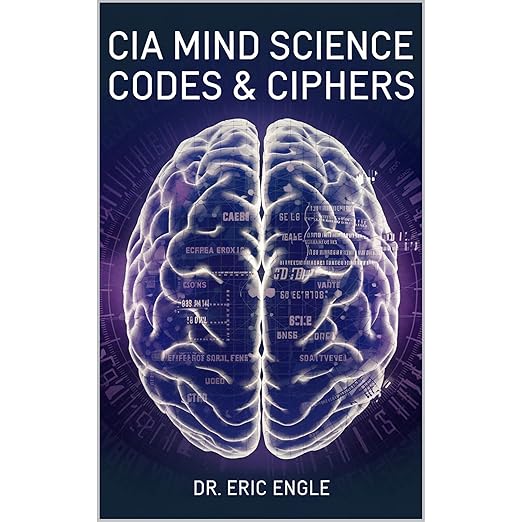
Books that promise to teach you both cryptography and the law of attraction in the same volume are not rare, but they are rarely what their titles suggest. CIA MIND SCIENCE, CODES & CIPHERS by Dr. Eric Engle, the eighth installment in his Strategy Series: How Wars Are Won, sits squarely in that ambitious tradition. The audiobook runs just over six hours, narrated by Virtual Voice, and it arrives with an explicitly self-improvement pitch grafted onto what is ostensibly an intelligence tradecraft text. Whether those two halves cohere is the real question this audiobook poses to prospective listeners from the first chapter onward.
Engle holds legal degrees including an LL.M. and brings a scholar's organizational approach to open-source intelligence, NLP, and memory technique. The book's contents reflect genuine breadth: cognitive bias avoidance, hypnosis and neuro-linguistic programming, cryptographic fundamentals, manifestation frameworks, and OSINT methodology. Reviewer Ashley F. calls it "an entertaining, provocative guide," which is fair. The entertainment value and the practical value are two different things here, and they diverge more as the audiobook moves through its subject shifts.
Espionage Framing Stays Mostly Atmospheric
The sections on cognitive bias and memory technique are the audiobook's most grounded material. Engle draws on well-documented psychological research around heuristic failures and recall systems, including mnemonic devices and storytelling structures used for memorization, and these chapters give listeners genuinely useful tools regardless of whether the intelligence framing adds value. The memory mastery content reads as an accessible introduction to a field that has better dedicated books, but as a compact survey it functions reasonably well and moves quickly enough to hold attention across the audiobook's range of topics.
The cryptography sections are lighter than the title implies. Listeners expecting a technical primer on cipher mechanics or modern encryption protocols will find more of a historical survey of codes and their uses by intelligence agencies than any working knowledge of contemporary cryptographic practice. Reviewer Fred acknowledges that "the author promises to teach readers how to recall information instantly, manifest the reality they want, and even decode secret messages," while noting the ambition is wider than the delivery. That gap is real and consistent across the text. The CIA and espionage framing is largely atmospheric throughout, providing anecdotal hooks into each topic rather than declassified methodology or systematic tradecraft that listeners could apply independently.
Virtual Voice Amplifies an Already Rough Transition
The Virtual Voice narration is where this audiobook faces its most consistent limitation. AI narration handles expository nonfiction adequately when the prose is flat and sentence structures are straightforward, but Engle's writing has rhetorical flourishes and bulleted list structures that need a human voice to land with appropriate emphasis. Transitions between the book's very different subject areas, from manifestation frameworks to OSINT to brainwave entrainment, feel abrupt without a narrator capable of modulating register between modes. Reviewer Simply Healthy Karen noted that "the writing was rough and sometimes confusing" and that sections "jumped around so much," which the AI narration amplifies rather than smooths into something more cohesive.
That said, listeners who use audiobooks primarily as background listening while working or exercising may find the brisk pacing and frequent topic-switching a feature rather than a problem. The six-hour runtime means no single section overstays its welcome, and Engle's willingness to cover unusual and loosely connected ground keeps the experience from becoming monotonous even when individual chapters feel undercooked. If you approach this audiobook curious about a range of ideas rather than seeking deep instruction in any one of them, the format can serve that kind of broad curiosity reasonably well without requiring sustained critical engagement.
Social Engineering Earns Its Six Hours
The most interesting passages are Engle's sections on social engineering and influence, which draw on real intelligence community frameworks around persuasion, authority, and information asymmetry. These chapters have a rigor the manifestation sections lack, and they are where the promised "intelligence tradecraft as life hack" concept comes closest to being realized rather than merely claimed. His treatment of OSINT analysis, including the use of publicly available information to build profiles and identify patterns, is brief but grounded and more substantively useful than the book's marketing language suggests.
Listeners with background in psychology will recognize the cognitive bias material as standard territory repurposed through the espionage lens. Whether that reframing adds anything meaningful depends on how much the intelligence wrapper increases engagement for the individual listener. For some, the spy-world context will make familiar psychological concepts feel newly urgent. For others, it will feel like a marketing layer over content available more rigorously in dedicated books on behavioral economics or memory science. The answer to that question will probably determine whether six hours feels well spent or padded.
Strategy Series Fans Will Feel Right at Home
Listeners who will get the most from this audiobook are those already interested in self-improvement content who want an unconventional framing and are not bothered by inconsistent depth across topics. The book works best as a curiosity-driver, a survey that points toward memory technique, cognitive psychology, and basic cryptography history without going deep on any of them individually. Fans of the broader Strategy Series will find it consistent in ambition and format with what they have come to expect from Engle across the series. Listeners expecting genuine cryptography instruction, serious intelligence tradecraft methodology, or technically rigorous psychology should look elsewhere. The Virtual Voice narration is an additional practical consideration for anyone sensitive to AI performance, as it will be the most noticeable limitation across all six hours and is especially felt during the book's more rhetorically ambitious passages.
Does the CIA MIND SCIENCE, CODES & CIPHERS audiobook actually teach usable cryptography skills?
Primarily no. The cryptography content is a historical and conceptual survey rather than a technical primer. Listeners will come away with an understanding of how codes and ciphers have been used in intelligence history, but not with working knowledge of contemporary encryption methods or cipher mechanics.
How does the Virtual Voice narration affect the CIA MIND SCIENCE, CODES & CIPHERS audiobook experience?
It is the audiobook's most significant limitation. The AI narration handles flat expository passages adequately but struggles with the text's frequent register shifts between self-help rhetoric, technical explanation, and intelligence anecdote. Listeners sensitive to AI narration will notice it throughout all six hours.
Is CIA MIND SCIENCE, CODES & CIPHERS part of a series, and do I need to have read the others first?
It is the eighth book in Dr. Engle's Strategy Series: How Wars Are Won, but each volume is designed to stand alone thematically. No prior reading of the series is needed to follow this audiobook's content.
Is the self-improvement content in this audiobook credibly sourced or more motivational in nature?
Mixed. The cognitive bias and memory sections draw on legitimate psychological research and are reasonably sourced. The manifestation and law of attraction sections are more motivational in framing and lighter on empirical grounding. Listeners should approach those chapters with appropriate skepticism about the evidence base behind the claims.