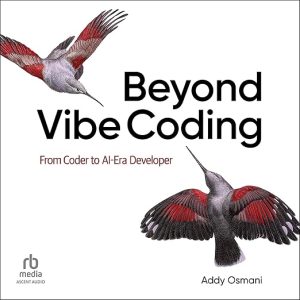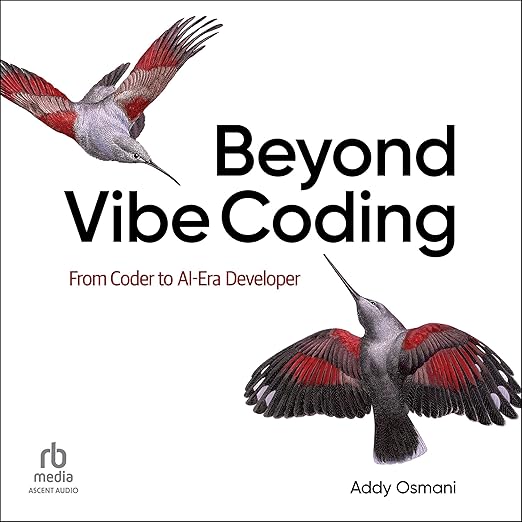
Every written review on this listing predates the audiobook. Ascent Audio released the recording on March 10, 2026, while the five reviews attached to it are dated between September 2025 and January 2026, and each one describes a printed object. Page counts. A creased back cover. Washed-out ink. A price tag. Not one of them concerns the recording, and none so much as mentions Mike Lenz, who is credited as the reader.
That gap matters more than it usually would, because the 3.7 average across twenty-one ratings does a great deal of quiet work in a buyer's head, and at least one of the two one-star ratings has nothing to do with a single word Addy Osmani wrote. Cameron Rye reports a copy that "arrived damaged, with a large crease spanning the entire back cover", then objects to cheap paper, faded ink and the price of a seventy-dollar book. Every one of those complaints evaporates the moment you press play on a digital file.
Twenty Pages Inflated Into a Nine-Hour Recording
Take the manufacturing grievance out of the sample and what remains is a disagreement about density, which happens to be the only question worth asking about a nine-hour, fifty-five-minute recording. Zach, a three-star reviewer who reports having followed Osmani's work for a long time, writes that "he really phone it in with this one" and then guesses at the method: roughly twenty pages of genuine notes, a large language model asked to inflate them into two hundred, editors hired to smooth the seams. The verdict is blunt. "Lots of fluff and filler, not much insight." An edit appended afterward confirms "I did in fact finish the book" and promises to raise the score, though the text breaks off mid-word before saying by how much.
A second one-star review presses the same charge harder, arguing that the material "could be done in 30 pages", that it is "the same bla bla bla over and over again", and that what is missing is a "Lack of real prompt engineering, API concepts and prod ready examples". Two five-star readers hold the opposite line. One calls the book "really informative". The other, writing from Germany, opens with a direct rebuttal, "Don't listen to people claiming this is too basic or badly written", calls it "a highly relevant work based on real world experience", and slots it alongside two other AI-development titles as part of a set. That reviewer is arguing with people who never appear on the page, which is useful in itself: it confirms the too-basic complaint exists and circulates, whatever you make of the defense.
Programming Shifts From Writing Code to Directing It
Set the reception aside and look at what the book is for. The subtitle is From Coder to AI-Era Developer, and the publisher's framing is that programming is shifting from writing code to directing it. The job becomes specifying goals and constraints precisely, reading what comes back with real suspicion, and fitting the returned pieces into something coherent. The warning is written into the copy rather than bolted on afterward: vibe coding is compared to a high-speed exploratory vehicle that "can take you off the beaten path quickly".
It helps that the book bothers to define its own title term. Vibe coding, in the description's words, is "a prompt-first, exploratory approach where you describe what you want in natural language and let a large language model fill in the blanks". That definition earns its place, because the phrase gets thrown around loosely enough to cover anything from careless prototyping to an entire methodology. Osmani treats it as a mode with a legitimate use and a specific failure pattern, and the second half of that formulation is why the book exists at all.
Specification and review is precisely the kind of material that survives the move to audio, because it is judgment rather than syntax. Osmani argues about where a developer's attention should go once typing has become cheap. How do you phrase a constraint so the model cannot wriggle out of it? How do you read generated code as a reviewer instead of an author? When is the right moment to throw the whole output away and start the prompt again? None of that requires a screen. A tech lead listening at half attention can follow the shape of the argument and return to specifics later, which is a defensible use of ten hours.
You Cannot Skim a Paragraph Already Absorbed
The filler complaint deserves weight, because two independent reviewers reached it separately and neither is hostile to the subject. If a meaningful share of a long recording is restatement, audio punishes that more than print does. You cannot skim a paragraph you have already absorbed, and skipping ahead inside a chapter you cannot see is guesswork. Anyone who reads quickly and impatiently should factor that in before committing. The counterweight is that neither five-star reviewer reports any such problem, and one of them had clearly read enough of the surrounding field for the comparison to mean something.
Format is the other consideration. GitHub Copilot and OpenAI Codex are named in the description, and the copy promises hands-on examples, which is a polite way of describing code listings. Those do not read aloud gracefully, and the description makes no mention of a companion PDF. Treat the recording as the argument and plan to have the examples in front of you somewhere else. The subject also moves quickly enough that a review pool whose most recent entry is dated January 2026 was already describing a tooling landscape that keeps rearranging itself. Buy this for the thinking, not for the tool specifics.
Failure-Mode Vocabulary Without Any Included Recipes
This suits developers and tech leads who already use an assistant daily and want vocabulary for the parts that keep going wrong: unreviewed output shipped on a deadline, architecture drifting because nobody was steering, junior engineers learning to accept rather than to read. It suits managers who need to discuss AI adoption without either evangelizing or panicking. And it suits anyone who wants the failure modes named out loud, since the publisher's own copy concedes that this way of working can deposit you somewhere you never intended to go.
Give it a miss if you want recipes. The reviewer hunting for prompt engineering technique, API concepts and production-ready examples did not find them, and nothing in the description promises them. Anyone who has followed Osmani's writing closely for years is also the likeliest to feel shortchanged, which is exactly the reading Zach offers. Treat the 3.7 with the skepticism it has earned: twenty-one ratings is a thin sample, one of the low scores concerns a cover crease, and every written response on the page was formed months before this recording existed.
- Narration: Mike Lenz is credited, and no review on the listing discusses the recording; the material asks a reader to keep a discursive argument legible across ten hours while code examples stay off-page.
- Themes: AI-assisted development, intent-driven workflows, critical review of generated code, the changing role of the senior developer
- Mood: Practical and cautionary, more editorial than tutorial
- Verdict: Worth it for the judgment layer around AI coding assistants, provided you accept that two reviewers found real padding.
Good to Know
Do the reviews tell you anything about the audiobook edition?
Not directly. All five landed between September 2025 and the following January, months before the March 2026 audio release, and every one of them describes a printed copy: page counts, paper stock, a creased cover, a seventy-dollar price. They are useful on the content and silent on the reading.
Does the book work without seeing the code examples?
Mostly. The argument concerns specifying goals and constraints, reviewing generated code critically, and integrating the results, which is judgment rather than syntax. The hands-on examples promised in the description are the part that suffers, and no companion PDF is mentioned anywhere in the copy, so plan to look elsewhere.
Is this audiobook pitched at beginners or experienced developers?
Experienced ones. The description names developers, tech leads and organizations, and the reviewer who wanted API depth and shippable examples was reading it as a practitioner text. Beginners looking for a first introduction to prompting will find the level assumed rather than taught.