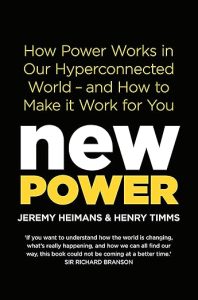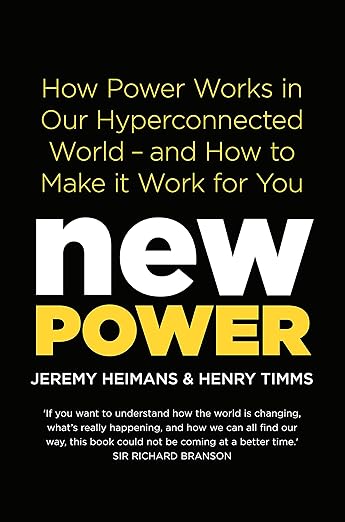
Two names appear on the cover of New Power, and only one of them reached this audiobook listing. Jeremy Heimans holds the byline here, while Henry Timms, named as co-author in the publisher's own description, does not. That clerical detail matters more than it looks, because what follows across nearly ten hours is unmistakably a joint argument, written in a confident plural voice and handed to one credited reader, Andrew Fallaize. Whether a book of that shape survives the move into audio depends less on charm than on whether a single delivery can keep two people's thinking coherent from the first case study to the last.
Running the Same Model Over MeToo and ISIS
Its organizing idea is a clean binary, and the binary survives compression well. Old power, in the authors' framing, was a thing you captured and then defended, held by few and closed off to almost everyone else. New power is made by the many, and the book describes it as open, participatory and peer-driven. The line the publisher pulls out for the blurb does the most work: power that "works like a current, not a currency". Once that distinction is lodged in your head, the rest of the book becomes a tour of what happens when the two collide, and the tour is stocked with recognizable material, from Facebook and Uber to the out-of-nowhere victories of Barack Obama and Donald Trump, the rise of #BlackLivesMatter and #MeToo, and the recruitment machinery of ISIS.
The part of the argument I find most useful is also the least comfortable. Heimans and Timms run the same model over #MeToo and over ISIS without flinching, treating participatory design as a mechanism rather than a virtue. A movement that recruits by handing followers something to make, share and own behaves the same way whether its aims are decent or monstrous. Plenty of books about networked organizing quietly skip that symmetry, or bolt it on as a closing caveat. The publisher's own summary puts the darker cases right up front, and the willingness to follow the logic wherever it lands is what lifts the book above the category's default optimism.
What I keep circling back to is the publication date. This one arrived at the start of 2018, and the eight years since have not been kind to some of its examples. The mega-platforms held up here as engines of participation now sit inside a very different public conversation, and the movements named in the same breath have each acquired a complicated afterlife. None of that voids the framework, and in places it vindicates it. But anyone starting the audiobook now is running a live experiment, applying a 2018 model to a landscape that 2018 could not see.
Built-In Repetition Makes This Travel by Ear
The framework travels well by ear, which is not true of every technology title at this length. Heimans and Timms build in repetition on purpose: a concept lands, gets a name, gets an example, then reappears three chapters later attached to a different case. That structure forgives a listener whose attention drifts for thirty seconds, and it is the strongest practical argument for taking this one by ear rather than on the page. Zoe E. Routh, one of only two people who left a written review, read it as an operating manual and called it "a useful playbook for exercising power as a leader in a world that is desperate to be part of positive change".
Routh also picked out the comparative work, admiring how evenly the book treats "successful, and less successful, political social movements, alongside businesses that are becoming more inclusive, participative, and less hierarchical". That balance is real, and it is where I found most of the value. Failures get airtime here, not just the case studies that flatter the thesis. Diane Bretherton, the other reviewer, put the experience more bluntly: "It is easy to read, quite racy actually, and well worth reading". Two reviews is a thin pool by any standard, and both of these are arguing with the book rather than describing it, which is the most useful kind of thin pool to have.
Fallaize Must Keep a Long Roster Straight
Bretherton's four-star review also holds the sharpest criticism available, and it is a fair one. The book, that review argues, "does suffer a little from overconfidence, which might stem from youthful exuberance", and the point underneath is one any reader of trend books should carry: novelty and personal discovery are not the same thing. A closing thought about lateral communication and soft leadership having been widely explored before breaks off mid-sentence in the text visible on the listing, so where that argument ended is not recoverable. The objection survives the truncation, and it lands on a book that does present its central distinction as something newly found.
Weigh two structural things before you buy. The score reads 4.1 from twenty ratings, a thin base by any measure, and it tells you far more about how few people have logged an opinion than about the book itself. And the case-study density that makes the framework stick also makes the middle stretch demanding by ear. Company names, campaigns, founders and movements arrive quickly, and audio gives you no margin to flick back two pages when one of them returns unannounced. Andrew Fallaize carries all of it, and what the material asks of a reader here is bookkeeping as much as delivery: keeping a long roster of examples distinct and retrievable across ten hours.
Reads More Like a Keynote Than Research
I would put this in front of anyone whose job involves getting people to do something without being able to order them to. Campaign organizers, nonprofit leads, community managers, internal-communications staff, founders trying to build something participatory on top of a platform they do not control: the vocabulary alone earns its keep, because old power and new power give you a fast way to diagnose why a launch fell flat or why a petition caught fire. Readers already at home in popular social science will recognize the register immediately, and just under ten hours is a manageable commitment for it.
Current platform power is not what this book maps, and buying it as a 2026 guide will disappoint. Anyone wanting an account of the last eight years, the regulatory fights, the algorithmic backlash, the participatory promises that curdled, should look for something written well after 2018. Specialists will also find the treatment broad rather than deep, closer to a keynote expanded to book length than to original research. For everyone else, the framework has proved more durable than its illustrations, and hearing it argued at length, with the failures left in, is a better use of ten hours than most of what this category offers.
Common Questions
Does the New Power audiobook credit both of its authors?
The listing carries Jeremy Heimans alone, but the publisher's own description names Henry Timms as co-author, and the book is written throughout in the plural. Treat the byline as incomplete rather than disputed, and expect two voices arguing as one across the whole running time.
Is an audiobook a sensible format for a case-study-heavy title like this?
Mostly yes. The authors repeat each concept with a fresh example a few chapters later, which suits listening far better than a dense reference text would. The exception is the crowded middle stretch, where company and campaign names arrive faster than audio lets you retrieve them.