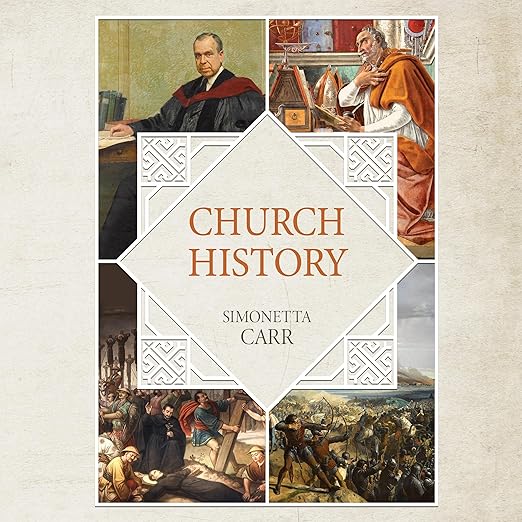
Church history for children is a harder project than it sounds. The two thousand years between the death of the apostles and the present include persecution, councils, schisms, reformations, and centuries of political entanglement, all of which need to be made accessible to a reader who may not yet have the historical or theological context to place them. Simonetta Carr is an author with a track record in Christian educational literature for young people, and this audiobook, Church History, represents her attempt to cover the full sweep of that story in a way that holds a child's attention without flattening the complexity that makes the history worth knowing.
Sarah Zimmerman narrates the audiobook, and the seven-hour-and-thirty-eight-minute runtime is a significant undertaking for a children's title. This is not a short picture-book experience; it is a substantive historical survey aimed at independent readers in the ten-to-twelve range, or family listening sessions where parents and children engage with the material together. Zimmerman's narration reflects that scope. She reads with warmth and engagement without the exaggerated expressivity that sometimes makes children's audiobook narration feel condescending to older young listeners.
God Keeping His Word Even When It Looked Impossible
Carr's framing comes from the passage in Matthew 16:18 where Jesus promises that nothing will destroy his church. That promise becomes the organizing thread of the book: two thousand years of history as a story of God keeping his word even when circumstances made it look impossible. The structure is chronological, beginning after the death of the twelve apostles and moving through the patristic period, the great councils, the medieval church, the Reformation, and on to the contemporary global church. Each period is covered at a length appropriate to its significance without turning any era into the entire subject of the book.
The decision to frame this as a theological narrative rather than a purely historical survey is the book's most distinctive choice. History books for children often default to a sequence of events and names. Carr keeps the events and names, there are plenty of both across seven-plus hours, but she consistently returns to the animating question of how the church survived and what that survival means within the theological framework the book operates inside. Reviewers who have used it with children in the target age range note that this approach helps young readers maintain orientation across a very long span of time and a large number of figures.
Zimmerman Keeps Polycarp and Chrysostom Consistent
The audiobook format suits this material in practical ways. Seven hours of church history covers a great deal of ground, and many young readers who would not sustain attention through a book of this length in print will engage with it through listening. Family car trips, homeschool sessions, or bedtime listening over multiple nights all make the format work in contexts where the print version might be set aside before completion. One reviewer describes her husband, children, and herself all engaging meaningfully with the content, which reflects the cross-age accessibility of the narrative.
Sarah Zimmerman handles the pronunciation of historical names and technical theological terms with consistency throughout, which is no small accomplishment over this runtime. Names like Polycarp, Chrysostom, and Athanasius appear frequently enough that inconsistent pronunciation would become distracting. Her delivery makes the figures feel like real people rather than distant labels, which is essential for a book that is asking young listeners to maintain emotional as well as intellectual engagement with characters they cannot look up in a familiar cultural context.
A Paper-Quality Comment Meant for Print
The sections covering periods of persecution are handled with appropriate seriousness for the age range. Carr does not minimize the violence or the difficulty of the historical record, but she contextualizes it within the theological narrative in ways that allow young listeners to process it without being overwhelmed. The Reformation chapters are among the most narrative-driven sections of the book, with the drama of figures like Luther and Calvin given room to develop as characters rather than just names attached to doctrinal positions. That narrative attention makes the later sections of the audiobook particularly engaging after the more survey-like early chapters.
The 4.9 rating across forty-two reviews is unusually consistent for a niche children's educational title. Reviewers note the book's accessibility for independent readers in the ten-to-twelve range, its value as a family resource, and the quality of the research behind the content. The reviewer who notes the paper quality of the physical edition is speaking to the print version, but the care in the physical production reflects the care in the content, and that care is fully present in the audiobook version as well.
Written From Within the Tradition It Surveys
Families homeschooling with a Christian curriculum will find this audiobook a natural fit for history study at the middle-grade level. Church congregations looking for accessible age-appropriate resources on Christian history for youth programs will find it works across a range of ages from ten upward. Adults who want a concise introduction to Christian church history and are comfortable with the theological framing of the narrative will find Carr's survey surprisingly comprehensive for its target audience. Listeners outside a Christian faith context who want a neutral historical treatment should look elsewhere; this book is written from within the tradition it surveys, and that perspective shapes every chapter.
The audiobook format makes this a practical choice for parents who want their children to engage with church history but find sitting down with a dense print text unlikely to succeed over a seven-hour span. Listening during school time, during family meals, or across a week of car trips distributes the content in ways that accumulate naturally. The chronological structure supports retention because each period builds on the one that preceded it, and Zimmerman's narration maintains enough engagement across the full runtime that the book does not lose its audience before reaching the Reformation chapters that many young listeners will find most dramatic.